
- System Efficiency: LONGi ONE claims a system-level efficiency of up to 90.3%, reducing energy loss between components.
- Battery Safety: PotisEdge's '5S' battery technology boasts 'zero thermal runaway' incidents across 12 GWh of deployed systems.
- Deployment Speed: OneMatrix 2.0 aims to reduce deployment time by up to 30% and lower lifecycle costs.
Experts view LONGi's 'One' strategy as a bold but high-stakes move to redefine solar-plus-storage systems, with potential to improve efficiency and accountability but also risks of vendor lock-in and concentrated supplier dependency.
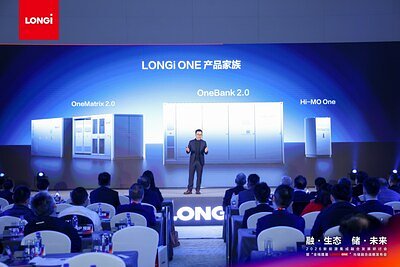
LONGi's 'One' Strategy: A Unified Bid for Solar-Plus-Storage Dominance
BEIJING – April 01, 2026 – Solar technology leader LONGi has officially entered a new strategic era with the launch of LONGi ONE, an integrated solar-plus-storage solution designed to replace the industry's historically fragmented, multi-vendor approach. Unveiled today, the initiative aims to reframe solar power systems not as a collection of disparate parts, but as a single, intelligent "Solar Generator," marking a significant bet on the future of energy system architecture.
This move signals a strategic pivot from assembling components to delivering a cohesive, factory-integrated system. As renewable energy becomes a central component of the global power grid, the complexities of sourcing panels, inverters, and batteries from different manufacturers have created bottlenecks related to performance loss, difficult commissioning, and muddled accountability when issues arise. LONGi ONE is the company's ambitious answer to these challenges, promising a unified system, a single software platform, and one point of responsibility for the entire lifecycle of the project.
A New Era of System Integration
The core of the LONGi ONE strategy rests on three principles: One System, One Platform, and One Responsibility. By moving to a full-stack, self-developed architecture, the company aims to eliminate the efficiency losses that occur between mismatched components. The goal is to create a seamless ecosystem, much like a modern smartphone where the hardware and software are designed in tandem for optimal performance.
An AI-driven platform serves as the brain of the system, coordinating energy generation from solar panels, storage in batteries, and consumption by the end-user. This enables predictive energy management and real-time optimization, promising higher yields and quicker returns on investment. For customers, this approach promises to transform the complex process of building a solar-plus-storage plant into a more streamlined, plug-and-play experience, significantly shortening deployment timelines.
This vision of a simplified, high-performance energy block directly challenges the established industry practice of relying on specialized engineering, procurement, and construction (EPC) firms to piece together solutions. By offering a pre-integrated and optimized system, LONGi is positioning itself not just as a component supplier, but as a comprehensive energy solutions partner.
Under the Hood: Advanced Tech and Performance Claims
Anchoring the LONGi ONE portfolio are significant technological claims. For the commercial and industrial (C&I) market, the Hi-MO One solution features modules with a claimed efficiency of 24.8%. This figure places it at the forefront of the market, competing directly with other top-tier manufacturers like Aiko Solar and Maxeon, who have also pushed the boundaries of Back-Contact (BC) solar cell technology. More impressively, LONGi claims the integrated Hi-MO One system can achieve a system-level efficiency of up to 90.3%, a metric that reflects the reduced energy loss between panel, inverter, and battery.
On the storage side, the system incorporates advanced "5S" battery technology developed in collaboration with energy storage safety expert PotisEdge. This partnership brings a decade of experience and a record of "zero thermal runaway" incidents across 12 GWh of deployed systems, addressing one of the most critical concerns in battery storage. For utility-scale projects, the OneBank 2.0 storage solution features a proprietary Intelligent Cloud Control System (iCCS) capable of millisecond-scale fault detection, which LONGi states can reduce system-level failure rates by 60% and cut pre-commissioning times by over 30%.
A flexible, modular offering, OneMatrix 2.0, provides plant-level deployment options for various storage durations, aiming to reduce deployment time by up to 30% and lower overall lifecycle costs for large-scale energy providers.
The Battle for System Supremacy
While LONGi's scale makes this a landmark announcement, it is entering an arena where the battle for integration is already underway. The market is showing a clear preference for unified solutions, shifting focus from the cost-per-component to the total "system value" and "whole life cycle value." Companies like Tesla, with its highly integrated Powerwall, have set a benchmark for residential systems, while competitors such as BYD, Sungrow, and Enphase have also made significant strides in offering more cohesive energy storage ecosystems.
LONGi's entry intensifies this competition, leveraging its massive manufacturing capacity and leadership in solar cell technology as a formidable advantage. The company is betting that its ability to control the entire technology stack—from the silicon wafer to the AI management platform—will allow it to deliver a level of performance and reliability that multi-vendor systems cannot match. This move is a direct challenge to the traditional market structure, putting pressure on competitors to either deepen their own integration or find new ways to prove the value of a more open, component-based approach.
One Vendor, One Promise: A Double-Edged Sword
The most disruptive element of the strategy may be the principle of "One Responsibility." For project developers and C&I customers, the appeal is undeniable. Dealing with a single vendor for procurement, installation support, service, and warranties eliminates the finger-pointing that often plagues projects when components from multiple manufacturers fail to work together seamlessly. A single point of contact promises faster issue resolution and clearer accountability, significantly de-risking a major capital investment.
However, this model is not without its potential drawbacks. Relying on a single company for an entire energy system introduces the risk of vendor lock-in, potentially limiting a customer's flexibility to upgrade or replace individual components with technology from other innovators in the future. It also concentrates supplier risk; the long-term performance and support of the entire system become wholly dependent on the financial health and service quality of one company. Industry analysts suggest that while the simplicity is attractive, sophisticated buyers will need to weigh it against the potential loss of pricing leverage and technological flexibility that a multi-vendor market provides.
To back its single-source promise, LONGi has announced the "2830 Plan," an ambitious initiative to establish 30 localized service centers in key global markets by 2028. This network, building on 13 GWh of delivery experience across 120 countries, is essential infrastructure for making the "One Responsibility" model credible on a global scale. It signals a deep investment in post-sales support, aiming to provide the rapid, localized service necessary to manage these complex, integrated systems and build customer confidence. This global service backbone will be critical as LONGi works to establish the "Solar Generator" as the new standard for the ongoing energy transition.