
- $11.5 million in funding secured from Web2 and Web3 investors
- 10,000 transactions per second (TPS) capacity at costs below one cent
- 50+ partnerships, including Animoca Brands and Lamborghini
Experts would likely conclude that LightLink's Stella Wallet represents a significant step toward mainstream Web3 adoption by eliminating technical barriers through chain abstraction and gasless transactions.
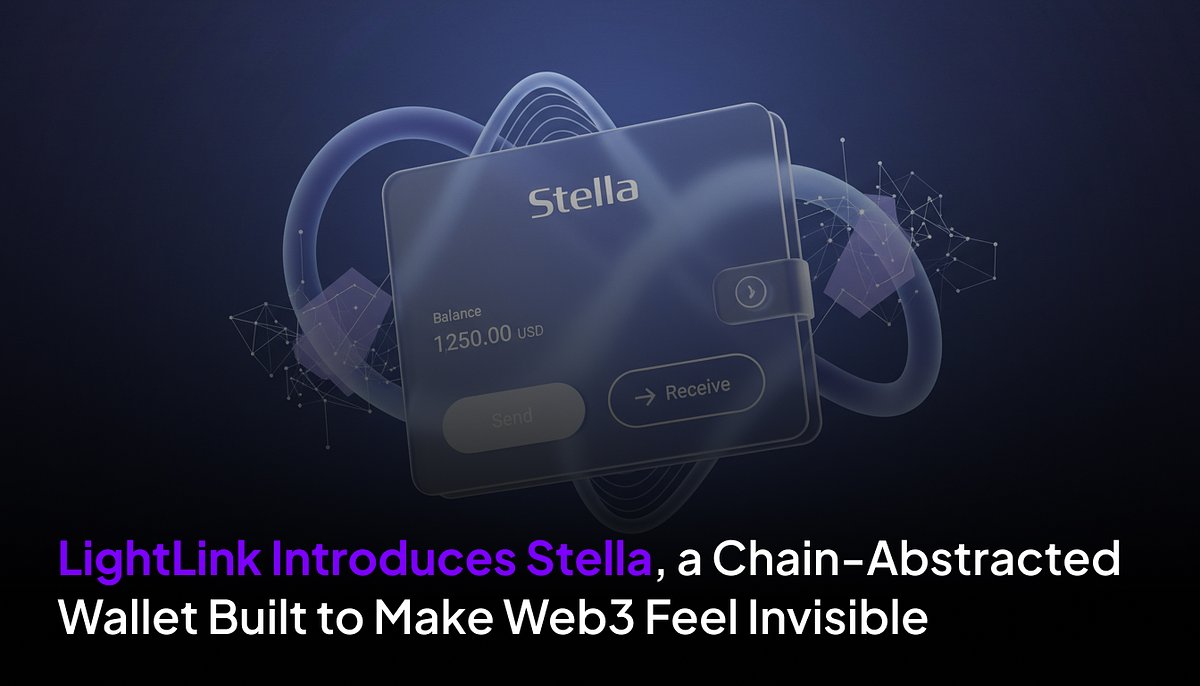
LightLink's Stella Wallet Aims to Make Web3 Invisible for Mass Adoption
MELBOURNE, Australia – January 05, 2026 – LightLink, an Ethereum Layer 2 network focused on enterprise adoption, today announced the early-access launch of Stella, its first native wallet. The new product aims to tackle one of the biggest hurdles to mainstream blockchain adoption: overwhelming complexity. By creating a 'chain-abstracted' experience, Stella is designed to make interacting with Web3 as intuitive as browsing the internet, hiding the intricate mechanics of blockchain technology from the end-user.
The wallet is initially available to a select group of VIP community members, whose feedback will shape its public rollout slated for the first quarter of 2026. The launch marks a significant milestone for LightLink, which has built its reputation on providing gasless, high-throughput solutions for businesses.
“Stella is our declaration that Web3 should feel simple,” said Roy Hui, CEO and Co-Founder of LightLink, in the announcement. “The industry has normalised friction; manual network switching, gas fees, RPC settings. Users shouldn’t need to understand infrastructure just to transact. Stella is the foundation for a future where people interact with blockchain the same way they use the internet: naturally and without technical barriers.”
Unpacking an 'Invisible' Web3 Experience
For years, the promise of a decentralized web has been hampered by a notoriously steep learning curve. Users are often required to manage complex seed phrases, navigate different blockchain networks manually, and hold multiple native tokens just to pay for transaction fees, known as 'gas'. Stella is engineered to dismantle these barriers one by one.
The wallet introduces a simplified onboarding process using familiar Apple or Google authentication, bypassing the need for users to create and secure a traditional cryptographic key. Access is further streamlined through biometric security, mirroring the user experience of modern banking and fintech apps.
At its core is the concept of 'chain abstraction,' a technical framework that unifies interactions across different blockchains. For the user, this means that the wallet can execute complex, cross-chain tasks without requiring them to manually switch networks or use complicated bridging protocols. This is achieved through native integrations with established interoperability protocols like Stargate and decentralized exchanges such as Oku and Amped Finance, creating a single, unified interface for a multichain world. The 'seedless security' model also removes the burden of storing a 12 or 24-word recovery phrase, a common point of failure and anxiety for newcomers.
The Engine Room: A Gasless Enterprise Model
While Stella provides the user-friendly interface, its power is derived from LightLink's underlying Layer 2 infrastructure. Built on Ethereum using Optimum architecture and optimistic rollups, the network is designed for enterprise-grade scale, claiming the capacity to handle over 10,000 transactions per second (TPS) at costs below one cent. It also utilizes Celestia for data availability, a modular approach that enhances scalability and reduces costs.
A key innovation is LightLink's 'Enterprise Mode,' a subscription-based model that enables businesses and dApp developers to pre-pay for their users' transaction fees. This allows partner applications to offer a completely gasless experience, eliminating a significant point of friction. For a fixed monthly fee, companies can whitelist their applications, ensuring their customers can mint assets, execute trades, or interact with services without needing to hold or even know about cryptocurrency.
This model effectively transforms unpredictable blockchain costs into a predictable operational expense, much like a subscription to a cloud service provider like AWS. It's a strategic move designed to attract large-scale businesses that want to leverage blockchain's benefits without forcing a complex and unfamiliar payment system onto their customers.
“Enterprises want Web3 experiences that feel familiar to their customers,” added Dan Enright, Ecosystem Lead at LightLink. “Stella gives builders a wallet layer that doesn’t require users to think about chains or gas. It dramatically reduces drop-off points and opens the door to mainstream-ready applications. This is a major unlock for ecosystem partners and a cornerstone for everything coming in 2026.”
From Gaming Giants to Supercars: Building a High-Profile Ecosystem
LightLink's strategy is already validated by a series of high-profile partnerships, demonstrating tangible demand for its simplified, gasless blockchain solutions. The company has secured over $11.5 million in funding from a mix of Web2 and Web3 investors, including T&B Media Global, MH Ventures, and NxGen, signaling broad confidence in its approach.
One of its most significant collaborations is with Animoca Brands, a leader in Web3 gaming. The partnership aims to integrate LightLink's technology into select games and metaverse projects, allowing millions of gamers to engage in on-chain activities like earning rewards and leveling up without paying gas fees. This move is seen as critical for making blockchain gaming accessible to a mass audience.
Further showcasing its real-world application, LightLink is the official blockchain partner for Lamborghini's 'Fast ForWorld' digital experience. The platform allows fans to engage with the iconic supercar brand, minting digital collectibles and participating in gamified quests. By running on LightLink, the experience is seamless and free of transaction fees for users, lowering the barrier to entry for brand enthusiasts who may have no prior crypto experience.
With over 50 partnerships, more than 40 million transactions processed, and a history stretching back to 2017 through its parent company, Pellar, LightLink has methodically built the foundation for this next phase of its growth. The launch of Stella serves as the gateway connecting this powerful enterprise infrastructure to the everyday user, aiming to finally bridge the gap between niche technology and mainstream utility.