
- 12-nozzle architecture: Eliminates purge towers, reducing filament waste by up to 90%.
- Print speed: 800 mm/s with 25,000 mm/s² acceleration, challenging industrial machines.
- Build volume: 300x300x300mm, enabling large-scale multi-material prints.
Experts view AtomForm's Palette 300 as a groundbreaking solution for sustainable, high-speed multi-material 3D printing, potentially setting a new standard for prosumer and professional applications.
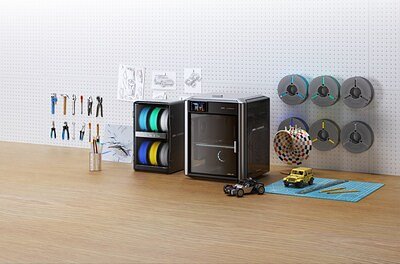
AtomForm's 12-Nozzle 3D Printer Aims to End Multi-Color Waste
LAS VEGAS, NV – January 06, 2026 – The world of desktop 3D printing has long been constrained by a difficult trade-off: create complex, multi-color objects and generate significant plastic waste, or stick to simple, single-color prints. At CES 2026, newcomer AtomForm unveiled a machine designed to eliminate that compromise. The Palette 300, a sleek and ambitious 3D printer, is making waves with its radical 12-nozzle architecture that promises to deliver vibrant, multi-material creations at high speed and with minimal waste, potentially setting a new standard for the prosumer market.
Founded in 2023 as part of the MOVA Group, a company with a background in consumer robotics, AtomForm is making a bold entrance. Its debut product directly confronts the biggest headaches in multi-material additive manufacturing, offering a solution that could democratize capabilities previously reserved for expensive industrial machines.
A Radical New Approach to Multi-Material Printing
The centerpiece of the Palette 300 is its revolutionary design featuring 12 independent, intelligent nozzles managed by a proprietary OmniElement™ Automatic Nozzle Swapping System. This stands in stark contrast to the prevailing methods for multi-color printing on the desktop. Competing systems, such as Bambu Lab's popular Automatic Material System (AMS) or the Mosaic Palette, typically feed different filaments into a single extruder. While effective, this process requires the printer to purge the old color before introducing the new one, creating a wasteful block of mixed plastic known as a "purge tower" beside the main print.
AtomForm's approach physically swaps the entire nozzle assembly for each material change. With a dedicated nozzle for each of its 12 loaded filaments, the printer eliminates the need for purging. This not only allows for cleaner transitions between up to 36 different colors (when paired with its RFD-6 filament drying boxes) but also enables true multi-material printing in a single job. Users can combine disparate materials, such as rigid PLA with flexible TPU or soluble support materials, to create complex functional parts, articulated models, and prototypes that more closely resemble final production goods—all without the messy post-processing or assembly required by single-extruder machines.
"The Palette 300 isn't about incremental improvement, it's about removing the long-standing barriers of multi-color, multi-material 3D printing," said Jagger Shang, Head of Product at AtomForm, in the company's official announcement. "We built a platform where creators don't have to choose between detail, color, material diversity, or speed."
Tackling 3D Printing's Persistent Waste Problem
Perhaps the most significant claim made by AtomForm is its promise to reduce filament waste by up to 90%. For anyone who has run a multi-color print on a conventional system, the sight of a purge tower larger than the print itself is a familiar and frustrating source of cost and environmental guilt. By dedicating a nozzle to each filament, the Palette 300 sidesteps this entire process. The result is a dramatic reduction in wasted material, which directly translates to lower operational costs for hobbyists, schools, and small businesses.
This focus on efficiency extends beyond material use. The company states its ReadyPrint™ swap technology makes material transitions exceptionally fast, contributing to shorter overall print times compared to the stop-and-purge cycle of competitors. In a field where sustainability is an increasing concern, this near-zero-waste approach to multi-color printing represents a major step forward. It transforms what was once an inherently wasteful process into a far more efficient and environmentally conscious method of fabrication, potentially making complex 3D printing more economically viable for a broader range of applications, from educational models to small-batch manufacturing.
Blurring the Line Between Consumer and Industrial Speed
While its multi-material capability is the headline feature, the Palette 300's performance specifications are equally aggressive. The printer boasts a maximum print speed of 800 mm/s and a staggering 25,000 mm/s² acceleration. These figures place it firmly in the high-performance category, challenging the speeds of top-tier prosumer machines that have recently pushed the boundaries of desktop printing. This industrial-tier throughput, combined with a generous 300x300x300mm build volume, positions the Palette 300 as a serious tool for rapid prototyping and on-demand production.
Engineers and designers can iterate on complex, multi-part assemblies faster, while creators can produce larger and more detailed artistic pieces in a fraction of the time. The combination of speed and multi-material functionality suggests a workflow where a detailed, full-color prototype could be produced overnight, a task that would previously have taken days or required expensive outsourcing.
AI and Automation Lower the Barrier to Entry
To ensure its high-speed, high-precision printing is reliable, AtomForm has integrated a sophisticated suite of smart technology. The Palette 300 is equipped with over 50 sensors and four AI-powered cameras that act as a silent supervisor throughout the printing process. This closed-loop system actively monitors for common print failures, such as first-layer adhesion problems, filament jams, and nozzle deviations.
The AI system can automatically calibrate nozzle alignment, a critical and often tedious task on multi-nozzle machines, and detect tiny defects before they escalate into a failed print. This level of automation is designed to dramatically increase first-time success rates and lower the steep learning curve often associated with advanced 3D printing. The goal is to provide a tool that works reliably out of the box, appealing to educators, designers, and professionals who need consistent results without becoming expert technicians. Furthering its appeal for shared spaces, the machine operates at a quiet ≤48 dB and includes a built-in air filtration system, making it suitable for an office, classroom, or home studio.
Market Disruption and the Path to Availability
AtomForm is entering a competitive market, but its strategy appears calculated to cause a stir. The company is leveraging a Kickstarter campaign in the first quarter of 2026 to launch the Palette 300, offering it at a highly competitive early-bird price of $999 for those who place a small deposit. This is a significant discount from the planned retail price of $2,199. This approach aims to rapidly build a community of early adopters and generate market momentum against established players.
With commercial availability planned for the second quarter of 2026, the industry will be watching closely to see if the Palette 300 can deliver on its ambitious promises. If its unique nozzle-swapping system proves as effective and reliable as claimed, it could fundamentally reshape expectations for what a desktop 3D printer can achieve, making truly complex and colorful creation more accessible, sustainable, and efficient for everyone.