
- C$900 million facility: Li-FT acquires a dormant diamond mine in Quebec for a fraction of its original cost.
- C$30 million option fee: Initial cash outlay to hold the option and begin feasibility work.
- 2.2 million-tonne-per-annum processing plant: Potential repurposing for lithium production.
Experts would likely conclude that Li-FT's bold strategy represents a high-risk, high-reward bet on accelerating Canada's battery supply chain, with significant technical and financial hurdles to overcome.
Li-FT's High-Stakes Bet: Turning a Diamond Mine into a Lithium Lode
VANCOUVER, British Columbia – June 24, 2026 – In a bold move that speaks volumes about the shifting tides of global commodities, Li-FT Power Ltd. has laid a significant wager on resurrecting a fallen giant. The lithium developer announced it has secured a binding call option to acquire the Renard diamond mine, a sprawling C$900 million facility in Quebec that fell into creditor protection. The plan is not to hunt for more diamonds, but to transform the site into a processing hub for lithium, the white gold of the electric vehicle revolution. For a C$12 million option fee and the assumption of hefty maintenance costs, Li-FT has bought itself a two-year window to determine if this audacious conversion is the key to unlocking Canada’s battery supply chain ambitions.
This isn't merely a real estate transaction; it's a high-stakes corporate maneuver that could redefine the economics of lithium mining in North America. By opting for a brownfield site over a greenfield build, Li-FT aims to sidestep years of permitting and construction, potentially catapulting its massive Adina lithium deposit to the front of the production line. But the path is fraught with technical, financial, and legal hurdles, making this a pivotal test of strategy and execution for the Vancouver-based company.
A Phoenix from the Ashes: The Renard Mine's Second Act
The Renard mine is a monument to a different era. Brought into production by Stornoway Diamonds in 2016, it was meant to be Quebec's first and only diamond operation, a glittering prize in the province's northern expanse. But the volatile diamond market proved unforgiving. After a first restructuring in 2019, Stornoway again sought protection under the Companies’ Creditors Arrangement Act (CCAA) in late 2023, finally halting operations in January 2025. The state-of-the-art processing plant, airport, and 330-bed camp fell silent.
Li-FT Power sees opportunity in this industrial carcass. The company’s vision is to leverage the nearly C$1 billion of invested capital for a fraction of the original cost. The core of the strategy lies in repurposing Renard’s 2.2 million-tonne-per-annum processing plant for spodumene ore from its nearby Adina Lithium Project. The logic is compelling: avoiding the immense environmental impact and capital outlay of a new greenfield mill could shave years and hundreds of millions of dollars off the project's development timeline.
This approach represents a powerful model for sustainable transformation in the mining sector. Rather than leaving a massive industrial footprint to be remediated, Li-FT proposes to breathe new life into it, aligning with a growing ESG mandate for circularity and resource efficiency. However, history casts a long shadow. This is not the first time a lithium player has coveted Renard. Winsome Resources attempted a similar move in 2024 before market conditions forced it to abandon the plan. In a twist of corporate fate, Li-FT acquired Winsome earlier this year, consolidating the Adina project and inheriting the strategic challenge of making the Renard conversion work where others have faltered.
The C$30 Million Option: A Calculated Strategic Gamble
Li-FT's option is anything but a cheap lottery ticket. The deal structure reveals a significant upfront financial commitment and a complex web of contingencies. The initial C$12 million option fee is only the beginning. Upon court approval, Li-FT must deposit an additional C$18 million in trust to cover the first year of care and maintenance (C&M) costs for the dormant mine, with a similar deposit required for the second year. This brings the immediate cash outlay to C$30 million simply to hold the option and begin the feasibility work.
During this two-year period, Li-FT's technical teams will be under immense pressure to validate the conversion. While the press release notes that Renard’s circuits—including crushers and dense media separation (DMS)—are “compatible with spodumene concentrate production,” the devil is in the details. Converting a plant optimized for recovering hard diamonds to efficiently process and concentrate spodumene ore will undoubtedly require significant modifications and engineering. The feasibility studies must prove not only that it is technically possible but also economically viable on a massive scale.
Simultaneously, the company's lawyers and executives must navigate a labyrinth of legal and regulatory approvals. The entire transaction hinges on a July 2, 2026, hearing where the Superior Court of Québec will decide whether to approve the option agreement under the CCAA proceedings. Further approvals are needed from the Ministère des Ressources naturelles et des Forêts (MRNF) to postpone site rehabilitation work. The deal is laden with conditions, from securing financial guarantees for eventual closure to negotiating a final acquisition agreement and obtaining all necessary regulatory green lights. Any single failure point could terminate the option, potentially forcing Li-FT to forfeit its significant investment.
Forging Canada's Battery Belt
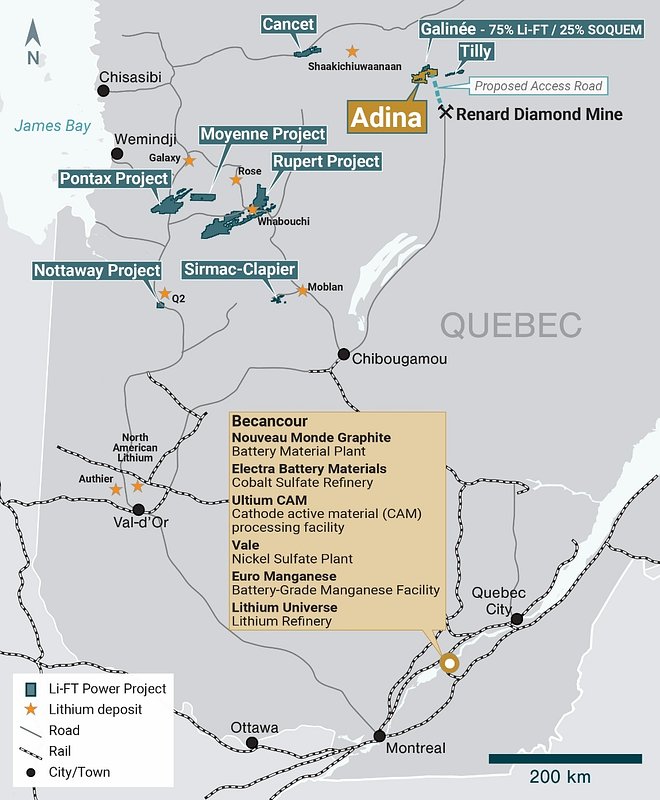
Should Li-FT succeed, the strategic prize is enormous, not just for the company but for Canada. The Renard site is located just 60 kilometers south of Li-FT’s Adina Lithium Project, which boasts one of the largest high-grade, hard-rock lithium resources in North America. The mine’s all-season road connects to a national railway at Chibougamau, which in turn leads directly to the burgeoning EV battery supply chain hub in Bécancour, Quebec.
This creates a direct, vertically integrated pathway from a tier-one lithium deposit to a critical processing hub with established logistics to the heart of Canada's battery ambitions. In the global race to secure critical mineral supply chains, speed and capital efficiency are paramount. By potentially leapfrogging the 5-10 year timeline typical for a new mine and mill, Li-FT could position itself as a foundational supplier of Canadian-processed lithium concentrate just as demand from battery and auto manufacturers ramps up.
The move aligns perfectly with the stated industrial strategies of both Quebec and the federal government, which have committed billions to building a domestic EV ecosystem. A successful repurposing of Renard would be a major political and economic win, demonstrating that Canada can build out its critical mineral capacity quickly and responsibly. For Li-FT, it is a company-defining gambit that, if successful, will transform it from a developer into a producer and a key player in the electrification of North America.