
- 240Hz RGB Stripe OLED: World's first panel combining high refresh rate and optimized text clarity
- 480Hz Refresh Rate: High-refresh-rate mode for competitive gaming
- 60% Growth: Projected shipment growth for OLED monitors in the coming year
Experts agree that LG's new 240Hz RGB Stripe OLED panel represents a significant advancement in display technology, effectively merging the needs of gamers and professionals while addressing long-standing text clarity issues in OLED monitors.
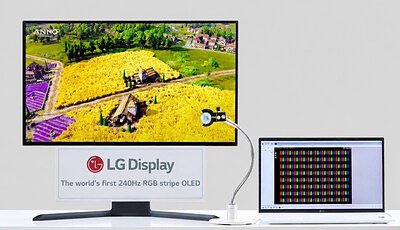
LG's New OLED Redefines Displays for Gamers and Professionals
SEOUL, South Korea – May 29, 2026 – LG Display has commenced mass production of a groundbreaking new screen that could fundamentally reshape the premium monitor market. The company announced it is now manufacturing the world's first 240Hz RGB Stripe OLED panel, a technology designed to bridge the gap between the ultra-fast performance demanded by gamers and the crystal-clear text required by professionals.
This move marks a significant milestone in the evolution of display technology, directly addressing one of the few remaining criticisms of OLED monitors while doubling down on their inherent strengths. By combining a high refresh rate with a subpixel structure optimized for text clarity, LG Display is positioning OLED not just as an option for high-end entertainment, but as the definitive choice for any demanding desktop user.
The 'Do-It-All' Display Arrives
For years, users have often faced a choice: a monitor with a sky-high refresh rate for smooth gaming, or a high-resolution screen with perfect color for creative work. LG Display's new panel aims to render that compromise obsolete. A key innovation is the integration of its proprietary Dynamic Frequency & Resolution (DFR) technology, which effectively creates a 'dual-mode' monitor.
In its high-resolution mode, the panel operates at a full 4K resolution with a blistering 240Hz refresh rate. This setting is ideal for content creators, video editors, and designers who need to see every detail of their work with pristine sharpness and color accuracy, while still benefiting from exceptionally smooth cursor movements and window animations. The high pixel density of 160 pixels per inch (PPI) ensures that images and complex user interfaces are rendered with incredible precision.
With a simple switch, users can pivot to a high-refresh-rate mode, which drops the resolution to Full HD (FHD) but pushes the refresh rate to an astonishing 480Hz. For competitive gamers, this translates into a tangible advantage. The dramatic increase in frames displayed per second minimizes motion blur and input lag, providing the near-instantaneous visual feedback necessary for fast-paced esports titles. This versatility directly caters to the growing market of hybrid users who rely on a single setup for both their professional careers and their gaming hobbies.
Finally, Crystal-Clear Text on an OLED
Perhaps the most significant advancement of this new panel lies in its subpixel structure. The term 'RGB Stripe' is key. For years, one of the main drawbacks of OLED monitors, particularly for productivity tasks, has been text clarity. Competing OLED technologies like Samsung's QD-OLED and even some of LG's previous WOLED panels used non-standard subpixel layouts, such as triangular or RWBG (Red-White-Blue-Green) arrangements.
These layouts, while excellent for media consumption, often confused font-rendering technologies like Microsoft's ClearType, which is optimized for the traditional vertical red, green, and blue stripes found in most LCDs. The result was often noticeable color fringing—subtle green or purple halos around text—that could make reading for extended periods uncomfortable and lead to eye strain. This made many professionals, such as coders, writers, and financial traders, hesitant to adopt the technology despite its superior contrast and response times.
The new 240Hz RGB Stripe OLED panel solves this problem head-on. By aligning the subpixels in the conventional linear stripe pattern that operating systems expect, it delivers text that is as sharp and clear as a high-end LCD. This innovation eliminates the trade-off, allowing users to enjoy the perfect blacks, instantaneous pixel response, and vibrant colors of OLED without sacrificing readability during an 8-hour workday.
OLED's Conquest of the High-End Market
LG Display's strategic push comes at a time of significant growth in the premium monitor sector. The market, valued at over $60 billion, is being fueled by the demands of high-performance gaming, the widespread adoption of remote work, and the rise of AI-powered PCs that require more capable displays for multitasking. The OLED monitor segment, in particular, is on a steep upward trajectory, with some analysts projecting shipment growth of over 60% in the coming year.
By mass-producing a panel that addresses both gaming and professional needs, LG Display is aiming to accelerate the market's transition from premium LCDs to OLEDs. While high-end LCDs with Mini-LED backlights have closed the gap in brightness and contrast, they still cannot match OLED's per-pixel light control, which delivers true blacks and an infinite contrast ratio. This new panel neutralizes one of LCD's last remaining advantages: superior text rendering.
The move also intensifies the competition with rival Samsung Display. While both companies are champions of OLED technology, they have pursued different technical paths. LG's focus on a true RGB Stripe layout at high refresh rates is a direct challenge to Samsung's QD-OLED, which has also seen recent innovations to improve its own subpixel arrangement and text clarity. The fact that other major brands like ASUS and MSI are also announcing new monitors featuring RGB Stripe layouts indicates a clear industry-wide trend toward solving the text-rendering issue, validating LG's strategic direction.
What's Next for Premium Displays?
LG Display is initially launching the panel in a 27-inch size, widely considered the sweet spot for desktop monitors, in collaboration with leading global brands. An expansion of the lineup to other sizes and form factors is planned for the near future. This focused rollout allows the company to target the largest segment of the premium market first.
"The world's first commercialization of 240Hz RGB Stripe OLED demonstrates the strength of OLED as a culmination of advanced display technologies," said Hyeon-woo Lee, Head of the Large Display Business Unit at LG Display, in the company's press release. "As a technology-driven company, we will accelerate the expansion of OLED in the monitor market and steer the premium segment based on our technological leadership and business competitiveness."
While consumer concerns about OLED, such as cost and the potential for burn-in, remain, manufacturers are making significant strides. Prices continue to become more competitive as production scales, and sophisticated built-in features and improved warranties are mitigating the risk of permanent image retention. The introduction of a panel that so effectively merges the worlds of professional productivity and elite gaming is a powerful statement that could redefine consumer expectations and further cement OLED's place as the undisputed king of high-end displays.