
- $2.6 billion: Global legal AI software market value in 2024
- 28%: Projected annual growth rate of the legal AI market
- 344%: ROI delivered by Lexis+ AI over three years
Experts emphasize that while Lexlegis's 'hallucination-free' AI is a compelling innovation, the legal industry remains cautious, prioritizing human oversight and data accuracy above all else.
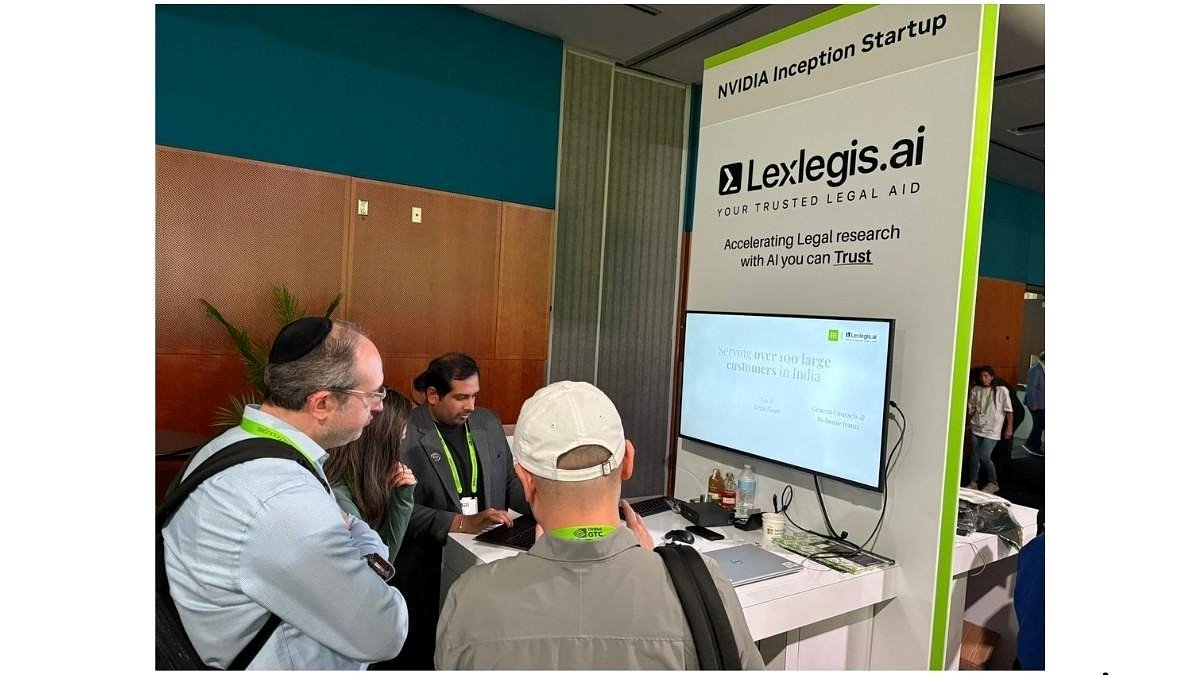
Lexlegis Enters U.S. Legal AI Arena with 'Hallucination-Free' Vow
SAN JOSÉ, CA – March 27, 2026 – Amid the flurry of innovation at NVIDIA GTC 2026, Indian AI legal technology company Lexlegis made a significant move, announcing the U.S. beta launch of its platform, Legal AID. The launch signals not only a strategic entry into the world's most competitive legal market but also an ambitious vision to create what the company calls a 'Legal Intelligence Factory,' built on the promise of delivering grounded, hallucination-free AI outputs.
The platform, whose name stands for Ask, Interact, and Draft, was showcased to an audience of corporate legal teams and law firms, drawing praise for its intuitive design and high-precision results. Already operational in India, Legal AID is designed to tackle complex legal research and drafting by integrating structured legal datasets with purpose-built AI.
“We are now in the era of the Intelligence Factory, where AI is no longer just about models, but about building systems that continuously generate reliable intelligence at scale,” said Saakar Yadav, Founder of Lexlegis, in a statement. “The real differentiator will be how effectively organization’s structure and operationalize their data, especially in domains like law where accuracy is critical and trust is paramount.”
This entry comes as Lexlegis leadership engaged with top figures in the AI world, including NVIDIA CEO Jensen Huang and Perplexity founder Aravind Srinivas, underscoring the company's ambition to position itself as a global player in the specialized field of legal AI.
A Crowded and Cautious Battlefield
Lexlegis is stepping into a U.S. legal AI market that is both booming and fiercely contested. The global legal AI software market, valued at over $2.6 billion in 2024, is projected to grow at a staggering compound annual growth rate of over 28%. This rapid expansion is fueled by legal departments projected to triple their technology budgets through 2025 to keep pace with demands for efficiency.
However, the field is dominated by established giants and heavily funded challengers. Incumbents like LexisNexis with its Lexis+ AI and Thomson Reuters with its CoCounsel platform (acquired from Casetext) have already integrated generative AI deep into their extensive legal databases and workflows. These platforms are rapidly being adopted, with a recent Forrester study showing Lexis+ AI delivering a 344% ROI over three years by enhancing research efficiency. Meanwhile, startups like Harvey AI, now valued at over $11 billion, have secured a strong foothold in over half of the top 100 U.S. law firms.
Despite the enthusiasm, the target audience remains deeply cautious. A 2025 survey shows that while lawyers are eager to adopt AI for document review (77%) and legal research (74%), their primary concerns are data privacy, security, and accuracy. The profession's ethical and professional obligations demand absolute precision, making the adoption of any new tool a high-stakes decision.
The High Stakes of 'Hallucination-Free' AI
The central pillar of Lexlegis’s U.S. market pitch is its claim of delivering “grounded, hallucination-free legal intelligence.” AI “hallucinations”—where a model generates plausible but factually incorrect information—are the single greatest barrier to trust in legal AI. In a field where a fabricated case citation can lead to sanctions, the risk is not theoretical.
Lexlegis asserts its platform avoids this pitfall by being “built on structured legal intelligence,” ensuring all outputs are accurate, compliant, and explainable. This approach of grounding responses in a verified, proprietary dataset is the industry's primary strategy for mitigating hallucinations. Competitors are also aggressively tackling this issue. LexisNexis, for instance, reports that its grounding techniques have reduced its AI's hallucination rate to 17%, a figure it contrasts with the 34% rate it claims for some competitors. Harvey AI similarly states that it “grounds every answer to the exact source that it used to respond.”
While Lexlegis's focus on a “hallucination-free” experience is a powerful selling point, legal technology experts stress that the industry standard remains rigorous human oversight. The American Bar Association and other professional bodies have been clear: lawyers are ultimately responsible for verifying the accuracy of any work product, whether generated by a junior associate or an AI. The promise of flawless AI is compelling, but for now, it serves as an assistant, not an autonomous replacement.
Building the 'Legal Intelligence Factory'
Beyond its immediate toolset, Lexlegis is promoting a broader paradigm shift with its concept of the “Legal Intelligence Factory.” This vision describes an integrated, AI-driven ecosystem designed to continuously generate legal insights, documentation, and actionable recommendations. It moves beyond single-task automation to create a feedback loop where the AI learns and improves from ongoing interactions and new data, tailored to a firm’s specific needs.
While Lexlegis has uniquely branded the concept, the underlying trend toward integrated platforms is reshaping the industry. Thomson Reuters is embedding its CoCounsel AI across Westlaw, Practical Law, and Microsoft 365 to create a seamless workflow. Harvey AI has introduced a “Workflow Builder” to allow firms to create custom, repeatable AI-powered processes. The market is clearly evolving from a collection of disparate tools to comprehensive platforms that serve as a central nervous system for legal operations.
The potential benefits are immense: radical efficiency gains, reduced costs, and the ability to scale legal services more effectively. Firms like A&O Shearman have already documented saving several hours per week per staff member using such tools. However, the challenges of implementing an “intelligence factory” are equally significant. It requires robust data governance, seamless integration with existing systems, and substantial organizational change management—a difficult hurdle in a profession often resistant to rapid technological shifts. For Lexlegis, proving it can not only provide the engine but also help firms build the factory will be a critical test.
As Lexlegis begins its U.S. beta, its success will depend on its ability to back its bold claims with demonstrable performance. The company's entry from India into the heart of the American legal tech market is a testament to the global nature of AI innovation. Its vision for a reliable, integrated intelligence factory is compelling, but it faces a discerning clientele that values trust and accuracy above all else. The ultimate verdict will be rendered not in a press release, but in the demanding, day-to-day practice of law.