
- PCIe Gen4x4 performance: Sequential read speeds up to 7400 MB/s and 4K random read performance hitting 1000K IOPS
- Edge AI market growth: Projected to reach $66 billion by 2030 with a CAGR of over 21%
- AI PC shipments: Forecasted to surge to 143 million units by 2026, over half of the global PC market
Experts would likely conclude that Lexar's AI Storage Core represents a strategic and timely investment in edge computing, addressing critical storage bottlenecks for AI workloads and positioning the company as a key enabler in the rapidly growing AI hardware market.
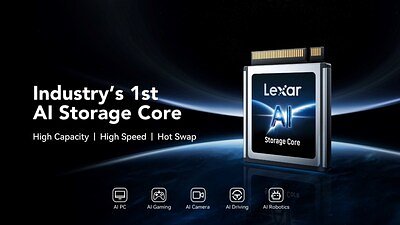
Lexar's AI Core: A Strategic Bet on the Future of Edge Computing
SAN JOSE, CA – November 26, 2025 – As artificial intelligence continues its relentless march from the cloud into our PCs, cars, and factory floors, a quiet but critical bottleneck has emerged. The sophisticated algorithms driving on-device AI demand unprecedented speed and responsiveness from a component often taken for granted: storage. In a significant strategic pivot, memory brand Lexar has moved to address this challenge head-on, unveiling what it calls the industry's first AI Storage Core. This is not merely an incremental product update; it represents a calculated investment aimed at positioning the company as a foundational enabler for the entire edge AI ecosystem.
The announcement signals a deeper understanding of where the market is headed. While the industry has been captivated by the processing power of new NPUs and GPUs, the reality for engineers is that AI performance is often constrained by how quickly data can be fed to these processors. Traditional storage, designed for sequential file access, struggles with the extreme random input/output (I/O) workloads characteristic of AI tasks like loading large language models (LLMs) or processing real-time sensor data. Lexar's move is a bet that solving this storage problem is the key to unlocking the full potential of next-generation intelligent devices.
Breaking the AI Bottleneck
Lexar's AI Storage Core is engineered to tackle the specific performance profile of AI workloads. The company highlights innovations that go far beyond the raw sequential speeds advertised by consumer SSDs. Central to this is an optimization for small-block (512B) I/O, a critical factor for AI. Expert analysis confirms that loading LLMs and other generative AI models involves a storm of small, random read requests. Improving performance here directly translates to faster application launches and more responsive AI assistants.
Underpinning this is a multi-layered approach involving SLC Boost and advanced Read Cache layers, which work in concert with the host system to accelerate data access. Drawing from the technology of its parent company, Longsys, the new modules are capable of top-tier PCIe Gen4x4 performance, with potential sequential read speeds reaching up to 7400 MB/s and 4K random read performance hitting 1000K IOPS. These figures place the device in the upper echelon of high-performance storage, but it's the specific tuning for AI that constitutes the strategic differentiation.
Furthermore, the AI Storage Core's hot-swappable design introduces a level of flexibility previously unseen in core system storage. The ability to boot an entire operating system, applications, and AI models directly from a removable module transforms the concept of system portability. For professionals, this could mean carrying their entire secure, high-performance AI workstation in their pocket, seamlessly moving between different hardware setups without data transfer or configuration headaches.
A Strategic Pivot to the Edge
Lexar's investment is astutely timed to coincide with an explosion in the edge AI market. With Gartner forecasting that AI PC shipments will surge to 143 million units by 2026—representing more than half of the global PC market—the demand for specialized components is set to skyrocket. The broader edge AI market itself is projected to grow at a compound annual growth rate (CAGR) of over 21%, reaching a value of more than $66 billion by 2030. By creating a purpose-built solution, Lexar is aiming to capture a strategic segment of this rapidly expanding hardware market.
This move also reflects the larger industry trend of decentralization. Shifting AI processing from centralized data centers to the edge reduces latency, enhances privacy, and lowers data transmission costs. Lexar's AI Storage Core is positioned as a key enabler of this shift. For applications in autonomous vehicles or industrial robotics, the ability to process data in real-time without relying on a cloud connection is not just a benefit—it's a mission-critical requirement.
While competitors like Western Digital and Micron are also targeting the AI space with high-endurance cards and enterprise SSDs, Lexar's branding of a holistic "AI Storage Core" is a shrewd marketing and product strategy. It frames the solution not as a generic component, but as an integral part of the AI processing pipeline, designed from the ground up for intelligent workloads.
Forged in Silicon: The Longsys Connection
The credibility of Lexar's ambitious claims is substantially bolstered by the technological prowess of its parent company, Longsys. The AI Storage Core's remarkable durability—offering dustproof, waterproof, shock-resistant, and radiation-resistant properties—is a direct result of Longsys's advanced integrated packaging technology. This System-in-Package (SiP) approach fundamentally changes how SSDs are built.
Instead of mounting components onto a traditional Printed Circuit Board (PCB), this method integrates the controller, NAND flash, and other circuits into a single, sealed semiconductor package. This eliminates nearly a thousand potential points of failure (solder joints) found in standard SSDs, elevating the device's reliability to chip-level standards and drastically reducing defect rates. This manufacturing innovation is what allows Lexar to promise future models with a wide-temperature operating range of –40°C to 85°C, a non-negotiable feature for automotive and industrial deployments.
This deep integration of design and manufacturing illustrates a powerful synergy. Lexar provides the brand recognition and market access, while Longsys provides the core semiconductor expertise and capital-intensive production capabilities. It's a strategic alignment that gives Lexar a formidable advantage in delivering highly reliable, specialized hardware at scale.
Enabling the Next Wave of Intelligent Machines
The true impact of this strategic investment will be measured by its adoption across key verticals. For the burgeoning AI PC market, the combination of high capacity (up to 4TB), extreme speed, and hot-swappability offers a compelling value proposition for power users and developers. In the automotive sector, the promise of rugged, wide-temperature models capable of ingesting and processing simultaneous data streams from LiDAR, radar, and cameras is essential for advancing autonomous driving systems.
In AI robotics, the compact, shock-resistant design is ideal for space-constrained and mobile applications in logistics, manufacturing, and exploration. The ability to swap modules allows for rapid upgrades to a robot's "identity" or intelligence, accelerating development cycles. Even creative fields benefit; the sustained performance is crucial for AI-assisted cameras capturing 4K/8K video while performing real-time subject tracking and scene optimization.
By creating a storage solution that is not just faster, but fundamentally more reliable and flexible for AI-specific demands, Lexar is doing more than launching a new product line. It is making a strategic play to supply a foundational component for the next era of computing. This move underscores a crucial truth: the future of artificial intelligence will be built not only on brilliant software but also on purpose-built hardware designed to handle its unique and relentless demands.