
- 40% reduction in agricultural water use with 'soil battery' technology
- 50x water retention: The organic polymer can absorb and hold up to 50 times its weight in water
- 20% less fertilizer needed due to reduced nutrient leaching
Experts view this initiative as a promising step toward sustainable agriculture in arid regions, with the potential to significantly improve water efficiency and soil health while supporting national food security goals.
Saudi Arabia's Bid to Tame the Desert with 'Soil Battery' Tech
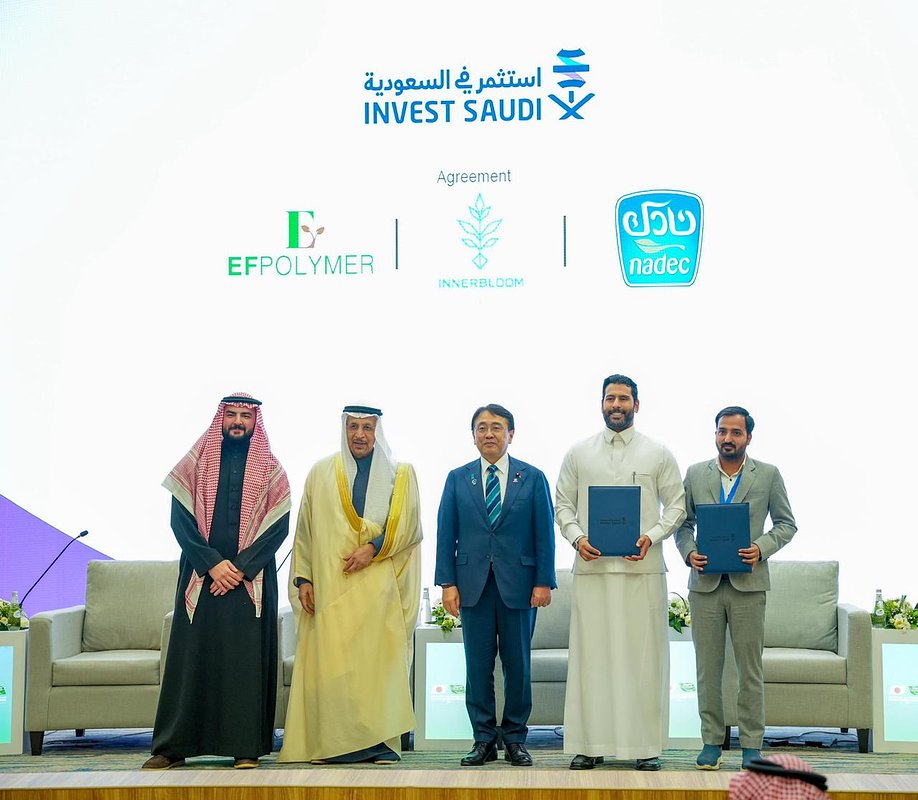
Singapore, Jan. 16, 2026 -- In a landmark move to combat severe water scarcity, Saudi Arabia's National Agricultural Development Company (NADEC) has launched large-scale field trials of a revolutionary technology that could slash agricultural water use by up to 40%. The partnership with EF Polymer, a deep-tech firm, will deploy a unique, 100% organic "soil battery" made from upcycled food waste, marking a critical step in the Kingdom's ambitious quest for food and water security.
The collaboration, strategically facilitated by the Japanese venture capital fund Universal Materials Incubator, represents a significant pivot for one of the Middle East's largest food producers, signaling a deeper commitment to regenerative agriculture in one of the world's most arid regions.
A 'Soil Battery' to Quench the Desert's Thirst
At the heart of this initiative is EF Polymer's proprietary solution: a biodegradable powder engineered to address the fundamental challenges of farming in dry climates. Derived from inedible fruit residues like orange and banana peels, the material functions as a superabsorbent polymer (SAP). When mixed into the soil, it can absorb and retain up to 50 times its own weight in water, creating a localized moisture reservoir directly at the plant's root zone.
This "soil battery" gradually releases water as the soil dries, ensuring a consistent supply for crops and dramatically reducing the need for frequent irrigation. The potential impact is profound: trials suggest it can cut water consumption by up to 40% and reduce fertilizer requirements by 20%, as the polymer also minimizes nutrient leaching.
Unlike many conventional SAPs, which are petroleum-based and can degrade into harmful microplastics, EF Polymer's solution is fully organic and biodegradable. Over the course of about a year, it breaks down completely into organic carbon, organic matter, and valuable trace nutrients like magnesium and calcium, actively enriching the soil. This dual function of water retention and soil enhancement aligns perfectly with the principles of regenerative agriculture, which aims to restore rather than deplete natural resources.
The technology's credibility is bolstered by certifications from leading organic standards bodies, including the Organic Materials Review Institute (OMRI) and Ecocert, confirming its suitability for sustainable farming. It has already found commercial success in diverse markets such as Japan, the United States, India, and Turkiye, demonstrating its viability under various climatic conditions.
Aligning with a National Vision
This partnership is not merely a corporate sustainability project; it is a direct and tangible contribution to Saudi Vision 2030, the Kingdom's sweeping blueprint for economic diversification and social reform. Central to this vision are the twin goals of ensuring national food security and drastically improving water management.
The challenge is immense. The agricultural sector in Saudi Arabia consumes approximately 11.4 billion cubic meters of water annually, much of it drawn from finite, non-renewable groundwater aquifers. Recognizing the unsustainability of this model, Vision 2030 has set an aggressive target: to reduce the use of non-renewable groundwater by 90%.
By adopting technologies like EF Polymer, NADEC is at the forefront of this national imperative. The project directly supports the goals of the National Water Strategy and the Saudi Green Initiative, which seek to implement smarter irrigation, promote water reuse, and combat desertification. If the trials prove successful at scale, this technology could provide a powerful tool for shifting the Kingdom's agricultural sector towards a more sustainable and resilient future, reducing reliance on food imports and preserving precious water reserves for future generations.
NADEC's Pivot to Regenerative Agriculture
For NADEC, a company with a 44-year legacy in Saudi agriculture, this initiative is a cornerstone of its "New Dawn" strategy—a five-year plan focused on embedding sustainability and resource circularity into its core operations. The company is moving beyond conventional methods to embrace a holistic, regenerative approach that views soil health and resource efficiency as competitive advantages.
"Strategic agriculture today requires a long-term commitment to soil health and resource circularity," stated Mohamed Al-Rajhi, VP of supply chain sector at NADEC. "NADEC is leading the shift toward regenerative practices that restore our natural capital rather than merely consuming it. By diversifying our crop portfolio and investing in closed-loop nutrient management, we are insulating our operations against global price volatility and environmental shifts."
This commitment extends beyond the EF Polymer trials. NADEC is already integrating advanced technologies across its operations, from AI-driven irrigation systems to satellite-based crop monitoring, to optimize every input. The company recently entered into a power purchase agreement for solar energy and has accelerated wastewater upcycling, demonstrating a comprehensive approach to reducing its environmental footprint.
"We are aggressively deploying AI-driven irrigation systems and satellite-based crop monitoring to optimize every drop of water and every hectare of land," Al-Rajhi added. "This strategic pivot toward agri-digitization allows us to mitigate climate risks in real-time while significantly reducing our carbon footprint. Our commitment to sustainability is our greatest competitive advantage, ensuring that NADEC remains the cornerstone of the Middle East’s agri-food sector for decades to come."
From Wheat Fields to Global Blueprint
The initial field trials are strategically focused on crops vital to the Kingdom's food security. Tests have already commenced on wheat, a water-intensive staple, to validate the polymer's water retention capabilities. Further specialized testing is scheduled for March on high-value crops like olive trees and blueberries to evaluate its impact on yield and nutrient efficiency.
The choice of these crops is deliberate. As Al-Rajhi noted, "These trials focus on strategically scalable crops like wheat and olive trees to ensure the future of the Kingdom’s food security is both sustainable and locally rooted."
The successful scouting and facilitation of this partnership by Universal Materials Incubator, a Japanese venture fund specializing in material sciences, highlights a growing trend of cross-border collaboration to solve pressing environmental challenges. UMI's role was to identify a cutting-edge technology that could be deployed at an industrial scale, bridging the gap between an innovator like EF Polymer and an agricultural giant like NADEC.
As the world grapples with a future where freshwater demand is projected to outstrip supply by 40% by 2030, the lessons learned in the Saudi desert could have global implications. This collaboration serves as a powerful case study, offering a potential blueprint for how technology, strategic investment, and national will can converge to create resilient food systems in the face of climate change and resource scarcity. The success of these trials may not only transform agriculture in the Kingdom but also provide a beacon of hope for arid regions worldwide.