
- Market Growth: Physical AI market projected to grow from $5 billion in 2025 to $80 billion by 2035, with a 34%+ CAGR.
- Innovation: Leopard Imaging introduced the world's first RGB-IR active stereo camera with 10 GigE interface.
- Applications: Technology deployed in robotics, autonomous driving, and agriculture for enhanced perception and automation.
Experts agree that Leopard Imaging's advanced vision solutions are pivotal for the real-world deployment of Physical AI, addressing critical challenges in perception and automation across industries.
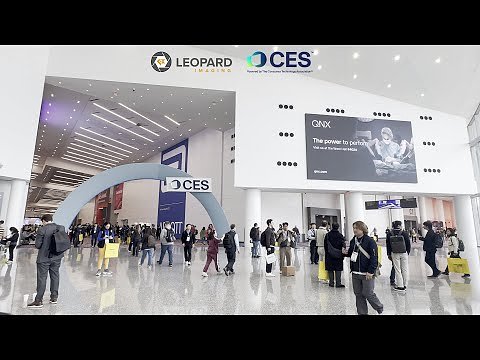
Leopard Imaging Arms 'Physical AI' With Advanced Vision for the Real World
FREMONT, CA – January 19, 2026 – As the dust settles on CES 2026, one theme has emerged as the defining force for the next technological epoch: Physical AI. This paradigm shift, where artificial intelligence moves beyond digital screens to perceive and interact with the tangible world, dominated the Las Vegas show floor. Amidst the futuristic displays, Silicon Valley-based Leopard Imaging Inc. demonstrated its critical role in this evolution, showcasing a portfolio of advanced embedded cameras and vision solutions designed to serve as the eyes for this new generation of intelligent machines.
While generative AI has captured headlines for its ability to create digital content, Physical AI represents the next frontier—empowering robots, vehicles, and smart devices to perform complex actions in real-time. Leopard Imaging's showcase directly addressed this trend, presenting end-to-end vision systems that bridge the gap between complex algorithms and physical hardware.
The Dawn of Physical AI
Physical AI is not merely a buzzword; it represents a market projected to undergo explosive growth. Valued at over $5 billion in 2025, industry forecasts predict the market could soar to over $80 billion by 2035, driven by a compound annual growth rate exceeding 34%. This surge is fueled by advancements in robotics, edge computing, and a pressing need for automation across industries facing labor shortages and safety challenges.
CES 2026 officially recognized this shift, with keynote speeches and technology demonstrations centered on AI's entry into the physical domain. From humanoid robots performing factory tasks to autonomous agricultural equipment, the event underscored the necessity for robust, high-fidelity sensory input. For these machines to navigate, understand, and act safely, they require perception systems that are far more sophisticated than simple cameras. They need to see in three dimensions, function in challenging lighting, and interpret motion with flawless clarity—capabilities that are at the core of Leopard Imaging's latest offerings.
The Eyes of the Machine
At the heart of Leopard Imaging's CES presentation were several key product innovations designed to meet the demanding perception requirements of Physical AI. These are not just incremental upgrades but highly specialized tools that solve fundamental challenges in machine vision.
A standout was the company's introduction of what it calls the world's first RGB-IR active stereo camera with a 10 GigE interface. This single device combines multiple critical technologies. The RGB-IR capability allows it to capture both visible light and infrared data, ensuring reliable performance in any lighting condition, from bright sunlight to complete darkness. Its active stereo vision system projects an invisible light pattern to calculate depth with high precision, enabling machines to accurately perceive 3D space and interact with objects. Tying it all together is the 10 Gigabit Ethernet (10GigE) interface, which provides the massive bandwidth needed to stream high-resolution color, infrared, and depth data over long distances with minimal latency—a non-negotiable for real-time robotic control and autonomous navigation.
Further expanding its depth-sensing portfolio, the company also highlighted its iToF (indirect Time-of-Flight) and global-shutter depth cameras. iToF technology provides dense, accurate depth maps crucial for object recognition and collision avoidance. The inclusion of global shutter sensors is a critical feature for any application involving movement. Unlike rolling shutters that can distort fast-moving objects, a global shutter captures the entire scene instantly, providing crisp, motion-artifact-free images essential for industrial inspection lines and autonomous vehicles.
Another significant product showcased was a 5MP camera featuring a Back-Side Illuminated (BSI) global shutter sensor with High Dynamic Range (HDR). This powerful combination addresses multiple environmental challenges simultaneously. The BSI sensor enhances low-light sensitivity, the global shutter ensures motion clarity, and HDR allows the camera to capture detail in scenes with extreme contrasts of light and shadow—such as a vehicle exiting a dark tunnel into bright daylight. This level of environmental resilience is paramount for safety-critical applications like Advanced Driver-Assistance Systems (ADAS).
Revolutionizing Industries from Farms to Factories
The impact of these advanced vision systems extends across a diverse range of sectors. Leopard Imaging's demonstrations at CES illustrated how this technology is moving from the lab to real-world deployment, driving efficiency and enabling new capabilities.
In Robotics and AI-Based Automation, these cameras provide the high-fidelity perception needed for tasks like bin-picking, precise assembly, and safe human-robot collaboration. The ability to see in 3D and capture clear images of moving parts allows robots to operate faster and more accurately than ever before, boosting productivity in manufacturing and logistics.
For Autonomous Driving and ADAS, vision systems with HDR and multi-spectral capabilities are essential for reliable perception in all weather and lighting conditions. These cameras are the foundation for features like pedestrian detection, lane-keeping assist, and fully autonomous navigation, where failure to perceive the environment correctly is not an option.
Even agriculture is being transformed. In Agriculture Technology, drones and ground robots equipped with multi-spectral imaging systems can monitor crop health, identify pests, and analyze soil conditions with a precision far beyond the human eye. This data enables precision farming, optimizing the use of water and fertilizer, increasing yields, and promoting sustainable practices.
An Ecosystem Approach to Accelerate Adoption
Perhaps one of the most significant aspects of Leopard Imaging's strategy is its focus on interoperability. The company has engineered its products to be compatible with leading industry platforms, including NVIDIA Jetson and Holoscan, Qualcomm's AI Platform, and the ubiquitous Raspberry Pi. This ecosystem-friendly approach is crucial for accelerating the adoption of Physical AI.
By ensuring its cameras work seamlessly with the computing platforms that developers and engineers already use, the company dramatically lowers the barrier to entry for creating advanced autonomous systems. A developer prototyping a new robot on a Raspberry Pi can use the same family of vision technologies when scaling up to an industrial-grade system powered by an NVIDIA Jetson module. This flexibility, combined with support for a wide array of interfaces like GMSL2, MIPI, and USB 3.0, allows integrators to select the best hardware for their specific application without being locked into a proprietary ecosystem.
This strategy directly addresses one of the primary barriers to widespread AI adoption: integration complexity. By providing standardized, ready-to-deploy solutions, Leopard Imaging helps bridge the gap between cutting-edge sensor technology and practical, scalable implementation. As the industry moves forward, this focus on creating an open and accessible hardware ecosystem will be as important as the performance of the sensors themselves, empowering a broader community of innovators to build the future of intelligent machines.