
- Capacity: 7,600 passengers and 2,350 crew, making it a floating metropolis.
- Size: Over 250,000 gross tons, one of the largest cruise ships in the world.
- Dining Venues: 28 distinct options, including high-margin ticketed experiences.
Experts would likely conclude that the Legend of the Seas represents a strategic leap in the vacation economy, combining unprecedented scale with curated experiences, though its reliance on LNG as a transitional fuel highlights the maritime industry's complex sustainability challenges.
Legend of the Seas: A Floating Metropolis Redefining the Vacation Economy
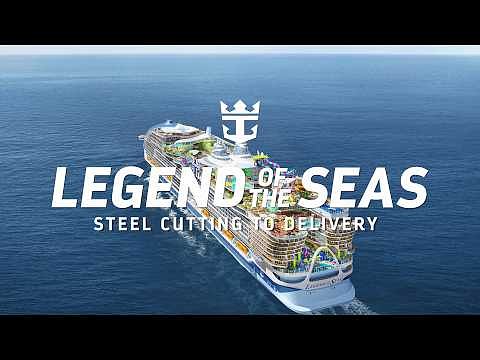
TURKU, FINLAND – June 10, 2026 – Amidst the hum of the Meyer Turku shipyard, a facility that has become a modern cradle of maritime giants, Royal Caribbean today officially took delivery of Legend of the Seas. While the press release celebrates the launch of the third vessel in the revolutionary Icon Class, the real story isn't just about a new ship. It's about the delivery of a meticulously engineered floating metropolis, the latest node in a sprawling vacation ecosystem designed to dominate a market and redefine its very parameters. This isn't just another cruise ship; it's a calculated move in a long-term industrial and economic strategy.
A New Blueprint for the Experience Economy
The sheer scale of Legend of the Seas is difficult to comprehend. At over 250,000 gross tons and with a capacity for 7,600 passengers and 2,350 crew, it functions as a small city. But its design genius lies not in its size, but in its segmentation. The ship is carved into eight distinct "neighborhoods," a design philosophy that transforms a monolithic structure into a curated collection of experiences. From the open-air Central Park, with its 30,000 real plants, to the adrenaline-fueled Thrill Island, Royal Caribbean is engineering an environment to eliminate choice paralysis and maximize engagement.
This is the "why behind the buy" in its most tangible form. The company is betting that by offering an unparalleled density of activities, it can capture the entire vacation wallet of a multi-generational family. The ship boasts 28 distinct dining venues, a deliberate strategy to cater to every palate and price point. New concepts like the "Hollywoodland Supper Club" and the "Royal Railway – Legend Station," an immersive five-course journey, are not just restaurants; they are ticketed, high-margin experiences. They represent a shift from all-inclusive buffets to a la carte entertainment, turning dinner into a show.
The family-centric design is relentless. The Surfside neighborhood is a self-contained haven for young families, while attractions like the Category 6 waterpark—the largest at sea—and the Crown's Edge, a terrifying hybrid of a skywalk and zip line suspended 154 feet above the ocean, cater to thrill-seeking teens and adults. Entertainment is similarly diversified, from a Broadway-style production of "Charlie and the Chocolate Factory" to high-diving spectacles in the AquaDome. The strategy is clear: create a closed-loop system so compelling that guests have little reason to look elsewhere, either on the ship or for their next vacation.
The Double-Edged Sword of LNG
Beneath the dazzling amenities lies a complex and critical subplot: sustainability. Legend of the Seas is Royal Caribbean's fourth ship powered by liquefied natural gas (LNG), a fuel the company champions as a cornerstone of its journey toward a net-zero cruise ship by 2035. As Royal Caribbean Group Chairman and CEO Jason Liberty stated, the new ship reflects an ambition to "continuously redefine the vacation experience," and today, that redefinition is inextricably linked to environmental performance.
On paper, the benefits of LNG are significant. It virtually eliminates sulfur oxides and particulate matter and drastically cuts nitrogen oxides. However, the "Unfiltered" truth is that LNG is a transitional fuel with a significant caveat: methane slip. Methane, the primary component of LNG, is a potent greenhouse gas, and any unburned fuel that escapes into the atmosphere can offset the CO2 reduction benefits. While engine manufacturers and shipbuilders like Meyer Turku are working to mitigate this, it highlights the profound challenges facing the maritime industry's decarbonization efforts.
Royal Caribbean is hedging its bets by layering technologies. Legend of the Seas is equipped with a waste heat recovery system, the ability to connect to shore power in port, and even the first fuel cells on a ship of its class to generate auxiliary power and fresh water. These are not silver bullets but incremental gains in a long war against emissions. The massive investment in LNG represents a high-stakes calculation that it is the best available bridge to future fuels like green hydrogen or ammonia, which are not yet viable at this scale.
Forging Giants: The Meyer Turku Symbiosis
The creation of a vessel like Legend of the Seas is an industrial feat that is only possible through a deep, symbiotic partnership. The long-term framework agreement between Royal Caribbean Group and Meyer Turku, securing shipbuilding capacity through 2036, is perhaps the most strategically important element of this story. It guarantees a pipeline for four more Icon Class ships beyond Legend, locking in a key supplier and creating a formidable barrier to entry for competitors.
This is not a simple client-vendor relationship. As Meyer Turku CEO Casimir Lindholm noted, "constructing the series has enabled us to develop our production processes in a systematic way." Each ship is an iteration on the last, a rolling R&D project on a colossal scale. Lessons learned from Icon of the Seas and Star of the Seas have been incorporated into Legend, refining everything from energy efficiency to passenger flow. This continuous improvement loop is a powerful competitive advantage, creating a moving target that is difficult for rivals to hit.
This partnership also anchors a vital regional innovation ecosystem here in Finland. Building these ships requires a vast network of thousands of engineers, designers, and specialized suppliers. The technical complexity, from installing the massive AquaDome to integrating the kinetic art sculpture known as The Pearl, fosters a level of expertise that reinforces Turku's position as a global center for cruise ship construction.
The ship will soon depart for Cadiz, Spain, for final touches before its highly anticipated European debut in July. This initial deployment in the Mediterranean is a savvy move, introducing the game-changing class to a mature market before it transitions to its Caribbean homeport in Fort Lauderdale. It acts as a global marketing tour for the company's premier product line. As Royal Caribbean President and CEO Michael Bayley said, the team looks forward to making the ship's debut "a legendary one." The name is fitting, as Legend of the Seas is more than a vessel; it is a powerful statement about the future of the vacation economy, built on a foundation of strategic innovation, industrial scale, and a high-stakes bet on a greener, more experience-driven future.