
- 20,000 square meters: Size of LC Sign's advanced manufacturing base in Guangzhou
- 300,000 sets annually: Capacity for producing customized products
- 400 employees: Team of engineers, designers, and craftsmen powering the MaaS model
Experts would likely conclude that LC Sign's Manufacturing-as-a-Service (MaaS) model successfully bridges the gap between bespoke customization and industrial-scale production, offering a scalable solution for global brand consistency and compliance.
LC Sign's MaaS Model: Crafting Brand Identity at Industrial Scale
GUANGZHOU, China – December 29, 2025 – In an era where a brand's visual identity is paramount, multinational corporations face a persistent challenge: how to deploy distinctive, high-quality signage consistently across a fractured global landscape of regulations and logistical hurdles. A Guangzhou-based manufacturer, LC Sign, is scaling a solution that addresses this very problem, positioning itself not merely as a supplier, but as a strategic partner in brand expression.
Since its founding in 2011, the company has championed a project-driven philosophy it calls 'Manufacturing-as-a-Service' (MaaS). This model, honed over more than a decade, aims to resolve the inherent industry conflict between bespoke customization and industrial-scale production. While many manufacturers pivot from standardization to customization as an afterthought, LC Sign built its entire operation around the principle of tailored creation, enabling it to deliver highly specific visual assets with the speed and reliability of a modern factory.
Redefining Production with 'Manufacturing-as-a-Service'
The term 'Manufacturing-as-a-Service' is part of a broader Industry 4.0 trend where production capabilities are offered as a flexible, on-demand service. LC Sign's interpretation of MaaS, however, is a proprietary, closed-loop system that extends far beyond simple contract manufacturing. It integrates design engineering, material science, precision machining, and global logistics into a single, cohesive project-focused workflow.
This approach allows the company to function as a centralized hub for a brand's global visual assets. Instead of a company coordinating with dozens of local vendors—each with varying quality standards and capabilities—they can rely on a single partner to execute a unified vision. The model is designed to support a high degree of design freedom, ensuring that each sign, light box, or brand installation is perfectly adapted to its specific architectural and cultural environment.
"We never changed who we are – we are the manufacturing partner of the brand," stated Anne L., CEO of LC Sign, in a recent announcement. "Whether the client is a global chain or a dynamic start-up, our manufacturing model ensures that each logo is 'tailored' to the environment in which it operates."
This service-oriented structure is a significant departure from the traditional Original Equipment Manufacturer (OEM) relationship, which often focuses on mass-producing a standardized design. By treating every order as a distinct project, LC Sign can manage the complexities of customization—from material selection to intricate fabrication—within a scalable and efficient framework.
The Silent Architect of Global Brand Identity
For global brand managers and project contractors, the tangible benefits of this model lie in its ability to solve complex logistical and regulatory challenges. Maintaining brand consistency for a luxury retailer opening stores in Paris, New York, and Tokyo, for instance, requires navigating a maze of local building codes, electrical standards, and installation requirements. LC Sign's deep expertise in international compliance, including key certifications like CE, ISO9001, and particularly UL for the demanding U.S. market, is a cornerstone of its value proposition.
The company cites its work for TRYP by Wyndham hotels in the United States, where it delivered a full set of UL-compliant outdoor signage within a tight 7–9 day timeline. This rapid turnaround, combined with guaranteed compliance, eliminates significant friction for contractors and developers. Further evidence of its high-stakes capability includes creating detailed 360° visual elements for luxury giants like Louis Vuitton and Dior and producing creative installations for public landmarks, such as the JEWEL BLOOMS display at Singapore's Changi Airport.
Another key innovation is the use of modular pre-installation. By assembling and testing complex signage systems in the factory before shipping, the company drastically reduces on-site installation time and labor costs. This pre-fabrication ensures a higher degree of quality control and simplifies the final deployment, a critical factor in fast-paced retail and commercial construction projects.
Craftsmanship at Scale: The Engine Behind the Factory Doors
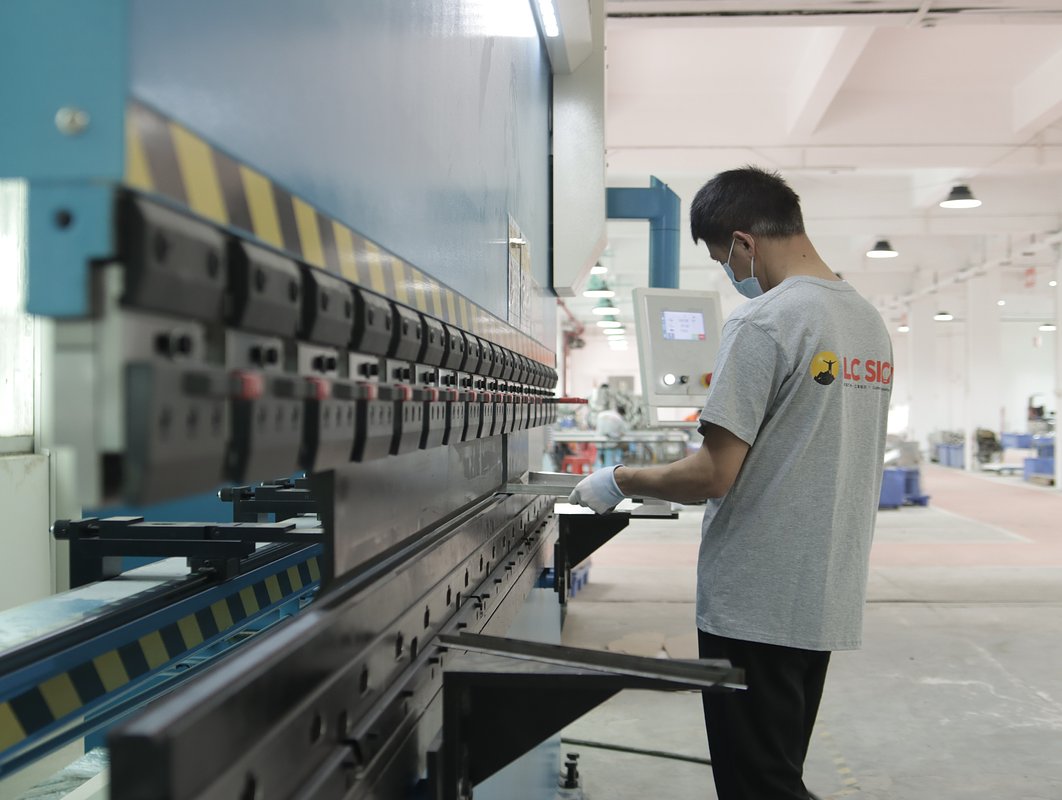
LC Sign's ability to deliver on its MaaS promise is backed by a formidable physical and human infrastructure. The company operates an advanced manufacturing base of over 20,000 square meters in Guangzhou, a global hub for LED technology and manufacturing. This facility is engineered for flexibility, capable of producing over 300,000 sets of customized products annually.
Crucially, this industrial scale is powered by a team of over 400 employees, including senior engineers, designers, and skilled craftsmen. This blend of human expertise and automated precision challenges the notion that large-scale production must come at the expense of bespoke quality. The team's deep knowledge in fine machining and material science allows for the execution of non-standard projects with meticulous accuracy, from the subtle glow of a high-end neon sign to the robust engineering of a large outdoor pylon.
While the global LED signage market includes massive players like Samsung and LG, they often focus on standardized digital displays. LC Sign has carved its niche by focusing exclusively on custom-built physical branding systems, competing with a vast landscape of Chinese and international manufacturers by leveraging its unique, service-driven production model.
A Diverse Ecosystem from Startups to Global Giants
The flexibility of the project-centric model has allowed LC Sign to cultivate a remarkably diverse client ecosystem. The company provides critical supply chain support for signage resellers, ensures brand uniformity for multinational corporations, and offers compliant engineering solutions for project contractors. This reach extends to the rapidly growing segment of new businesses and creators.
For emerging startups, a professional and polished visual identity is essential for building market awareness. LC Sign provides a path for these new brands to access high-quality, custom signage without needing deep manufacturing expertise. The model has also proven adaptable to the needs of the modern creator economy. The company highlights a project for a 5-million-follower Instagram influencer, for whom they built vibrant, photo-ready decor designed to be visually striking on camera, demonstrating an understanding of branding in the digital age.
This ability to cater to individual consumers with high-end needs for personalized space decoration alongside massive corporate rollouts underscores the true scalability of their approach. By treating every project with the same rigorous process, the MaaS model effectively democratizes access to high-caliber, custom manufacturing.
In a world increasingly dominated by experiential marketing, where physical presence and brand consistency are more critical than ever, this synthesis of customization and scale offers a compelling blueprint for the future of manufacturing partnerships. As Anne L. added, "Customization is not our add-on, it's our background." This philosophy suggests a long-term commitment to being an essential, albeit often invisible, partner in building the world's most recognizable brands.