
- 26% increase in sales conversions reported by early adopters of Krisp's technology
- 57% improvement in Net Promoter Score (NPS) observed with the new system
- Less than 200 milliseconds of latency in real-time accent clarification
Experts would likely conclude that Krisp's listener-side accent conversion technology offers a promising solution to reduce communication barriers in global workplaces, though it raises important ethical considerations about linguistic diversity and cultural identity.
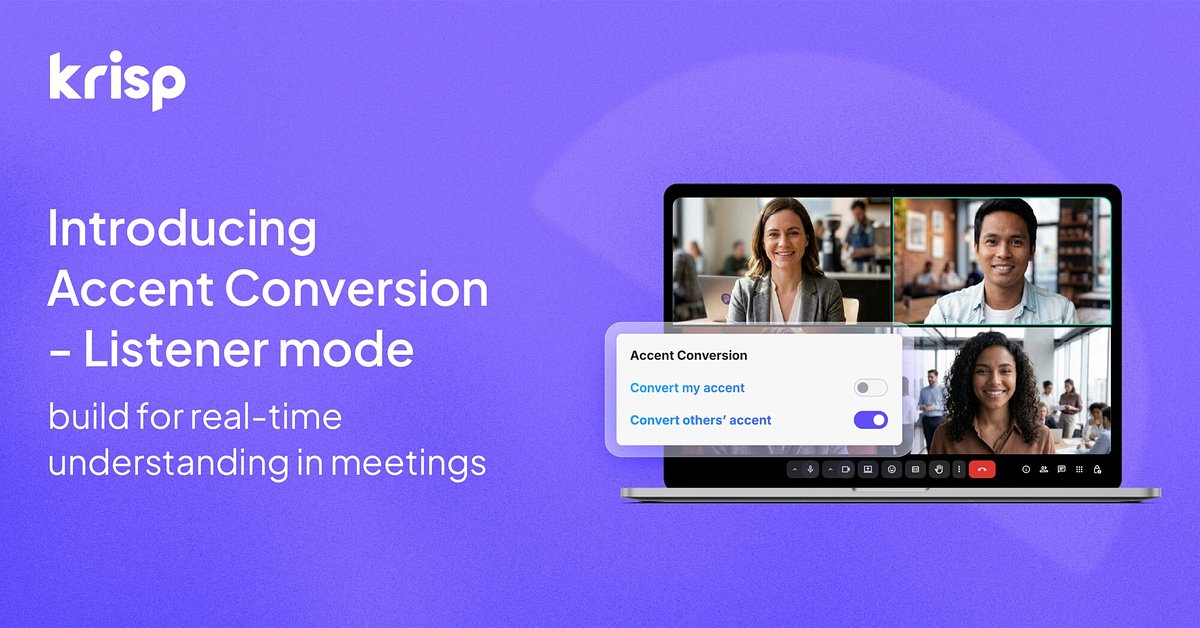
Krisp AI Clarifies Accents, Aiming for a More Inclusive Workplace
BERKELEY, CA – March 03, 2026 – In an increasingly connected yet often misunderstood world, voice AI pioneer Krisp has introduced a technology that aims to solve a fundamental challenge of global communication: the accent barrier. The company has launched Listener-side Accent Conversion, a real-time system designed not to change how a person speaks, but to clarify their speech for the listener, potentially reshaping communication in global meetings, customer support, and interactions with AI agents.
For years, voice technology has focused on removing environmental distractions with noise cancellation or documenting conversations through transcription. However, Krisp argues that even with pristine audio and a perfect transcript, the real-time cognitive load of decoding an unfamiliar accent can lead to misunderstandings, repetition, and lost context. The new system addresses this gap by processing incoming audio directly on the listener's device, subtly modifying phonemes—the basic units of sound—that are commonly misheard across different English accents. The process occurs with less than 200 milliseconds of latency, making it imperceptible to the human ear, and preserves the speaker’s unique voice, tone, and cadence.
“I’ve spent more than 20 years working in tech with an Armenian accent. I know what it feels like to repeat yourself on a call, or to see someone concentrating on your pronunciation instead of your idea,” said Arto Minasyan, Co-Founder and President of Krisp, in a statement. “We built Accent Conversion because communication should be about ideas, not decoding speech. If technology can remove that barrier in real time, conversations become clearer and more equal for everyone involved.”
The Business Case for Clarity
The launch arrives as businesses are rapidly adopting AI to enhance efficiency and customer experience. The global voice AI market is on a steep growth trajectory, projected to surge from just over $3 billion in 2024 to nearly $48 billion by 2034. A significant portion of this growth is driven by the contact center industry, where clear communication is directly tied to revenue and customer satisfaction.
Accent variability is a major source of friction in customer support. Misunderstandings can lead to longer call times, frustrated customers, and increased cognitive strain on agents who must navigate diverse accents throughout their day. Krisp’s technology targets this pain point directly. By enhancing what agents hear, the company aims to reduce repetition and improve first-call resolution. Internal data suggests the impact is significant, with early adopters reporting up to a 26% increase in sales conversions and a 57% improvement in Net Promoter Score (NPS).
“In contact centers and AI systems, the strain isn’t abstract. Agents process multiple accents all day, often in a second language,” noted Davit Baghdasaryan, Co-Founder and CEO of Krisp. “That adds friction, time, and cognitive load to every interaction. Listener-side Accent Conversion addresses the problem at the point where speech is received, helping both humans and AI systems operate more reliably without asking anyone to change how they speak.”
This approach also has profound implications for hiring and workforce management. By making accent a non-issue, companies can broaden their talent pools and reduce the need for costly and often controversial accent neutralization training, focusing instead on skills and expertise.
Navigating the Ethical Tightrope
While the potential benefits are clear, the concept of modifying accents, even for the listener, has sparked a nuanced debate. Critics raise concerns about promoting a form of linguistic homogeneity, questioning what constitutes a “neutral” or standard accent and whether such technology could inadvertently devalue cultural and linguistic diversity. The discussion pivots on a fine line: is this a tool for clarity and inclusion, or a step toward erasing vocal identity?
Krisp has been deliberate in its positioning, framing the technology as “accent clarification” rather than “conversion.” The company emphasizes that the speaker’s voice remains unaltered to anyone not using the software, and the listener-side adaptation is optional. A crucial element of this ethical framework is the technology's privacy-first architecture. All audio processing happens locally on the user's device, with no raw audio or transcripts sent to the cloud or stored, a design that mitigates many of the privacy risks associated with voice data.
By focusing on the listener, the company argues it is shifting the burden of understanding from the individual speaker to technology, empowering people to speak confidently in their natural voice without anxiety about being misunderstood. The goal, as framed by the company, is not to make everyone sound the same, but to ensure everyone can be understood.
A Crowded Field and a Clear Roadmap
Krisp is not operating in a vacuum. The voice AI space is crowded with tech giants like Google, Microsoft, and Cisco, alongside specialized Contact Center AI (CCAI) providers such as Talkdesk and Observe.AI. These platforms offer a suite of tools for transcription, translation, and agent assistance. However, Krisp’s listener-side, on-device accent clarification provides a unique and focused differentiator in the market.
The technology is currently available in Krisp’s Voice AI for Meetings application for Mac and Windows and is being integrated into its Call Center AI platform. The models have been trained on a wide array of English accents, showing the strongest results with Indian, Filipino, Latin American, African, and Chinese-Mandarin accents, with coverage continually expanding.
The company's development roadmap is aggressive. An SDK is being rolled out to allow developers to embed the functionality directly into their own applications and voice agents, opening the door for widespread adoption. Krisp has also been rapidly iterating, with recent updates delivering significant improvements in the naturalness and stability of the modified audio, particularly for accents with vast regional variations. This continuous refinement, based on user feedback and expert evaluation, demonstrates a commitment to maturing the technology for wide-scale, production-level use in the most demanding communication environments.
Topics & Related
AI & Machine Learning
Fintech
Generative AI
Machine Learning
Related Company Pulse