
- 75th Edition: The 2026 Hyakumangoku Festival marks its 75th anniversary.
- 2,000 Participants: The grand procession features over 2,000 participants in period costumes.
- 2024 Earthquake Tribute: The festival includes Kiriko lantern floats from the Noto Peninsula, honoring its recovery from the 2024 earthquake.
Experts would likely conclude that the 2026 Hyakumangoku Festival uniquely merges historical reverence with contemporary cultural relevance, reinforcing Kanazawa's identity as a hub of tradition and resilience.
Kanazawa's Samurai Festival: TV Stars, Tradition, and Resilience
KANAZAWA, Japan – April 01, 2026 – This June, the streets of Kanazawa will once again transform into a vibrant stage for history as the city celebrates its 75th Hyakumangoku Festival. From June 5 to June 7, this grand event commemorates the city's founding moment, but the 2026 edition promises to be a particularly resonant affair, blending samurai legacy with the star power of contemporary television and a poignant display of regional solidarity.
The festival, the largest in Ishikawa Prefecture, is a living monument to Lord Maeda Toshiie's triumphant entry into Kanazawa Castle on June 14, 1583. This pivotal event laid the foundation for the powerful Kaga Domain, which would shape Kanazawa into the cultural powerhouse it remains today. This year, the festival not only honors this deep history but also reflects the present, featuring the lead actors from Japan's most prestigious historical drama and incorporating a powerful tribute to the neighboring Noto Peninsula's ongoing recovery.
A Legacy of Power and Culture
To understand the Hyakumangoku Festival is to understand the legacy of the Maeda clan. For nearly three centuries, from 1583 to 1871, the Maeda family governed the Kaga Domain, a territory renowned as the wealthiest in feudal Japan. Its name, Hyakumangoku, literally means "one million koku" of rice, a measure of wealth and productivity that signified immense economic power, second only to the ruling Tokugawa shogunate.
Lord Maeda Toshiie and his successors made a strategic choice. Rather than pouring their vast resources into military expansion, which could have been perceived as a threat by the shogunate in Edo (modern-day Tokyo), they invested heavily in culture, arts, and crafts. This patronage cultivated an environment of extraordinary refinement and aesthetic innovation. Kanazawa became a center for gold leaf production, intricate lacquerware, vibrant Kaga-Yūzen silk dyeing, and the delicate arts of Noh theater and the tea ceremony. This cultural policy not only preserved peace but also forged the city’s enduring identity as a capital of high culture and exquisite craftsmanship.
The modern festival, which began in its current form in 1952, builds upon this legacy. It evolved from earlier city celebrations dating back to the 1920s and gained significant national attention after 1984, when the tradition of casting famous actors to portray Lord Toshiie began. Today, the festival is the city's beating heart, a dynamic expression of a history that is not merely remembered but actively performed and celebrated.
Where History Meets Stardom
This year's festival is set for a cultural convergence that happens only once in a generation. The roles of the city’s founders, Lord Maeda Toshiie and his formidable consort, Omatsu-no-Kata, will be portrayed by actors Daito Shunsuke and Sugai Yuka. This is no ordinary casting choice. Both actors are currently starring in the very same roles in Toyotomi Kyodai!, the 2026 NHK Taiga Drama.
In Japan, the annual Taiga Drama is a cultural institution. Broadcast by the national public broadcaster since 1963, this year-long historical series commands massive viewership and shapes the popular imagination of historical figures for years to come. For many Japanese, the actors who portray these figures become indelibly linked with them. To have the current on-screen Toshiie and Matsu step out of the television and into the actual streets of Kanazawa, embodying the characters in the very setting they founded, creates a powerful and almost surreal experience for spectators.
This star-studded casting is expected to draw enormous crowds and media attention from across the country, bridging the gap between historical enthusiasts and fans of contemporary drama. It transforms the historical reenactment into a major national event, breathing new life into the 443-year-old story and introducing Kanazawa's samurai legacy to a new and broader audience.
A Procession of Solidarity and Spectacle
The festival's centerpiece is the Hyakumangoku Gyōretsu, a grand procession held on Saturday, June 6. From 2:00 p.m. to 6:00 p.m., a stunning parade of over 2,000 participants in period costume will depart from the magnificent Tsuzumimon Gate at Kanazawa Station and wind its way through the city center to the grounds of Kanazawa Castle Park. The procession is a living tableau of Kaga culture, featuring horseback samurai, court ladies, and foot soldiers.
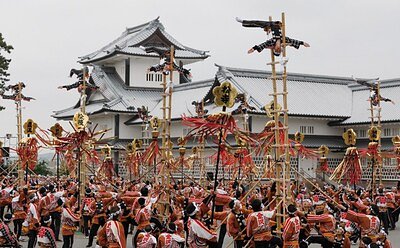
Interspersed throughout the parade are electrifying performances that showcase the domain's unique traditions. The Kaga Tobi, the legendary firefighters of the Edo period, will perform their breathtaking acrobatic ladder stunts at four locations along the route, drawing gasps from the crowd. The thunderous Kaga Shishi lion dance, a designated cultural property of Kanazawa, will move through the streets with an ancient, primal energy. Music corps will fill the air with sound, adding to the festive atmosphere.
Yet, this year, the procession carries an even deeper meaning. Woven into the pageantry will be the Kiriko lantern floats from the Noto Peninsula. This inclusion is a powerful and deliberate gesture of solidarity with the region as it continues to recover from the devastating 2024 earthquake. The towering, illuminated Kiriko floats are central to Noto's own vibrant festival culture. Seeing them move through the streets of Kanazawa, welcomed and celebrated, transforms the Hyakumangoku Festival from a purely historical celebration into a profound symbol of regional resilience, unity, and hope. It is a visual statement that the entire Hokuriku region stands together.
An Invitation to Living Culture
While the procession is the main event, the festival offers a three-day immersion into the soul of Kanazawa. The celebration extends far beyond the parade route, inviting both residents and visitors to actively participate in the city's living traditions. As evening falls, the Hyakumangoku Takigi Nō will bring the ancient art of Noh theater to life in the open air of Kanazawa Castle Park. Performed by the haunting glow of firelight, this tradition offers a direct link to the refined entertainment of the Maeda lords.
For those seeking a taste of Kanazawa's famed aesthetic, the Hyakumangoku Chakai will hold large-scale tea ceremonies, offering a window into the graceful and disciplined world of Kaga's tea culture. But perhaps the most inclusive event is the Hyakumangoku Odori Nagashi, a massive street dance where thousands of participants in matching yukata (summer kimono) dance in unison through the city's main thoroughfares. Crucially, the event is open to all—no experience or affiliation is required, embodying a spirit of communal joy and participation.
Through these diverse events, the Hyakumangoku Festival asserts that Kanazawa's history is not something to be observed from a distance. It is a culture to be experienced, performed, and shared, a vibrant legacy that continues to define the city each June.