
- Tumor Growth Inhibition (TGI): JIN-A02 achieved a maximum TGI of 168.2% in preclinical models, indicating significant tumor regression.
- Brain Metastasis Reduction: In early clinical trials, JIN-A02 reduced brain metastatic lesions by 25% in a patient with EGFR-mutant NSCLC.
- Lung Tumor Shrinkage: One patient in the 300 mg dose cohort saw lung tumors shrink by up to 44.9% by the seventh treatment cycle.
Experts view JIN-A02 as a promising breakthrough for patients with drug-resistant EGFR-mutant NSCLC, particularly those with the C797S resistance mutation, due to its demonstrated preclinical and early clinical efficacy, including activity against brain metastases.
J INTS BIO's JIN-A02 Offers New Hope for Drug-Resistant Lung Cancer
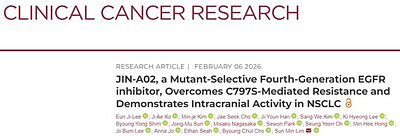
SEOUL, South Korea – February 12, 2026 – For patients with a specific type of non-small cell lung cancer (NSCLC), the battle against the disease often becomes a race against time and evolution. While targeted therapies have revolutionized treatment, cancer frequently adapts, developing resistance that renders powerful drugs ineffective. Now, research published in the prestigious journal Clinical Cancer Research details a promising new weapon in this fight: an investigational fourth-generation drug that shows significant activity against tumors that have learned to evade current treatments.
The study, led by researchers in collaboration with South Korean biotech firm J INTS BIO, Inc., outlines the preclinical and early clinical success of JIN-A02, an EGFR tyrosine kinase inhibitor (TKI). The findings present a potential lifeline for patients with EGFR-mutant NSCLC whose cancers have developed the notorious C797S resistance mutation after treatment with third-generation inhibitors like Tagrisso (osimertinib), a scenario for which there are currently no approved targeted therapies.
The Unbreachable Wall of Resistance
Non-small cell lung cancer is the most common type of lung cancer, and a significant subset of these cases is driven by mutations in the epidermal growth factor receptor (EGFR) gene. This discovery led to the development of EGFR TKIs, drugs that specifically target the mutated protein and have dramatically improved patient outcomes over the past decade.
However, the success of these therapies is often temporary. Cancer, in its relentless drive to survive, evolves. Patients treated with third-generation TKIs—the current standard of care for many—frequently see their tumors develop a secondary mutation known as C797S. This single change in the EGFR protein effectively blocks the drug from binding to its target, rendering the therapy useless and leaving patients with few viable options beyond conventional chemotherapy.
This acquired resistance represents one of the most significant unmet needs in modern oncology. The C797S mutation has become a symbol of cancer's adaptability and a formidable challenge for clinicians. Compounding the problem, EGFR-mutant lung cancer has a high propensity to spread to the brain, creating metastatic lesions that are notoriously difficult to treat due to the protective blood-brain barrier (BBB), which prevents many drugs from reaching their target.
A Fourth-Generation Breakthrough
JIN-A02 was engineered specifically to overcome this wall of resistance. As a fourth-generation EGFR inhibitor, it was designed with a molecular structure capable of effectively binding to and inhibiting the EGFR protein even when the C797S mutation is present. Critically, it was also designed to be highly selective, minimizing its activity against the normal, or 'wild-type', EGFR found in healthy cells, a key attribute for reducing side effects like rash and diarrhea that can plague patients on less selective inhibitors.
The preclinical data presented in Clinical Cancer Research is striking. In laboratory models derived from patient tumors harboring the exact resistance mutations (E19del/T790M/C797S) that make them unresponsive to Tagrisso, JIN-A02 demonstrated powerful antitumor activity. It achieved a maximum tumor growth inhibition (TGI) of 168.2%, a figure that not only signifies a complete halt of tumor growth but indicates significant tumor regression. This performance substantially exceeded the effects of Tagrisso under the same conditions.
Perhaps most importantly, JIN-A02 showed remarkable efficacy in intracranial tumor models. The drug was able to cross the blood-brain barrier in sufficient concentrations to produce rapid and sustained reductions in tumor burden in the brain. This suggests that JIN-A02 could offer a dual benefit: controlling the primary cancer while simultaneously treating or preventing the devastating spread to the central nervous system.
From the Lab to the Clinic: Early Human Trials Show Promise
The true test of any investigational drug lies in its performance in human patients. The publication also includes early but encouraging observations from an ongoing Phase 1/2 clinical trial (NCT05394831) of JIN-A02. The trial has enrolled patients with advanced EGFR-mutant NSCLC who have progressed on prior EGFR-targeted therapies and chemotherapy—a heavily pre-treated population with limited prognosis.
As of the data cutoff, 23 patients had been treated across various dose levels. The drug has been well-tolerated, with no dose-limiting toxicities observed up to the 300 mg dose. Among these patients, the results have provided the first clinical proof of concept. One patient in the 300 mg dose cohort achieved a confirmed partial response, with their lung tumors shrinking by 39.7% by the third cycle of treatment. The response was durable, deepening to a maximum reduction of 44.9% by the seventh cycle.
This same patient also had metastatic lesions in the brain, which decreased in size by 25% by the fifth cycle, with the response maintained through the seventh. This clinical finding reinforces the preclinical data suggesting the drug's potent activity within the brain.
Further validation came from molecular analysis of the patient's blood. Using a liquid biopsy technique that measures circulating tumor DNA (ctDNA), researchers observed a complete clearance of the target C797S mutation and the original EGFR exon 19 deletion. This demonstrates that JIN-A02 was successfully hitting its target at a molecular level, and this target engagement translated directly into a meaningful and visible clinical response.
Charting the Path Forward
The journey from an investigational compound to an approved medicine is long, but these initial results have generated significant optimism within the oncology community. Professor Sun Min Lim of Severance Hospital, the corresponding author of the study, highlighted the importance of these findings.
"JIN-A02 has demonstrated meaningful preclinical activity and early clinical signals targeting C797S-mediated resistance, for which treatment options have been extremely limited following the failure of third-generation EGFR-targeted therapies," stated Professor Lim. "In particular, the observed activity in brain metastases, along with a reduction in EGFR mutations detected in plasma ctDNA, provides important support for its further clinical development."
J INTS BIO has stated its intention to accelerate the clinical development of JIN-A02. The company's focus will be on optimizing the drug's dosage, expanding the clinical trial to gather more data on its efficacy in patients with brain metastases, and further validating biomarkers that can predict which patients are most likely to respond. For thousands of patients who currently face a therapeutic dead end, this research represents a crucial step toward establishing a new and desperately needed standard of care.