
- 597 meticulously planned running routes transformed into frames for the film.
- 2,792 miles collectively covered by runners to create the stop-motion animation.
- 80% of children with clubfoot in low- and middle-income countries lack access to care.
Experts would likely conclude that 'Miles to Miracle' represents a groundbreaking fusion of technology, community engagement, and global health advocacy, demonstrating how innovative applications of everyday tools can drive meaningful social impact.
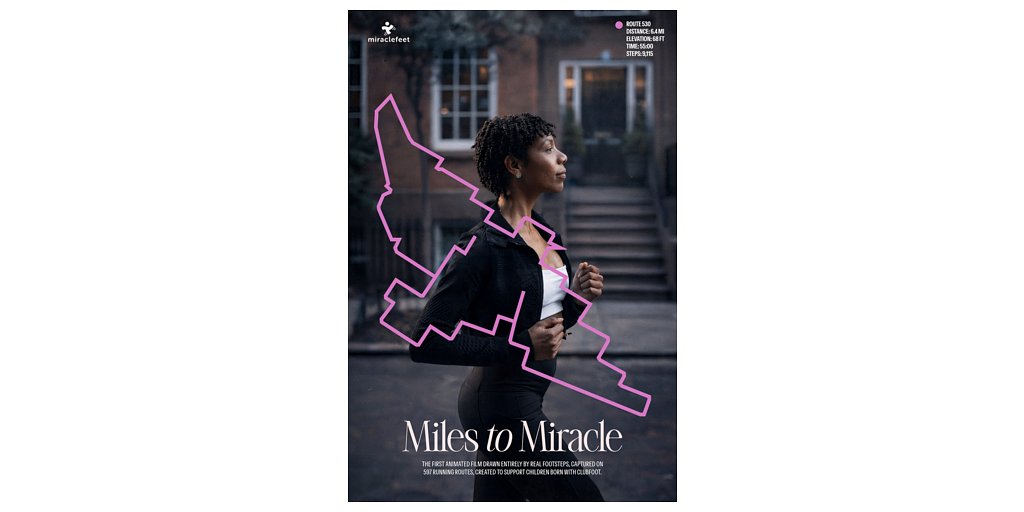
Innovation in Motion: GPS Art Powers a Film for Global Health Equity
NEW YORK, NY – June 02, 2026 – In the bustling streets of lower Manhattan, a different kind of marathon has been run. Not for a medal, but for a message. Global nonprofit MiracleFeet has unveiled ‘Miles to Miracle,’ a project that redefines the intersection of technology, community, and health advocacy. It’s an animated short film with a profound distinction: it is, by all accounts, the world’s first to be drawn entirely by the real, GPS-tracked footsteps of hundreds of runners.
This initiative moves far beyond a typical awareness campaign. By transforming the data from a popular running app into a powerful narrative about a treatable birth defect, MiracleFeet and its partners have created a new playbook for how industries can leverage everyday technology to address critical global challenges. It’s a case study in how innovative application, not just invention, is driving the next wave of social impact.
The Art of Movement: A New Canvas for Advocacy
The creative and technical ingenuity behind ‘Miles to Miracle’ is staggering. The film tells the generational story of a girl born with clubfoot, a condition where the feet are twisted inward, and the life-changing impact of treatment. To bring this story to life, the creators didn’t turn to CGI studios or traditional animators. Instead, they turned to the New York City running community.
Working with health marketing agency Klick Health, the project harnessed the phenomenon of “GPS art.” A total of 597 meticulously planned running, walking, and jogging routes were designed. Each route, when traced on a map, formed a single, distinct image—a bird, a leaf, a human leg, or the face of the film’s protagonist. Participants used the Strava app to record their movements, collectively covering 2,792 miles to “draw” the 597 individual frames needed for the stop-motion film.
“Movement had to drive every part of this film,” explained Dan Macena, Associate Creative Director at Klick Health. “By turning Strava art into a stop-motion animated story – and turning real footsteps into part of the score – a community of runners helped tell a story powered by their own steps.”
This innovative process extended even to the film's soundscape. The creative team layered authentic instrumentation with percussion captured from the runners' actual strides, embedding the theme of movement into the very auditory fabric of the film. The result is not just a visual spectacle but an immersive experience born from collective human effort, facilitated by accessible technology.
Bridging the Global Mobility Gap
While the film's production is a marvel of modern marketing, its purpose is rooted in a stark global health reality. Clubfoot affects an estimated 200,000 newborns each year. In high-income countries, it is a highly treatable condition, almost always corrected in infancy using a nonsurgical, low-cost method. Yet, for many around the world, this simple solution remains out of reach.
According to MiracleFeet, a staggering 80 percent of children with clubfoot in low- and middle-income countries lack access to care. Without treatment, these children face a lifetime of disability, pain, social stigma, and exclusion. They are often unable to walk, attend school, or participate fully in their communities.
“Those numbers are devastating because clubfoot is treatable without surgery,” affirmed Dr. Joshua E. Hyman of CUIMC/New York-Presbyterian Morgan Stanley Children's Hospital. “With early diagnosis and proper Ponseti treatment, children born with clubfoot can achieve functional, pain-free mobility. The tragedy is not that treatment does not exist. It is that too many children still cannot access it.”
This is the gap MiracleFeet was founded to close. Since 2010, the organization has worked with local healthcare partners to establish over 560 clinics in 39 countries, supporting treatment for more than 130,000 children. The ‘Miles to Miracle’ campaign is the organization’s most ambitious effort yet to bring this hidden crisis into the public consciousness.
“‘Miles to Miracle’ shows what mobility makes possible: the chance to walk, run, play, go to school, and thrive,” said Daphne de Souza Lima Sorensen, CEO of MiracleFeet. “A simple treatment is all that stands between a life of disability, stigma, and exclusion and one of mobility, independence, and opportunity.”
A Community Powered by Footsteps
A core strength of the campaign is its successful mobilization of a passionate community. The project partnered with prominent local running groups, including the Upper East Side Run Club, to recruit participants. For the runners, this was a chance to imbue their daily passion with a greater purpose.
“As runners, we never take for granted the ability to move,” said Nicholas Synan, Chief Running Officer of Upper East Side Run Club. “Being able to have every step go toward a greater impact is really special to us.”
The campaign doesn't end with the film's release. It strategically leverages the same technology to invite global participation. The routes used to create the film remain publicly available on Strava, and MiracleFeet has curated nine of the most iconic frames into the “MiracleFeet Circuit.” This collection offers challenges for all fitness levels, from a 3-mile “fun run” tracing a leaf to a 7.72-mile challenge that draws a striding leg.
This interactive element is a masterstroke of engagement. It transforms passive viewers into active participants, allowing anyone with a smartphone to physically connect with the film's message. As Associate Creative Director Kate Maldjian noted, “anyone can run or walk in the filmmakers’ footsteps and connect with the film in a personal way.” This creates a powerful, shareable experience that extends the campaign's reach organically through social networks, turning individual athletic pursuits into a collective engine for awareness and fundraising.
By building a campaign with a community rather than just for one, MiracleFeet has created a sustainable model for advocacy. The ‘Miles to Miracle’ film is not just a story to be watched, but a journey to be joined, ensuring that every new runner who traces a route in Manhattan, or is inspired to donate from afar, helps a child a world away take their first, unimpeded steps.