
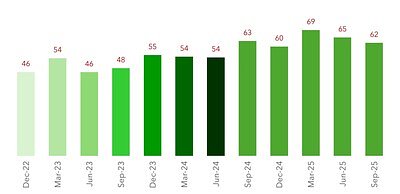
- Green Pulse Indicator (SPeX) Score: 62 (2% year-on-year dip, but 18% surge in 'implementation')
- MSMEs Adopting Green Practices: 54% classified as 'integrators'
- Sustainable Packaging Adoption: 50% of micro-enterprises (31-percentage-point jump from previous quarter)
Experts conclude that Indian MSMEs are transitioning from passive sustainability awareness to active implementation, driven by economic benefits and market access, though financial and regional challenges persist.
India's MSMEs Shift from Green Awareness to Action, Report Finds
MUMBAI, India – February 12, 2026 – India's vast network of Micro, Small, and Medium Enterprises (MSMEs) is undergoing a pivotal transformation in its approach to sustainability, shifting decisively from passive awareness to active implementation. A new report indicates that while general knowledge about sustainability concepts has softened, the on-the-ground adoption of green practices has surged, driven by a growing recognition that environmental responsibility is a powerful engine for profitability and market access.
The latest 'Green Pulse Indicator' (SPeX), a sustainability perception index released by Dun & Bradstreet and the Small Industries Development Bank of India (SIDBI) for the July-September 2025 quarter, captures this complex but promising trend. The overall index moderated slightly to 62, a 2% year-on-year dip, largely due to a 14% quarter-on-quarter decline in the 'awareness' pillar. However, this headline figure masks a more significant story: a remarkable 10% increase in 'willingness' to adopt green policies and an 18% surge in 'implementation,' marking a clear pivot from theory to practice.
This shift suggests that for a growing number of Indian entrepreneurs, sustainability is no longer an abstract corporate ideal but a tangible set of actions. The report classifies 54% of MSMEs as 'integrators'—businesses that are actively embedding environmental and social considerations into their core operations. This move from deliberation to execution signals a new phase of maturity in the sector's green journey.
From Understanding to Doing
The data reveals a distinct change in priorities. While past efforts may have focused on governance reforms, MSMEs are now channeling their energy into concrete environmental actions. The 'Reduce, Reuse, Recycle' (3R) principle has become a top priority for 31% of firms. This is reflected in the numbers: 46% of all MSMEs surveyed are now implementing recycling procedures, and an impressive 50% of micro-enterprises—often the most resource-constrained—have adopted sustainable packaging, a 31-percentage-point jump from the previous quarter.
Dr. Arun Singh, Global Chief Economist at Dun & Bradstreet, noted this transition. "While overall scores dipped... due to lower awareness among micro and medium enterprises, there was a strong rise in willingness and implementation," he stated. "This shows that many firms are shifting from understanding sustainability to actively adopting it... There is also a noticeable shift from governance reforms to environmental action, with recycling and sustainable packaging gaining momentum."
This hands-on approach is particularly evident among medium-sized enterprises, which are leading the charge. A striking 90% of these firms plan to expand their environmental initiatives, a 53-percentage-point surge, while 65% are in the process of implementing sustainability training for their staff. This demonstrates a strategic commitment to building long-term green capabilities.
The Business Case for Going Green
The driving force behind this surge in action is not merely altruism but a clear-eyed assessment of economic benefits. An overwhelming 86% of MSMEs now recognize sustainability as a direct lever for profitability—a 10-percentage-point increase from the prior quarter. Furthermore, 69% see it as a path to cost reduction, and 72% link it to improved access to lucrative export markets, a crucial factor for older, more established firms.
This sentiment is echoed by Dr. Ravindra Kumar Singh, Chief General Manager at SIDBI's Green Climate Finance Vertical. "The latest Green Pulse Survey... results are a powerful indicator that sustainability is not just a moral imperative, but a sound business strategy," he commented. He highlighted the "unprecedented 90% confidence level among businesses aged 25 years and older that sustainability adoption will enhance profitability," calling it a clear market shift.
The report indicates that peer pressure, cost efficiency, and incentives are key motivators. Younger firms and micro-enterprises are especially influenced by competitive dynamics, suggesting that as more businesses adopt green practices, a ripple effect is created across the market. With 60% of MSMEs focusing on making their supply chains more sustainable, the pressure to conform to green standards is cascading from larger corporations to their smaller suppliers, creating a virtuous cycle.
Persistent Hurdles and Regional Divides
Despite the powerful momentum, the path to a fully sustainable MSME sector is not without significant obstacles. The most persistent challenge remains financial. A concerning 45.2% of MSMEs operate without any dedicated budget for sustainability. Among those that do, only 16.3% allocate a meaningful 5-10% of their total expenditure to green initiatives. The high cost of implementation, lack of technical expertise, and constrained access to capital are consistent barriers reported across firms of all sizes and ages.
This financial strain creates a complex dynamic. While younger businesses show a high intent for full compliance, older firms, despite their strong willingness, often face cost-related barriers that stall their progress. This highlights a critical need for accessible and targeted financial support to translate intent into impact.
The report also reveals a stark regional divide in sustainability adoption, indicating that the green transition is not uniform across India. States like Bihar, Tripura, and Goa are making significant strides, with their SPeX scores rising by 5% quarter-on-quarter. Goa, in particular, stands out as the only state where a notable 14% of respondents are already in the full implementation phase. In sharp contrast, states like Chhattisgarh and Madhya Pradesh experienced sharp declines, signaling that local economic conditions, policy support, and awareness levels can dramatically influence progress.
Bridging the Gap with Strategic Support
Addressing these financial and regional gaps is crucial for unlocking the full potential of India's green MSME revolution. Financial institutions like SIDBI are stepping up to meet this need. Dr. Ravindra Kumar Singh confirmed that SIDBI's established 'Panchatatva' Missions—covering everything from energy efficiency to e-mobility—are accelerating momentum. He also pointed to upcoming initiatives like the GCF-funded "Financing Mitigation and Adaptation Projects (FMAP) for Indian MSMEs" designed to meet the growing demand for green finance.
However, money is only part of the solution. The report’s finding that awareness has declined, even as action has increased, points to a communication challenge. Intriguingly, news and social media have emerged as the most trusted sources for sustainability information (37%), surpassing government platforms (20%), especially for micro-businesses. This suggests that future awareness campaigns must be re-strategized to meet MSMEs on the platforms they actively use and trust, delivering practical, actionable information rather than abstract concepts.
As Indian MSMEs stand at this critical juncture, the path forward requires a dual approach. The entrepreneurial drive to innovate and adapt, now clearly focused on the tangible benefits of sustainability, provides a powerful engine for change. This bottom-up momentum, when coupled with top-down support in the form of targeted green financing, technical assistance, and smarter communication strategies, can ensure that this promising shift from awareness to action becomes a scalable, long-term, and inclusive economic transformation for the nation.