
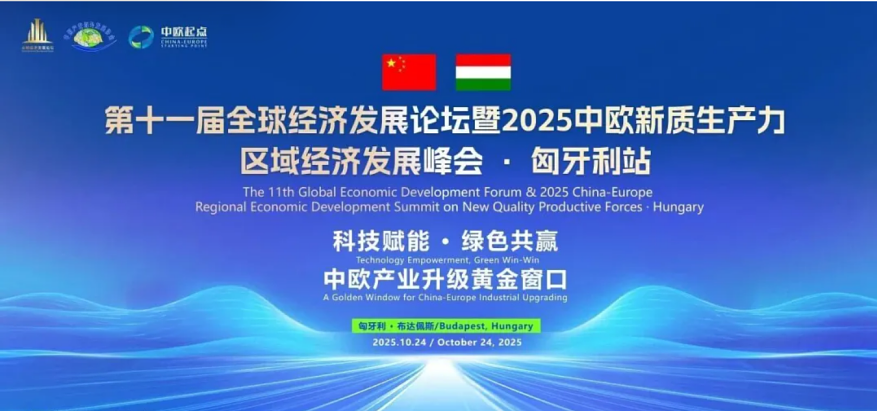
- 11th Global Economic Development Forum & China-Europe Regional Economic Development Summit held in Budapest, gathering over 100 officials and business leaders.
- Hungary is one of the most receptive environments for Chinese foreign direct investment (FDI) in the EU.
- Focus on high-value sectors like electric vehicle (EV) manufacturing, battery production, electronics, and logistics.
Experts view Hungary's 'Eastward Opening' policy as a strategic bridge for Chinese investment into the EU, offering a business-friendly environment with significant incentives, despite regulatory concerns in Brussels.
Hungary's Eastward Embrace: China's Bridge to the European Market
BUDAPEST, Hungary – April 02, 2026
By Jack Patterson
In the historic heart of Central Europe, a new economic bridge is being fortified. A recent summit in Budapest, the 11th Global Economic Development Forum & China-Europe Regional Economic Development Summit, served as the latest testament to Hungary's deepening role as a strategic gateway for Chinese enterprises entering the European Union. Under the banner of "Sharing Opportunities Between China and Europe, Creating a Valuable Future Together," the gathering of over 100 government officials, business leaders, and policy experts was more than a diplomatic formality; it was a workshop for building a new era of economic synergy, with firms like Jilian Construction Engineering providing the practical blueprints.
While the European Union grapples with a complex and often fraught relationship with Beijing, Hungary has carved out a distinct path. Its government's long-standing "Eastward Opening" policy has transformed the nation into one of the most receptive environments for Chinese foreign direct investment (FDI) in the bloc. This strategy was on full display at the forum, where Hungarian officials, including Bornemisza Miklós, Vice President of the Budapest Chamber of Commerce and Industry, detailed the country's preferential policies and key industrial targets, signaling that the door remains wide open for collaboration.
The 'Eastward Opening' in Practice
Hungary's appeal is no accident. It is the result of a deliberate, decade-long geopolitical and economic strategy. As a vocal proponent of China's Belt and Road Initiative (BRI) and an active member of the China-Central and Eastern European Countries (CEEC) cooperation framework, Budapest has positioned itself as a reliable and business-friendly partner for Beijing within the EU. This has attracted a wave of Chinese investment, particularly in high-value sectors like electric vehicle (EV) manufacturing, battery production, electronics, and logistics.
The country offers a compelling package: a strategic location at the crossroads of Europe, a skilled workforce, and a government willing to offer significant incentives, including tax breaks and subsidies. For Chinese companies looking to establish a foothold in the vast EU single market, Hungary presents a landing strip with fewer of the political and regulatory headwinds they might face in other Western European capitals. This pro-investment stance, however, has not gone unnoticed in Brussels, where concerns about a level playing field, transparency, and the EU's unified stance on China are frequently debated. Despite this scrutiny, the flow of capital continues, driven by mutual economic interests that events like the Budapest summit aim to amplify.
A Masterclass in Localization
As investment flows increase, the central challenge shifts from market entry to sustainable operation. This is where the practical experience of companies already on the ground becomes invaluable. Jilian Construction, a Chinese engineering firm with an established presence in Hungary, took center stage at the summit to share what its Hungarian head, Ms. Stella Cui, called a comprehensive "localization guide."
Her presentation moved beyond high-level strategy to address the granular realities of cross-cultural business. She detailed a framework for combining "Chinese efficiency" with "European standards," a concept that resonates deeply with international firms struggling to balance speed with rigorous compliance. According to Cui, success hinges on prioritizing strategic clarity and regulatory adherence from day one. This involves not just understanding local laws but also building local teams, adapting management styles, and integrating into the local supply chain.
This approach counters the stereotype of Chinese firms simply importing their domestic models. Instead, it advocates for a hybrid model—one that leverages the rapid decision-making and execution capabilities honed in China's competitive market while fully embracing Europe's stringent quality, labor, and environmental standards. The insights provided a roadmap for navigating the complexities of a foreign market, from initial team-building to final project execution, emphasizing that long-term success is built on a foundation of mutual trust and genuine integration, not just financial investment.
Forging a Green and Digital Future
The summit's focus extended beyond present opportunities to the future of China-EU collaboration, with two concepts dominating the discussion: green development and "new quality productivity." The latter, a central theme in China's current economic policy, signals a strategic shift away from traditional manufacturing toward innovation-driven, high-tech, and sustainable industries. This aligns closely with the EU's own Green Deal and digital transformation agendas, creating a potential foundation for powerful new partnerships.
Participants identified vast potential for synergy across technological innovation, industrial supply chains, and financial integration. The dialogue explored joint ventures in renewable energy, smart manufacturing, and the circular economy. For China, partnering with European firms offers access to cutting-edge technology and established green-sector expertise. For Europe, collaboration with China, a global leader in EV and solar panel production, is crucial for achieving ambitious climate goals and diversifying supply chains.
This shared focus on a sustainable future represents a powerful narrative for the China-Hungary, and by extension, China-EU relationship. It suggests a move from purely transactional trade to a more integrated partnership aimed at tackling global challenges. Companies like Jilian Construction, by emphasizing compliance and modern standards, are positioning themselves not just as builders of infrastructure, but as facilitators of this next-generation economic cooperation, where growth is measured not only by profit but also by its contribution to a more sustainable and technologically advanced global economy.