
- 120+ partners and customers attended the launch summit in Shenzhen.
- 65% year-on-year surge in Huawei's government and public sector sales in APAC.
- 3+3 high-level scenarios targeted under the 'AHEAD-APAC Program' for benchmarking.
Experts would likely conclude that Huawei's GEHPA-APAC Alliance is a strategic move to solidify its role in APAC's digital transformation, leveraging ecosystem-driven partnerships to outmaneuver global competitors and embed its technology in critical public sectors.
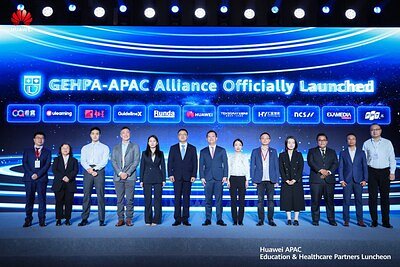
Huawei's New AI Alliance: A Strategic Play for APAC's Digital Future
SHENZHEN, China – June 09, 2026 – In a calculated move to cement its role as a core architect of Asia-Pacific's digital infrastructure, Huawei has officially launched the Global Education & Healthcare Partners Alliance for the APAC region (GEHPA-APAC). Unveiled last week at a summit that drew over 120 partners and customers to its Shenzhen headquarters, the alliance is more than a corporate initiative; it's a strategic gambit to deeply embed its technology and standards within the region's most critical public sectors.
While the stated mission is to advance "inclusive and intelligent" services, the alliance represents a significant escalation of Huawei's ecosystem-driven strategy. By corralling a host of local and international partners, the tech giant is positioning itself not merely as a vendor, but as the central nervous system for the AI-powered transformation of education and healthcare across a diverse and rapidly developing market.
The Geopolitical Chessboard
The launch of GEHPA-APAC cannot be viewed in a vacuum. It is the latest chapter in Huawei's strategic pivot away from the embattled consumer electronics sector toward enterprise and public sector solutions, where it has found fertile ground. Recent figures show the company’s government and public sector sales in APAC surged 65% year-on-year, a testament to a strategy that is clearly paying dividends. This alliance is designed to accelerate that momentum.
By focusing on education and healthcare, Huawei is targeting sectors that are not only ripe for technological disruption but are also pillars of national strategy for nearly every government in the region. As one industry analyst noted, "Becoming the technological backbone for a nation's schools and hospitals makes you an indispensable partner, insulating your business from the whims of geopolitical tensions." The company's 'AI+' strategy, as articulated by Vice President Yang Weijun, aims to "translate national-level strategies into practical projects," a clear signal of its intent to align closely with government ambitions.
This positions Huawei in direct competition with global cloud titans like Amazon Web Services, Microsoft Azure, and Google Cloud, as well as regional powerhouses like Alibaba Cloud and Tencent Cloud. However, Huawei's approach appears more deeply integrated. Rather than simply selling cloud services, it is building a federated model of co-innovation, a move designed to outmaneuver competitors by fostering deep-rooted local dependencies and customized solutions that are difficult to replicate.
An Ecosystem of Influence
At the heart of Huawei's strategy is a sophisticated blueprint for market penetration built on collaborative ecosystems. The company is leveraging two key frameworks: the 'AHEAD-APAC Program' and the 'EARN' framework. These are not mere marketing acronyms; they are operational roadmaps for scaling its influence.
The 'AHEAD-APAC Program' promises to establish "six lighthouse benchmarks across 3+3 high-level scenarios," backed by Huawei's expert support and marketing funds. This is a classic playbook for seeding a market: create high-profile success stories that demonstrate value and create a template for widespread adoption. By funding and co-branding these initial projects, Huawei lowers the barrier to entry for partners and customers, accelerating the adoption curve of its technologies.
Meanwhile, the 'EARN' framework—Experiencing AI, Allying with local ISVs, maintaining a Root presence, and Nurturing a win-win ecosystem—details the mechanics of this expansion. The strategy emphasizes deep localization, empowering regional leaders to build solutions tailored to their markets. Jean Wang, a Vice President in Huawei's APAC Public Sector, described it as a way to "turn complex customer challenges into strategic opportunities." The inclusion of diverse partners like Singapore’s NCS, Malaysia’s Examedia Solutions, and specialized AI firms like CourseGrading Intelligence and GuidelineX is telling. Huawei provides the foundational technology—the cloud infrastructure, the AI models—while local partners provide the specific applications, market access, and last-mile integration. This creates a powerful, four-party symbiotic relationship between Huawei, its software and system integration partners, the customers, and ultimately, the end-users.
Evelyn Wu, CEO of partner firm GuidelineX, underscored this dynamic, noting that partners "co-build capabilities, share risks and rewards, and define the future of healthcare in their markets." It is a model of shared fate, designed to build a wide and loyal base that grows alongside Huawei's platform.
The Promise and Peril of AI for All
Beyond the corporate strategy and competitive dynamics lies the profound potential impact on the ground. The Asia-Pacific region is a study in contrasts, with hyper-modern urban centers existing alongside vast rural populations with limited access to quality education and healthcare. The promise of AI is to bridge these gaps.
Partners at the summit showcased tangible applications. Examedia Solutions, for instance, is deploying an advanced Picture Archiving and Communication System (PACS) to integrate disparate imaging systems in Malaysia's public hospitals, a critical step for enabling remote diagnostics and efficient data sharing. In education, CourseGrading Intelligence is working with Huawei on AI platforms to create more personalized and engaging learning experiences. Kevin Yuan, the company's Deputy General Manager, articulated a vision where "every student can create, every teacher can inspire, and every school can lead in the digital age."
However, the path to this intelligent future is fraught with challenges. The digital divide remains a stark reality, and deploying advanced AI requires robust connectivity and digital literacy that are often lacking. Furthermore, the sensitive nature of health and educational data raises significant concerns around privacy, security, and data sovereignty. As one public health official from the region privately commented, "The interoperability is appealing, but we must have absolute certainty about where our citizens' data resides and who controls it."
Navigating the patchwork of national regulations, ethical considerations around algorithmic bias, and the sheer cost of digital transformation will be the true test of this alliance. Huawei's success will depend not only on the strength of its technology and its partner network but on its ability to build trust with governments and citizens across a complex and often skeptical region. The GEHPA-APAC Alliance is a bold declaration of intent, but the work of turning that vision into a sustainable and equitable reality has only just begun.