
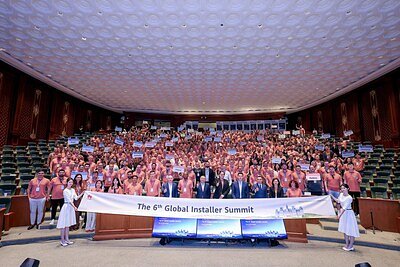
- 500+ partners from 29 countries attended Huawei's 6th Global Installer Summit.
- Huawei and Sungrow collectively control over 50% of the global PV inverter market (2024 data).
- FusionSolar AI agent aims to reduce O&M costs and boost productivity for solar installations.
Experts would likely conclude that Huawei's integration of AI with solar energy, combined with its global installer network, positions the company as a leader in the intelligent energy transition, addressing critical industry challenges like labor shortages and operational efficiency.
Huawei's AI Gambit: Fusing Intelligence with Solar for Global Dominance
DONGGUAN, China – March 27, 2026 – As the global race to decarbonize intensifies, Huawei Digital Power is making a bold play to lead the charge, placing its bets on the convergence of artificial intelligence and renewable energy. At its 6th Global Installer Summit in Songshan Lake, the company gathered over 500 partners from 29 countries, laying out a strategy that positions AI and its global network of installers as the twin pillars of its future growth.
The summit served as a platform to showcase not just new products, but a comprehensive vision for an intelligent, efficient, and interconnected green energy future. "Huawei adopts a deterministic strategy to embrace AI, digitalization, intelligence, and decarbonization," stated Zhou Jianjun, Vice President of Huawei and President of Global Marketing, Sales and Services at Huawei Digital Power, setting a clear tone for the event. This strategy moves beyond simply manufacturing hardware, aiming to create an entire ecosystem powered by data and intelligence.
The AI-Powered Energy Grid
Central to Huawei's vision is the deep integration of AI into every facet of the solar energy lifecycle. The company used the summit to launch its "Installer Voice Loop," an innovative, AI-powered platform designed to systematically gather, analyze, and act upon feedback from frontline installers. This initiative aims to create a rapid, closed-loop system for problem-solving and product enhancement, turning a constant stream of real-world data into actionable improvements.
Further cementing its AI focus, the company highlighted the "FusionSolar AI agent." Simon Sun, President of the Smart PV Management System Business, explained how this digital tool can dramatically boost productivity and slash operations and maintenance (O&M) costs for solar installations. The agent leverages AI for intelligent diagnostics, predictive maintenance, and performance optimization. For asset owners and operators, this translates to reduced downtime, higher energy yields, and improved return on investment—a critical advantage in the competitive energy market. This aligns with a broader industry trend where AI is being used to enhance forecasting, manage grid stability, and optimize the performance of renewable assets.
Empowering the 'Last Mile' of the Energy Transition
While technology took center stage, Huawei placed equal emphasis on the human element, specifically the installers and Engineering, Procurement, and Construction (EPC) companies responsible for deploying solar solutions. Jack Tong, President of the Global Residential and C&I Business Dept, described these partners as the "safety guardians, quality assurance providers, and last-mile value creators" in the global shift from passive energy consumers to active "prosumers."
This focus comes as the industry grapples with significant challenges, including a global shortage of skilled labor and the need for continuous training on rapidly evolving technologies. Huawei's strategy appears designed to directly address these pain points. The company introduced its "One-Fits-All" solutions for residential and commercial & industrial (C&I) scenarios. These systems are engineered for proactive safety, premium quality, and all-scenario adaptability, aiming to simplify the installation process, reduce complexity, and improve profitability for partners.
By creating more intuitive and integrated products, Huawei seeks to lower the barrier to entry and increase the efficiency of its installer network. This empowerment strategy was further underscored by the summit's "Best Installer Contest," where eight global representatives competed by sharing real-world case studies, showcasing practical expertise and innovative business models. The event culminated in an awards ceremony, celebrating excellence and fostering a sense of community and shared purpose.
Forging a Global Ecosystem Amid Fierce Competition
The summit's international attendance highlights the global scope of Huawei's ambition. The company is already a dominant force in the solar industry, consistently ranking as a top global supplier of PV inverters. Industry analysis from 2024 shows Huawei and its primary competitor, Sungrow, collectively command over half of the global market. With nine of the top ten PV inverter suppliers now based in China, the competition is intense, and building a loyal global ecosystem is paramount.
By bringing partners from Europe, Latin America, Africa, and Asia to its home base in Dongguan, Huawei is actively strengthening these crucial relationships. The strategy is not just about selling products but about building a collaborative network that can navigate diverse regulatory environments and market conditions. The company's commitment to quality, a point repeatedly emphasized by executives like CMO Xia Hesheng, is a key part of this trust-building exercise. "Huawei believes serving customers is its core purpose, with their needs driving development," Xia stated, reinforcing the customer-centric approach.
This global strategy is supported by a three-dimensional service system built on quality, expertise, and vision, as outlined by Allen Zeng, President of the Technical Service & Operation Dept. The goal is to make installers' work "simpler and more efficient," providing them with the tools, training, and support needed to succeed. As the industry moves into a new phase of intelligent, high-quality growth, this deep-seated collaboration with its global partners may prove to be Huawei's most significant competitive advantage. The convergence of advanced AI, simplified solutions, and a highly engaged global installer network forms the core of its plan to not only compete but to lead the next stage of the energy revolution.
Topics & Related
Industry Conference
Decarbonization
Net Zero
Generative AI
Automation
EBITDA
Related Company Pulse