
- 3,500 jobs at the new Vaudreuil-Soulanges Hospital
- 10,000 new positions projected by 2030
- 27% cut in Temporary Foreign Worker Program permits for 2026
Experts would likely conclude that the region's request for an immigration exception is a pragmatic response to a predictable labour crisis, balancing economic growth with the need for targeted immigration flexibility.
Hospital at Risk: Vaudreuil-Soulanges Demands Immigration Exception
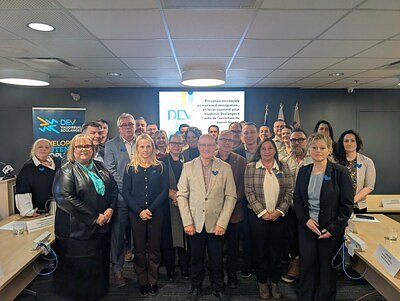
VAUDREUIL-DORION, QC – February 11, 2026 – In an unprecedented move, a unified front of political and business leaders from the Vaudreuil-Soulanges region has issued an urgent appeal to the federal and provincial governments for a “territorial exception” from new, restrictive immigration policies. The request, spearheaded by Développement Vaudreuil-Soulanges (DEV), aims to avert a looming labour crisis that threatens to undermine the local economy and, most critically, jeopardize the successful 2028 opening of the new Vaudreuil-Soulanges Hospital.
At a press conference today, regional leaders painted a stark picture of a thriving community on a collision course with government policy. With the creation of 3,500 jobs at the new hospital and a projected 10,000 new positions to fill by 2030, the region faces a staggering workforce demand that local labour pools cannot meet alone.
"Few regions in Québec can anticipate the scale of their workforce needs with such precision," said Danie Deschênes, Mayor of Notre-Dame-de-l'Île-Perrot and Chair of DEV. The plea is not for special treatment, leaders argued, but for a logical and necessary tool to manage predictable, explosive growth.
A Perfect Storm of Growth and Restriction
Vaudreuil-Soulanges is a victim of its own success. Recognized for its dynamic economy and sustained demographic growth that has consistently outpaced Greater Montreal, the region is now facing a perfect storm. The new hospital is the crown jewel of its development—a massive project, now over halfway complete, designed to serve a burgeoning population and reduce pressure on strained healthcare facilities in surrounding areas.
However, this monumental undertaking is set to land in a labour market already stretched thin. The Montérégie region, which includes Vaudreuil-Soulanges, consistently reports one of Quebec’s lowest unemployment rates and had nearly 27,000 vacant positions in 2023. The 3,500 hospital jobs—spanning everything from specialized medical roles to essential support staff—will create a powerful gravitational pull on the existing workforce, creating a vacuum that local businesses fear they cannot survive.
This predictable labour crunch is being dangerously exacerbated by a recent, sharp pivot in Canadian and Québecois immigration policy, shifting from a focus on volume to one of restriction and control.
The Policy Vise: How New Rules Are Squeezing Québec's Regions
The concerns voiced by Vaudreuil-Soulanges leaders are a direct reaction to a cascade of policy changes from both Ottawa and Québec City in late 2025 and early 2026. These new rules, designed to curb the overall number of temporary residents, have created significant hurdles for employers.
Federally, the government announced a dramatic cut in temporary resident admissions, with the target for new Temporary Foreign Worker Program (TFWP) permits slashed by 27% for 2026. Critically, Ottawa has also blocked new low-wage Labour Market Impact Assessments (LMIAs)—a key step for hiring foreign workers—in major census areas with unemployment at or above 6%. While Vaudreuil-Soulanges's rate is low, the policy signals a clear federal intention to tighten the taps on foreign labour.
Compounding the issue, the provincial government in Québec has initiated its own plan to reduce immigration levels. For the first time, Québec has set targets to lower its temporary resident population, aiming for a 13% reduction by 2029, with a specific focus on Montréal and Laval. The province also terminated the popular Programme de l'expérience québécoise (PEQ), a key pathway to permanent residency for many foreign workers and graduates, replacing it with a more restrictive points-based system.
Perhaps most challenging for many is a new provincial rule, effective December 17, 2025, requiring temporary foreign workers with three years of experience in Québec to demonstrate Level 4 spoken French to renew their work permits. While promoting francization is a key provincial goal, for workers and employers in the midst of a labour crisis, it represents another significant barrier to retaining an established, integrated workforce.
Businesses on the Brink and Lives in Limbo
For local businesses, these abstract policy shifts have immediate, tangible consequences. "The government is literally undermining our recruitment strategy for the coming years," said Jean-François Blanchard, CEO of CHSLD Manoir Harwood and Soulanges, which relies on 48 temporary foreign workers to care for its residents.
At Sanivac, a regional leader in environmental services, the uncertainty is forcing the company to consider scaling back operations. "Our intention remains to stay and grow here; however, current conditions are making that objective increasingly difficult to achieve," stated Carolyne Houle, the company's Vice-President of Human Resources.
The human cost is equally profound. Laurent Avril, Vice-President of Production at Fleury Michon Amérique in Rigaud, noted that six Moroccan workers hired through DEV-led missions allowed his company to expand. "These workers are now well integrated into the region. They have housing, cars, and actively participate in community life," he explained. "Losing them would force us to turn down contracts and slow the company's growth."
Francine St-Denis, Executive Director of Réseaux Vaudreuil-Soulanges, emphasized the deep roots these workers have established. "Behind every work permit are families and children who have put down roots here," she said. "We are asking to continue this work with respect for the paths already underway."
A Precedent-Setting Plea for Regional Autonomy
DEV’s formal request is five-fold: a “grandfather clause” to simplify permit renewals for current TFWs, an accelerated recruitment process for all businesses, specific measures to staff the hospital, support for local businesses that will lose workers to the hospital, and a clear recruitment strategy from Santé Québec.
While the term “territorial exception” is not a standard feature of immigration law, the concept of regional flexibility is not new. Federal programs like the Rural and Northern Immigration Pilot (RNIP) and the Atlantic Immigration Program (AIP) were designed specifically to address the unique labour needs of smaller communities. DEV’s request, however, is a more direct and urgent plea for a targeted carve-out in the face of policies that leaders feel ignore their unique and predictable circumstances.
Patrick Bousez, Warden of the MRC de Vaudreuil-Soulanges, framed the request as a matter of moral consistency. "This growth is guided by rigorous planning... The transitional measure requested by DEV is not a favour—it is a matter of consistency with what we have collectively promised citizens who chose our region," he stated. "This request is a necessity grounded in real needs and in our moral responsibility."
As of today, neither the federal Ministry of Immigration, Refugees and Citizenship nor Québec's Ministère de l'Immigration, de la Francisation et de l'Intégration has issued a formal response. The region of Vaudreuil-Soulanges waits, its ambitious future and the well-being of its residents hanging in the balance.