
- 84% Net Promoter Score (NPS): Exceptional customer satisfaction at Hisense's Qingdao factory.
- 62% reduction in time from capturing customer needs to implementing them as product functions.
- 20-second manufacturing cycle for complex 85-inch TVs, enabling rapid market response.
Experts would likely conclude that Hisense's WEF Lighthouse Award validates its leadership in customer-centric manufacturing, setting a new industry benchmark for efficiency, innovation, and responsiveness to consumer needs.
Hisense Sets Global TV Industry Benchmark with WEF Lighthouse Award
QINGDAO, China – February 03, 2026 – In a move that signals a significant shift in the global electronics landscape, Hisense has been recognized by the World Economic Forum (WEF) for transforming its Qingdao television factory into a global model of innovation. The facility was named a Customer Centricity Lighthouse, making it the first and only factory in the entire television industry to receive this specific and prestigious designation.
The award, part of the WEF’s Global Lighthouse Network, acknowledges manufacturers that are pioneers in adopting and implementing the technologies of the Fourth Industrial Revolution (4IR). This recognition places Hisense at the forefront of a new manufacturing philosophy where consumer needs are not an afterthought but the very starting point of the entire production process.
A New Benchmark for Manufacturing
The World Economic Forum’s Global Lighthouse Network, established in collaboration with McKinsey & Company, is a community of the world’s most advanced manufacturing facilities. Earning a spot in this exclusive group is a testament to a company's success in leveraging technologies like artificial intelligence, big data analytics, and the Internet of Things (IoT) to achieve transformative operational and financial results. The selection process is notoriously rigorous, involving a comprehensive application, site visits by independent experts, and a final review by a panel of leaders from academia and industry.
While the network recognizes excellence in areas like productivity and sustainability, the "Customer Centricity Lighthouse" is a newer and particularly crucial designation. It honors factories that have gone beyond internal efficiency metrics to fundamentally reorient their operations around delivering superior value to the end customer. For Hisense, this meant overhauling its processes to listen, interpret, and respond to consumer demands with unprecedented speed and accuracy in the fiercely competitive television market.
The Technology Behind the Transformation
Facing rapidly changing consumer tastes and relentless cost pressures, the Hisense Visual Technology Qingdao Factory embarked on a comprehensive digital transformation. The company embedded a suite of advanced technologies across its entire value chain, from initial research and development to the final assembly line. Artificial intelligence and big data analytics now power the factory’s ability to sift through vast amounts of market feedback, identifying emerging trends and translating them into actionable product features.
The results of this tech-fueled overhaul are staggering. Hisense reports that the factory has achieved a Net Promoter Score (NPS)—a key metric of customer loyalty—of 84%, indicating exceptional customer satisfaction. Internally, the transformation has yielded dramatic efficiency gains. The R&D cycle for new products has been slashed by 34%, and the critical time it takes to get from capturing a customer need to implementing it as a product function has been reduced by an impressive 62%. Furthermore, material costs have dropped by 18%, and the time required to train new employees has been cut by 60% through the use of virtual reality (VR) simulations.
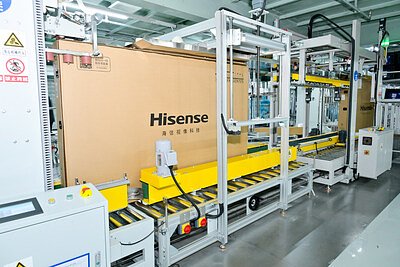
On the factory floor, this translates to remarkable speed. The production of a complex 85-inch television, from start to finish, now follows a 20-second manufacturing cycle, a pace that allows Hisense to meet market demand with agility.
"At Hisense, intelligent manufacturing starts from consumer needs," said Dennys Li, President at Hisense Visual Technology Co., Ltd., in a statement. "By building a human-centric manufacturing system, we translate customer insights into real product value with greater speed and precision."
A Pattern of Pioneering
This latest accolade is not an isolated success but the continuation of a long-term strategic vision. The Qingdao facility is Hisense’s third factory to be admitted into the WEF’s elite Lighthouse Network. This pattern underscores a deep, company-wide commitment to leading the industry in intelligent and sustainable manufacturing.
Previously, the Hisense Hitachi Huangdao factory was recognized as the world's first Sustainability Lighthouse in the Variable Refrigerant Flow (VRF) sector. That facility set its own benchmarks by leveraging AI-driven controls to reduce unit energy consumption by 38% and cut carbon emissions by 47%, equivalent to over 7,500 tons of CO2 annually. It simultaneously boosted labor productivity by 49% and reduced production costs by 35%, proving that environmental responsibility and operational excellence can go hand-in-hand. This broader context demonstrates that Hisense is pursuing a holistic strategy, integrating customer needs, operational efficiency, and sustainability into its core manufacturing DNA.
From Factory Floor to Consumer Living Room
The technological achievements and efficiency metrics, while impressive, ultimately serve a single purpose: to deliver a better product and experience to the consumer. The customer-centric model pioneered at the Qingdao factory directly impacts the televisions people buy and enjoy in their homes.
A 34% faster R&D cycle means the latest advancements in display technology, sound, and smart features reach the market sooner. The ability to rapidly translate customer feedback into product functions ensures that new Hisense TVs are more likely to have the features and user experience that buyers actually want. This agility is a key competitive advantage in a market where technology and consumer preferences evolve quickly.
This manufacturing prowess underpins Hisense’s growing market leadership. The company, which is an official sponsor of the FIFA World Cup 2026™, already ranks number one globally in the burgeoning segment of 100-inch and larger TVs and continues to innovate with technologies like its proprietary RGB MiniLED. By placing the customer at the heart of its most advanced factory, Hisense is not just building electronics more efficiently; it is building a new blueprint for success in the global consumer market.