
- 70% reduction in internal resistance compared to conventional multi-tab cells
- 250A (50C) instantaneous pulse discharge capability
- 1,000 cycles under demanding 30A high-rate discharge
Experts view Highstar's Malaysian tabless battery plant as a strategic move to strengthen its position in the global green energy sector, leveraging advanced technology and regional supply chain advantages.
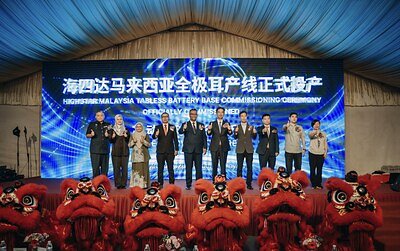
Highstar Ignites Global Battery Race with Malaysian Tabless Plant
KULIM, Malaysia – March 30, 2026 – In a significant move that redraws the map of the global battery supply chain, Chinese battery manufacturer Highstar has officially commenced production at its advanced manufacturing base in Kulim, Kedah. The facility, inaugurated on March 26, marks China's first overseas mass-production line for high-performance tabless cylindrical cells, signaling a new phase of international competition in the green energy sector.
The commissioning ceremony, attended by local dignitaries and global partners, also served as the stage for the global debut of Highstar's INR21700-50PS cell. This new 5.0Ah battery represents the successful transition of sophisticated tabless technology from the laboratory to intelligent mass production, positioning the company to compete in some of the world's most demanding technology markets. The move underscores a broader strategy among leading manufacturers to diversify production beyond domestic borders, seeking supply chain resilience and closer proximity to international customers.
Malaysia as a New Green-Tech Nexus
Highstar's choice of Kulim is a calculated element of its "long-termism" strategy. The company is betting on Malaysia's growing stature as a high-tech manufacturing hub and its favorable business environment. This investment is not merely about building a factory; it's about embedding the company within a burgeoning regional ecosystem for green technology.
"Choosing Kulim reflects our strategic response to global green energy trends and its premium business environment," stated Highstar Chairman Mr. Zhou Wen at the launch event. "This facility is a collaborative platform for global clients and a long-term commitment to Malaysia's industry. We will uphold localized operations and world-class standards to provide highly competitive power solutions."
This sentiment aligns with Malaysia's national ambition to attract foreign direct investment in high-value sectors. By establishing this state-of-the-art facility, Highstar contributes not only to local job creation but also to crucial technology transfer, bolstering Malaysia's position in the highly competitive global battery supply chain. The plant joins Highstar's other overseas operations, including a facility in Thailand, but the Malaysian base is uniquely focused on the company's most advanced tabless cell technology.
A Leap in Battery Performance
The centerpiece of the announcement is the INR21700-50PS cell, a product engineered to break existing performance barriers. The "tabless" design is the core innovation. Unlike traditional cylindrical cells that use small metal tabs to connect the battery's internal layers to its external terminals, a tabless architecture creates a direct connection along the entire edge of the electrode. This dramatically shortens the path for electrons to travel.
The result is a suite of impressive performance metrics. Highstar claims the new cell achieves an internal resistance of less than or equal to 3mΩ—a reduction of over 70% compared to conventional multi-tab cells. This translates to significantly less heat generation during high-power use, enhanced efficiency, and the ability to deliver extreme power. The company states the cell can handle an instantaneous pulse discharge of 250A (50C), a critical capability for power-hungry devices.
Further breakthroughs include:
* A Wide Operational Temperature Range: The cell is rated for stable discharge from a frigid -40°C to a scorching 80°C, opening up applications in extreme environments.
* Efficient Fast Charging: Leveraging a next-generation Silicon-Carbon (SiC) anode, the cell supports 3C fast charging, reaching 80% state of charge in just 15 minutes.
* Ultra-Long Cycle Life: The battery is engineered for durability, achieving 1,000 cycles even under a demanding 30A high-rate discharge, effectively doubling the lifespan of previous-generation cells.
These advancements are built on a foundation of material science, including a co-developed Ni90+ high-energy cathode and the aforementioned SiC anode, all integrated through a revolutionary "point-line-face" 3D conductive network inside the cell.
Targeting High-Stakes Industries
With its robust performance profile, the 21700-50PS is not a one-size-fits-all solution. Highstar is strategically targeting five core sectors where these advanced capabilities can provide a decisive competitive advantage: premium power tools, garden tools, industrial robots and AGVs, automatic identification and data capture (AIDC) devices, and the nascent but highly demanding electric Vertical Take-Off and Landing (eVTOL) vehicle market.
In the power tool market, which is projected to grow at a CAGR of nearly 10% over the next decade, the demand for more power, longer runtime, and faster charging in a cordless format is relentless. Highstar's cell directly addresses these needs. For industrial robotics and automated guided vehicles (AGVs), the long cycle life and reliability are paramount for minimizing downtime and maximizing productivity.
Perhaps the most ambitious target is the eVTOL sector. These "flying cars" require batteries with an unparalleled combination of high energy density for range, extreme power for take-off and landing, and uncompromising safety. The use of a silicon-carbon anode, known for its high energy capacity, makes the 21700-50PS a compelling candidate for aerospace applications where every gram counts.
Navigating a Fiercely Competitive Landscape
Highstar's bold move does not happen in a vacuum. The global battery industry is a hotbed of innovation and intense competition. The tabless architecture, popularized by Tesla's 4680 cell concept, is being pursued by nearly every major player.
Samsung SDI, a market leader, has been mass-producing its own high-power tabless cylindrical cells and claims a 90% reduction in internal resistance for its 46-series batteries. The South Korean giant also utilizes a silicon-carbon anode in its cells, enabling similar 15-minute fast-charging capabilities. Likewise, other Chinese competitors are not standing still. BAK Battery recently unveiled its own tabless 21700 cell with a comparable wide temperature range and low internal resistance, while EVE Energy is also a significant producer of tabless cylindrical cells.
Highstar's establishment of the Malaysian plant is therefore a crucial strategic play. It is not just about technological parity but also about manufacturing scale, global presence, and supply chain control. By being the first Chinese company to establish an overseas mass-production line for this specific technology, Highstar gains a valuable foothold in key international markets, potentially sidestepping geopolitical trade frictions and building a resilient, globalized production network. As the company's chairman noted, production is merely the starting point. With its new Malaysian engine, Highstar is now firmly in the race to power the next generation of technology.