
- 1,000 hours of real-world driving data used to train Helm.ai's urban driving planner, compared to millions of miles by competitors.
- Vision-only approach eliminates need for expensive lidar sensors and high-definition maps.
- Zero-shot generalization allows autonomous navigation in unseen locations without prior training.
Experts would likely conclude that Helm.ai's vision-only, data-efficient approach presents a viable alternative to traditional sensor-heavy autonomous driving systems, though its long-term safety and regulatory acceptance remain to be proven.
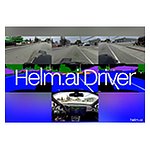
Helm.ai's Vision-Only AI Aims to Break Autonomous Driving's 'Data Wall'
REDWOOD CITY, CA – February 25, 2026 – In a move that challenges the prevailing industry consensus on autonomous vehicle development, AI software firm Helm.ai has announced a significant expansion of its flagship product, Helm.ai Driver. The company claims its production-ready, vision-only software stack can navigate complex urban environments without relying on expensive lidar sensors or high-definition (HD) maps, offering a seamless upgrade path from today’s advanced driver-assistance systems (Level 2+) all the way to fully autonomous Level 4 driving.
To substantiate its claims, the Redwood City-based company released a demonstration video showcasing a vehicle equipped with its software autonomously handling intricate city driving scenarios. The vehicle is seen navigating left and right turns at intersections, complying with complex traffic light patterns, and dynamically interacting with other cars and pedestrians, all supervised by a safety driver. This achievement, according to Helm.ai, represents a viable, cost-effective alternative to the hardware-heavy approaches favored by many competitors in the race to full autonomy.
A New Architecture to Demolish the 'Data Wall'
At the heart of Helm.ai's announcement is its strategy for overcoming what the industry has termed the "Data Wall." This refers to the point of diminishing returns where autonomous systems require exponentially more real-world driving data—often running into millions of miles and petabytes of information—to improve performance on rare or 'edge-case' scenarios. This brute-force data collection is not only prohibitively expensive but has become a major bottleneck for scaling advanced autonomy.
Helm.ai's solution is a proprietary architecture called 'Factored Embodied AI'. Unlike monolithic 'end-to-end' models that process raw pixel data and function as opaque 'black boxes', Helm.ai's system splits the problem into two distinct and interpretable layers: Perception and Policy. The Perception layer first processes raw camera data into a structured, semantic understanding of the world, identifying objects, lane lines, and drivable space in a 3D geometric format. This interpretable output then becomes the input for the end-to-end Policy model, which 'reasons' about traffic rules and makes driving decisions.
This factored approach is critical for two reasons. First, it allows the system to be trained with far greater data efficiency. Second, it provides the transparency and auditability that have been elusive in many AI systems, a crucial feature for achieving the rigorous ISO 26262 safety certification required for Level 3 'eyes-off' and Level 4 fully autonomous systems.
"The industry has reached a tipping point where brute-force data collection is no longer commercially viable for high-end autonomy," said Vladislav Voroninski, CEO and founder of Helm.ai, in the company's press release. "With Helm.ai Driver, we have fundamentally changed the unit economics of scalable autonomy. By delivering a vision-first system that powers advanced Level 2+ today, and serves as the software brain for the transition to Level 3 and Level 4 autonomy, we are providing OEMs with the only realistic path to deploying next-generation autonomy on mass-market compute platforms."
Unsupervised Learning and 'Semantic' Simulation
The company's claims of data efficiency are striking. While competitors have spent billions of dollars and logged millions of miles, Helm.ai states its urban driving planner reached its current maturity using only 1,000 hours of real-world driving data. This efficiency is credited to two core technologies: 'Deep Teaching' and 'semantic simulation'.
'Deep Teaching' is Helm.ai's proprietary unsupervised learning technique. Instead of relying on armies of human annotators to manually label countless hours of video—a costly and time-consuming process—this method enables the AI models to learn directly from vast quantities of unlabeled data, much of it sourced from the internet. This bypasses the traditional annotation bottleneck and allows for training at an immense scale.
This is paired with 'semantic simulation'. Rather than creating computationally expensive, photorealistic virtual worlds to train its AI, Helm.ai trains its Policy model on the underlying 'semantic geometry' of driving scenarios. By focusing on the structural and geometric essence of the world—the layout of roads, the position of cars, the rules of an intersection—the system can run through a virtually infinite number of scenarios with far less computational power. This allows the AI to learn how to handle critical corner cases in a highly efficient simulated environment before being fine-tuned with limited real-world data.
The Vision-Only Gamble in a Sensor-Rich World
Helm.ai's staunch commitment to a vision-only approach places it directly in one of the industry's most heated debates. Proponents, most notably Tesla, argue that since humans drive with their eyes, advanced AI should be able to do the same with cameras, which are significantly cheaper and easier to integrate than other sensors. This strategy dramatically lowers the hardware cost of an autonomous system, making it more viable for mass-market vehicles.
However, the majority of companies developing Level 4 systems, particularly robotaxi operators like Waymo and Cruise, rely on sensor fusion—a combination of cameras, radar, and lidar. Lidar, which uses lasers to create a detailed 3D point cloud of the environment, is prized for its precision and reliability in poor visibility conditions like rain, fog, and darkness, where cameras can struggle. Radar offers robustness in adverse weather as well. Proponents of sensor fusion argue that this redundancy is non-negotiable for achieving the highest levels of safety. This view is gaining traction with regulators, as some jurisdictions like China and safety bodies like the European NCAP are beginning to favor or mandate the inclusion of lidar for higher-level autonomous systems.
By betting on vision, Helm.ai is gambling that its software is powerful enough to overcome the inherent limitations of cameras, providing a level of safety and reliability that can satisfy both automakers and regulators without the added cost and complexity of lidar.
From Theory to Production and 'Zero-Shot' Generalization
Helm.ai is already translating its technology into commercial reality. The company has a multi-year joint development agreement with Honda Motor Co., which also invested in the firm. Helm.ai's software is slated to power the Advanced Driver Assistance Systems (ADAS) in Honda's upcoming 'Zero Series' of electric vehicles, scheduled for a 2026 launch, enabling hands-free driving capabilities.
Perhaps the most significant validation of its software-centric approach is the system's claimed ability for 'zero-shot' generalization. This means the vehicle can navigate effectively in a location it has never seen before, without any specific training data for that area. To prove this, Helm.ai deployed its system in Torrance, California, where it performed autonomous steering, lane changes, and turns at intersections without prior exposure to the city's streets. This ability to generalize across geographies is crucial for any automaker wanting to deploy autonomous features globally without the prohibitive expense of creating unique datasets and maps for every city.
By training its AI on the fundamental principles of driving and road structure rather than memorizing specific routes, Helm.ai aims to create a truly scalable system. This adaptability, combined with its data-efficient training and certifiable architecture, presents a compelling package for automakers looking for a pragmatic path forward in the complex and capital-intensive journey toward a fully autonomous future.