
- AI Integration: PatientGPT connects directly to a patient's electronic medical record, offering personalized health guidance.
- Market Growth: The AI in healthcare market is projected to grow from $15 billion in 2024 to over $110 billion by 2030.
- Human Safety Net: The system escalates to human clinicians when ambiguity or risk is detected, ensuring patient safety.
Experts view PatientGPT as a significant advancement in personalized healthcare, emphasizing its potential to bridge AI and clinical care while maintaining safety and privacy standards.
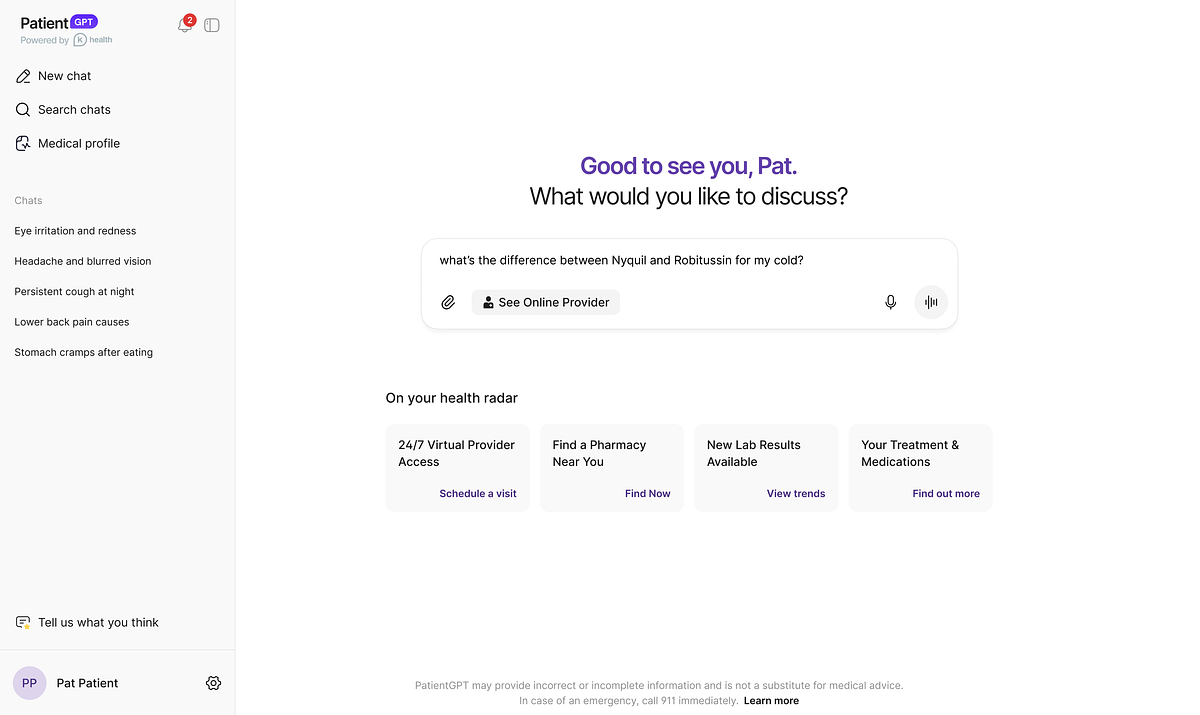
Hartford HealthCare Unveils PatientGPT, an AI Tied to Your Medical Records
HARTFORD, Conn. – March 26, 2026 – Hartford HealthCare, in collaboration with clinical AI company K Health, today announced the launch of PatientGPT, a novel artificial intelligence system designed to give patients a personalized, 24/7 connection to their health information and clinical care team. The new tool, which is being rolled out in a limited beta, integrates directly with a patient's electronic medical record, marking a significant step beyond the generic advice offered by mainstream consumer AI platforms.
A New Frontier in Personalized Health Guidance
As more Americans turn to AI for health queries, the conversations have largely occurred in a vacuum, disconnected from an individual's actual medical history. PatientGPT aims to change that. Accessible through the Hartford HealthCare patient portal and app, the tool is designed to provide personalized education and guidance grounded in each user's secure health data.
Unlike general-purpose chatbots, PatientGPT can help patients interpret their lab results in plain language, ask questions about their health within the context of their specific medical record, and even identify potential interactions between their prescribed medications. The system was developed over nearly a decade of research by K Health, which designed it to understand the complex language of medicine, including symptoms, treatments, and the nuances of real-world health conditions.
"We're on a mission to be the most consumer centric health system in the country," said Jeff Flaks, President & CEO of Hartford HealthCare, in a statement. "So much of healthcare has traditionally been organized around the provider, but it's clear we have to meet people where they are and where they desire to be met." This launch represents a move to provide support that is both technologically advanced and deeply integrated with the established patient-provider relationship.
The AI Assistant with a Human Safety Net
A key aspect of PatientGPT's design is its role as a sophisticated informational bridge, not a replacement for clinicians. The system operates with defined clinical guardrails and does not diagnose, prescribe treatments, or function autonomously. Instead, it is built to ask clarifying questions, surface relevant medical context, and, crucially, escalate to a human clinician whenever ambiguity or risk is detected.
This "human-in-the-loop" model is critical. When a patient's questions move beyond simple information, or if they choose to seek direct medical advice, PatientGPT provides a seamless pathway to connect with Hartford HealthCare clinicians. Options include initiating a virtual visit through the HHC 24/7 virtual care service or scheduling an in-person primary care or specialty appointment. This integrated approach is intended to eliminate the "dead end" experience often associated with standalone health bots that can leave users with information but no clear next step. For clinicians, summaries of these AI-powered conversations can be made available for review, providing valuable context before a visit and helping to streamline routine informational exchanges.
This design also positions the tool carefully within the evolving regulatory landscape. By focusing on education and triage rather than autonomous diagnosis, PatientGPT navigates the complex U.S. Food and Drug Administration (FDA) guidelines for AI/ML-based Software as a Medical Device (SaMD), which place a strong emphasis on safety, transparency, and human oversight.
Balancing Innovation, Privacy, and Trust
Introducing an AI that accesses personal health records inevitably raises questions about privacy and security. Hartford HealthCare and K Health have emphasized that PatientGPT operates entirely within the health system's secure, HIPAA-compliant infrastructure. All interactions are subject to the same stringent privacy and security protections that apply to existing electronic medical records.
Crucially, the organizations have stated that Hartford HealthCare patient data will not be used to train any external AI models. This addresses a major concern in health AI—that sensitive, personal information could be used to improve third-party commercial products. K Health CEO Allon Bloch has previously clarified that their proprietary AI models were trained on data from K Health's own millions of medical consultations and de-identified information from a partnership with the Mayo Clinic, not on data from its health system partners. This creates a clear boundary between the tool's operation and the training of its underlying algorithms.
This careful approach reflects a broader tension in public opinion. While surveys show that a majority of people express concerns about the privacy of their health data with AI, a significant number have already uploaded personal medical information to consumer chatbots, signaling a strong desire for the utility these tools promise. PatientGPT's model attempts to provide that utility within a trusted, secure healthcare environment.
A Strategic Partnership in a Burgeoning Market
The collaboration between Hartford HealthCare, a sprawling regional health system, and K Health, a well-funded AI innovator, exemplifies a key trend in the health tech industry. It represents a strategic bet that the future of healthcare lies in deeply integrated partnerships between established providers and agile technology firms.
For Hartford HealthCare, PatientGPT is not a standalone experiment but part of a broader, system-wide strategy to embrace artificial intelligence. The organization recently launched New England's first Center for AI Innovation in Healthcare to spearhead collaborations and ensure the safe and ethical deployment of AI. This initiative, along with existing AI-driven projects to optimize hospital operations, shows a deep commitment to leveraging technology to enhance access, quality, and affordability.
The launch comes as the market for AI in healthcare is poised for explosive growth, with some analysts projecting the market to grow from around $15 billion in 2024 to over $110 billion by 2030.
"We are at an inflection point in healthcare," stated Allon Bloch, CEO and Co-Founder of K Health. "The question isn't whether AI will shape healthcare, it's about how we do it in a safe, transparent way, inside a health system that connects to your medical records and your care team. PatientGPT represents that turning point." The beta launch in Connecticut will be closely watched as a test case for whether this new model of integrated AI can deliver on its promise to empower patients, support clinicians, and redefine the digital front door to healthcare.