
- €90 million investment: Haier Energy secured €90M in A-round funding for European expansion.
- -20°C reliability: E-Tower Ultra operates reliably in extreme cold temperatures.
- SiC technology: 150 kW PV inverter uses silicon carbide for higher efficiency.
Experts would likely conclude that Haier's strategic pivot into Europe's energy sector, backed by substantial investment and smart-home expertise, positions it as a formidable competitor in the decarbonization and energy management space.
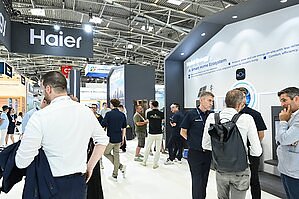
Haier's Gambit: From Smart Appliances to Powering Europe's Energy Future
MUNICH, GERMANY – June 23, 2026 – At this year's Intersolar Europe exhibition, a familiar name in households worldwide made a formidable debut in a new arena. Haier, the global appliance and consumer electronics behemoth, has officially planted its flag in the continent's complex energy landscape through its subsidiary, Haier Energy. The unveiling of a comprehensive portfolio of residential and commercial energy solutions is far more than a simple product launch; it represents a calculated, well-funded strategic pivot into a sector grappling with volatility, regulatory pressure, and an urgent need for decarbonization.
While dozens of companies showcased incremental improvements to solar panels and batteries, Haier Energy presented a complete ecosystem—integrating solar generation, storage, and AI-driven management. This move signals an ambition not just to compete, but to leverage its massive manufacturing scale and deep smart-home expertise to reshape how European homes and businesses consume and manage power.
A Calculated Entry into a Crowded Market
Haier Energy’s arrival is no speculative venture. It is the culmination of a deliberate strategy backed by significant capital and the parent company's extensive European infrastructure. In April 2025, the energy division secured over €90 million in A-round funding explicitly earmarked for overseas expansion, with Europe as the primary target. This financial muscle allows the company to enter a competitive market—populated by established German engineering firms and agile Asian tech giants—with the resources to build a robust local presence.
The strategy appears to be a “dual-drive” approach, simultaneously targeting the residential and the commercial & industrial (C&I) sectors. This isn't just about selling hardware; it's about embedding the Haier ecosystem into the fabric of European energy consumption. The company is leveraging the Haier Group’s existing success in the region, where its home appliance division has seen remarkable growth and aims to be a top-three player by 2026. This established brand recognition and distribution network provide a critical launchpad, de-risking market entry and offering a pre-built channel to millions of consumers.
Furthermore, this move aligns with the parent company's broader sustainability commitments. Haier Europe has already achieved its goal of sourcing 60% of its energy from renewables and is pursuing aggressive science-based targets for emissions reduction. By offering solutions that help its customers decarbonize, the company creates a powerful narrative loop, reinforcing its brand identity as a leader in both smart technology and sustainable living.
Redefining the Smart Home Power Plant
For the residential market, Haier Energy is moving beyond discrete components and toward a unified home energy platform. The flagship product, the E-Tower Ultra, is an all-in-one residential energy storage system (ESS) that embodies this philosophy. Its cable-free, modular architecture is a direct response to a key industry pain point: installation complexity. By simplifying the physical setup, the company aims to lower costs for installers and reduce friction for homeowners.
Beneath the surface, the system integrates sophisticated technology designed for real-world European conditions. Its ability to operate reliably in temperatures down to -20°C addresses climate realities, while built-in active fire protection technology confronts the safety concerns that can hinder consumer adoption of battery storage. An optional whole-home backup module provides the energy resilience that has become a top priority for households facing the threat of grid instability.
The true intelligence of the system, however, lies in the HEnvision AI platform. This software layer analyzes real-time electricity tariffs, weather forecasts, and a household's unique consumption patterns to automate charging and discharging. For a homeowner, this translates directly into quantifiable savings. The system can autonomously charge the battery when grid electricity is cheap or solar generation is abundant, and discharge it to power the home during expensive peak hours. This proactive energy arbitrage, managed by an AI, represents a significant step up from the more static schedules of earlier-generation systems and leverages the expertise Haier has already developed with its hOn smart appliance app.
Industrial-Grade Innovation: The Push for SiC and AI Safety
On the commercial and industrial front, Haier Energy is targeting the complex needs of manufacturing facilities, industrial parks, and commercial buildings with a solution focused on efficiency, safety, and long-term asset protection. The centerpiece of this offering is a new 150 kW PV inverter that showcases a meaningful technological leap: the integration of third-generation silicon carbide (SiC) semiconductors.
For leaders focused on execution over hype, this is a critical detail. Compared to traditional silicon, SiC technology offers fundamentally better performance in high-power applications. It enables higher conversion efficiency by reducing energy losses during the DC-to-AC power conversion, meaning more of the sun's energy makes it to the factory floor. SiC's superior thermal properties also allow for more compact, reliable inverters that generate less waste heat, reducing the need for complex and failure-prone cooling systems. This translates into higher energy yields, lower operational costs, and greater long-term reliability for a critical industrial asset.
The inverter's design also features eight independent Maximum Power Point Tracking (MPPT) channels, a feature that maximizes energy harvest from large, complex solar arrays that may have panels facing different directions or experiencing variable shading. For a business, this meticulous optimization of energy yield directly impacts the return on its renewable energy investment.
Safety, a paramount concern in industrial settings, is addressed through an AI-enabled Arc Fault Circuit Interrupter (AFCI). Standard AFCIs are designed to prevent fires by detecting dangerous electrical arcs. By adding an AI layer, Haier aims to improve detection accuracy, reduce costly nuisance trips, and provide smarter diagnostics—turning a simple safety device into an intelligent risk-management tool. This, combined with real-time monitoring of DC terminal temperatures, provides a multi-layered defense against operational hazards.