
- 95% accuracy: GreyMatter Foundry claims over 95% accuracy in simulating warehouse automation strategies.
- 130,000 agents: The platform leverages data from GreyOrange’s Certified Ranger Network (CRN) of over 130,000 global agents.
- 1 million optimizations per minute: The GreyMatter orchestration platform performs over 1 million optimizations per minute, enhancing predictive reliability.
Experts view GreyMatter Foundry as a game-changing tool for de-risking warehouse automation investments, offering unparalleled predictive accuracy and ROI analysis through real-world data integration.
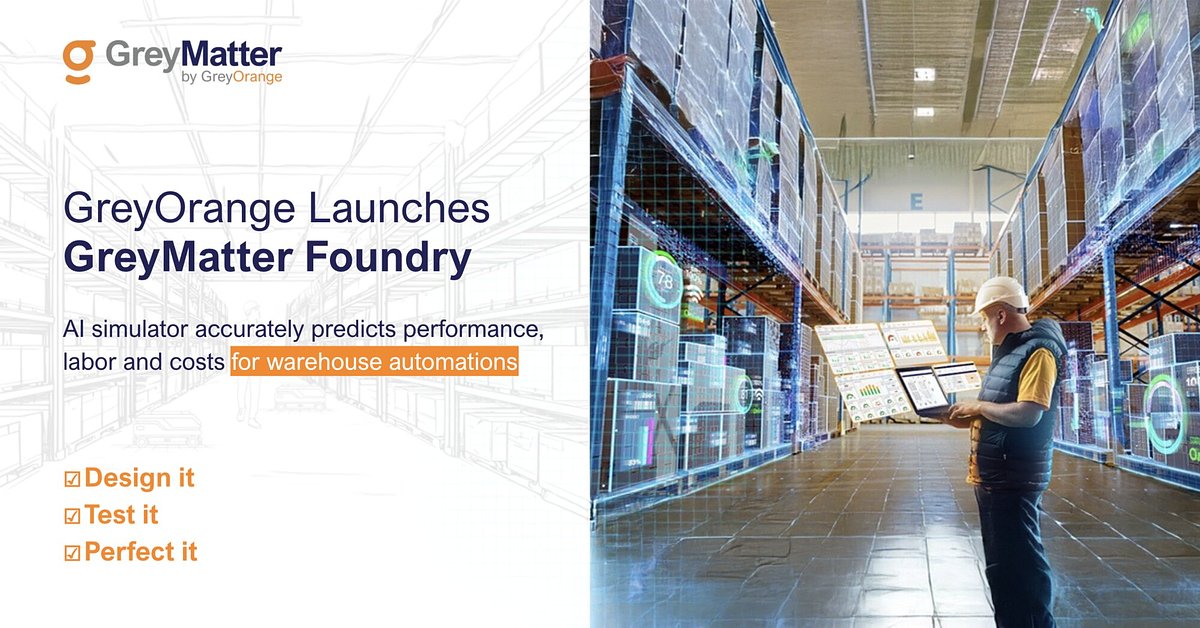
GreyOrange Unveils AI 'Crystal Ball' to De-Risk Warehouse Automation
ATLANTA, GA – April 13, 2026 – GreyOrange, a prominent firm in AI-powered warehouse orchestration, today announced the launch of GreyMatter Foundry, an immersive AI simulation platform designed to give supply chain leaders a high-fidelity preview of their automated future. The new tool aims to eliminate the guesswork and financial risks associated with modernizing fulfillment centers by allowing businesses to design, test, and validate complex automation strategies in a virtual environment with what the company claims is over 95% accuracy.
The launch addresses a critical pain point in the logistics industry, where multi-million dollar investments in robotics and automation can feel like a leap of faith. By unifying warehouse flow design, technology sizing, and layout planning into a single platform, GreyMatter Foundry enables customers to predict total system performance, estimate build-out costs, and visualize how fleets of robots and human workers will operate in harmony before committing significant capital.
“Warehouse automation should not be a leap of faith,” said Saurabh Gupta, CTO for GreyOrange, in a statement accompanying the announcement. “By putting the intelligence of our live, global GreyMatter network behind every simulation, we give distributors, 3PL’s, retailers and integrators a crystal ball grounded in real-world data.”
Bridging the Gap Between Blueprint and Reality
The decision to automate a warehouse is fraught with complexity. Companies face a dizzying array of choices in robotic hardware, software systems, and operational workflows. Integrating these new technologies with legacy enterprise resource planning (ERP) and warehouse management systems (WMS) often proves to be a significant technical hurdle. A miscalculation in design or an underestimation of peak season demand can lead to crippling bottlenecks, underutilized assets, and a failed return on investment.
GreyMatter Foundry is engineered to mitigate these risks by creating a 'digital twin' of a proposed or existing facility. Within this virtual space, logistics managers can run thousands of simulations in parallel, exploring an array of potential outcomes. Users can model the impact of labor shortages, plan staffing for peak periods like Black Friday, predict storage requirements for seasonal inventory, and test different layouts to achieve specific throughput goals.
The platform provides detailed 3D visualizations and walkthroughs, allowing stakeholders to see and understand the flow of goods and the interaction of various automated agents. This capability moves planning from static spreadsheets and theoretical diagrams to a dynamic, data-rich environment. By stress-testing designs against future growth scenarios and unexpected disruptions, businesses can arrive at deployment day with a much higher degree of confidence.
The Power of a Heterogeneous Digital Twin
While warehouse simulation software is not a new concept, with established players like FlexSim and AnyLogic offering powerful modeling tools, GreyOrange is differentiating Foundry through its specific focus on heterogeneous environments and its foundation in live operational data. Unlike traditional toolsets that may be limited to a single vendor's hardware, Foundry allows users to model an unlimited number of robotic agent types from different manufacturers, working alongside human-led processes, all within the same simulation.
This is crucial in today's landscape, where a 'best-of-breed' approach to automation is common. A modern warehouse might use autonomous mobile robots (AMRs) from one company, robotic picking arms from another, and automated storage and retrieval systems (AS/RS) from a third. Foundry aims to be the unifying brain that can predict how this diverse collective will perform together.
The platform’s predictive power is amplified by what the company calls the “CRN Advantage.” Foundry draws on the immense dataset generated by GreyOrange’s live GreyMatter orchestration platform, which manages a Certified Ranger Network (CRN) of over 130,000 agents globally. This network performs over 1 million optimizations per minute, providing a deep well of real-world data on robot performance, travel times, and task execution. By grounding its simulations in this live data, Foundry can achieve a level of predictive reliability that, according to industry analysts, sets a new standard for accuracy.
“Tools that allow for robust, predictive 'what-if' analysis are no longer a luxury; they are becoming essential for survival and competitive advantage in modern logistics,” noted one independent supply chain consultant. “The ability to accurately model a multi-vendor robotic ecosystem before you buy is a genuine game-changer.”
Quantifying ROI in an Uncertain Future
For C-suite executives, the most compelling feature of any new technology is its ability to deliver a clear return on investment. GreyMatter Foundry is positioned as a strategic financial tool as much as an operational one. By simulating different combinations of automation and labor, the platform can generate detailed ROI calculations and help businesses identify the most cost-effective path to achieving their performance targets.
An AI-powered Design Copilot further simplifies this process. Users can employ simple conversational prompts or pre-set templates to guide the simulation, asking the system to recommend solutions for specific throughput requirements or budget constraints. The platform can then analyze which mix of robotic agents and labor will meet demand cycles not just for today, but for five and ten years down the road, effectively future-proofing the investment.
This long-term planning capability is vital in an industry characterized by volatility. The simulations can account for potential labor challenges, rising operational costs, and shifting consumer demand, enabling businesses to build more resilient and adaptable supply chains. By identifying potential bottlenecks and inefficiencies in the virtual world, companies can save millions in costly retrofits and operational disruptions in the real world.
Reshaping the Future of Supply Chain Planning
The launch of advanced simulation platforms like GreyMatter Foundry signals a broader shift in how the entire logistics industry approaches planning and strategy. The era of reactive problem-solving is giving way to a new paradigm of proactive, data-driven optimization. The ability to create a highly accurate, dynamic model of future operations transforms capital expenditure from a high-risk gamble into a calculated strategic decision.
This evolution mirrors the rise of digital twins in manufacturing and aerospace, where virtual models are used to test, refine, and perfect complex systems before they are ever built. By bringing this level of sophistication to the warehouse floor, companies can not only enhance efficiency but also improve workforce management. Simulations can help optimize human-robot collaboration, identifying tasks best suited for each and designing workflows that are safer and more productive for human associates.
As supply chains become more complex and global pressures continue to mount, the ability to see around the corner is no longer just a competitive advantage—it is a necessity. With tools like GreyMatter Foundry, the industry is moving one step closer to a future where every warehouse is optimized for performance, resilience, and profitability before the first wall is ever constructed.