
- 80 petabytes: The size of the newly deployed high-density digital archive for a U.S. government agency.
- 3,200 drives: The number of Western Digital Ultrastar DC HC590 26TB SAS hard drives used in the system.
- 132 PODs: The modular units (JetStor XS3324D 4U 24-bay systems) that compose the entire storage architecture.
Experts would likely conclude that this deployment sets a new standard for secure, scalable, and cost-efficient long-term data storage in the public sector, addressing critical challenges in national security and governance infrastructure.
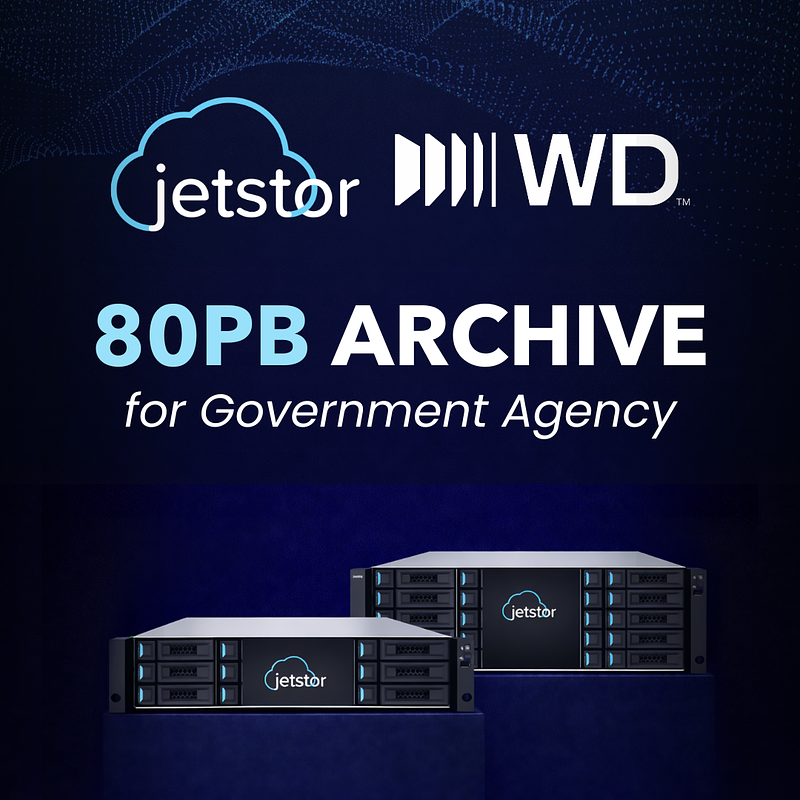
Gov't Secures 80 Petabyte Digital Archive with New Modular Storage System
PITTSBURGH, PA – March 30, 2026 – In a monumental feat of data engineering, storage solutions provider JetStor has successfully deployed an 80-petabyte (PB) high-density archive for a major, undisclosed U.S. government agency. The deployment, one of the largest of its kind in the public sector, provides a secure, on-premises fortress for the nation's critical long-term data, leveraging a sophisticated modular design and high-capacity drives from Western Digital (WD).
This massive undertaking addresses a core challenge for modern governance: how to economically and securely manage an ever-expanding universe of digital information. From historical records and scientific research to surveillance footage and regulatory data, government agencies are bound by strict retention and security policies, creating a relentless demand for storage that is not only vast but also resilient, compliant, and accessible for decades to come.
The Silent Infrastructure of National Security and Governance
While headlines often focus on software and cyberattacks, the physical infrastructure that underpins government data is a silent, critical component of national security and operational continuity. The 80PB JetStor archive represents the bedrock of this unseen infrastructure, built to meet rigorous security demands for long-term data retention at a scale that is difficult to comprehend—equivalent to trillions of pages of text or millions of hours of high-definition video.
Public-sector IT teams operate under a unique set of pressures. They must contend with exponential data growth while navigating tight budgets and strict procurement processes. Furthermore, the sensitive nature of government data often necessitates on-premises solutions, where agencies retain full physical and sovereign control, as opposed to relying solely on public cloud services. This deployment is a prime example of that necessity, providing a dedicated, isolated environment to protect vital information.
Security and compliance are non-negotiable. Such systems must adhere to stringent federal standards, such as those outlined by the National Institute of Standards and Technology (NIST) and Federal Information Processing Standards (FIPS), which govern everything from cryptographic modules to data sanitization. JetStor’s long history as a GSA-contract holder suggests a deep familiarity with these requirements. The architecture’s use of a dual Fibre Channel fabric provides an additional layer of security through "fabric isolation," ensuring data pathways are segregated and protected from the primary production network, minimizing attack surfaces and safeguarding data integrity.
A Blueprint for Zero-Downtime, Petabyte-Scale Growth
The key to successfully implementing an 80PB system without disrupting ongoing operations lies in its innovative architecture. JetStor developed a "zero-downtime POD blueprint," a standardized and repeatable modular design that transforms the daunting task of scaling into a predictable, manageable process. This approach directly counters the common pitfalls of large-scale deployments, where expansion can lead to costly downtime and operational chaos.
“When a government agency reaches this scale, the architecture has to be predictable from day one and stay serviceable as it grows,” said Gene Leyzarovich, Founder of JetStor, in the official announcement. “We standardized the deployment into repeatable POD building blocks and paired them with WD 26TB Ultrastar drives to deliver an active archive that scales cleanly, stays isolated on Fibre Channel, and remains straightforward to operate.”
Each "POD," or building block, is a self-contained unit of storage. The entire system is composed of 132 JetStor XS3324D 4U 24-bay systems, which act as the chassis for the immense capacity. This modularity means that as the agency’s data continues to grow, new PODs can be seamlessly integrated into the dual Fibre Channel fabric without taking the existing archive offline. This ensures continuous serviceability and allows IT staff to manage the infrastructure without extensive retraining, a significant operational and financial benefit.
The Economic and Technological Bedrock of a Digital Archive
At the heart of this massive archive are 3,200 WD Ultrastar DC HC590 26TB SAS hard drives. The choice of these enterprise-class drives is pivotal. In an era where flash storage dominates performance-tier conversations, high-capacity, high-reliability spinning disks remain the undisputed king for cost-effective, long-term archival storage. These drives are specifically engineered for data center environments, prioritizing storage density, power efficiency, and long-term reliability over raw speed.
WD's Ultrastar drives incorporate advanced technologies like OptiNAND to maximize storage density within the traditional 3.5-inch form factor. This allows system builders like JetStor to pack more petabytes into a smaller physical footprint, reducing the total cost of ownership (TCO) by saving on data center space, power, and cooling.
“Across both public and private sectors, the exponential growth of data is driving the need for storage solutions that deliver durability, predictable performance, and cost-efficient capacity at scale,” noted Dan Christman, Senior Vice President of Product Management and Emerging Businesses at WD. His statement underscores the market-wide trend that this project exemplifies.
The collaboration between JetStor, the system integrator, and WD, the component manufacturer, showcases a holistic approach to solving grand-challenge data problems. By pairing an intelligent, scalable architecture with the latest in high-density drive technology, the project delivers an 80PB archive that is not just large but also economically sustainable and operationally sound for the long horizon it is designed to serve. This strategic investment provides the government agency with a durable and secure foundation for its digital memory, ensuring that critical data remains protected and accessible for generations to come.