
- 5,500 metric tons: Annual carbon emissions reduction from the Ordos Zero-Carbon Airport Project
- 5.5 million kWh: Annual electricity consumption reduction at the same project
- 350kW: Capacity of each of the 18 customized high-performance evaporators supplied by Güntner for the project
Experts view Güntner's integration of digital controls, advanced heat pumps, and natural refrigerants as a critical step toward achieving carbon neutrality in Asia's cooling sector, aligning with global decarbonization trends and regulatory mandates.
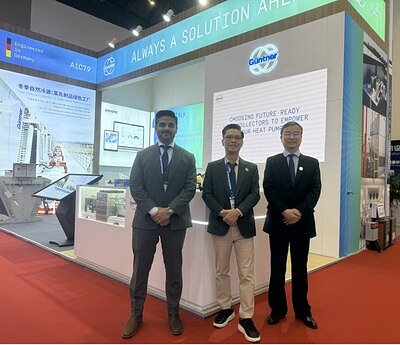
Güntner Drives Asia's Green Cooling Shift with Digital Tech
BEIJING, China – April 09, 2026 – As the global push for decarbonization intensifies, the refrigeration and air conditioning industry stands at a critical juncture, particularly in the rapidly developing Asia-Pacific region. At the recent China Refrigeration 2026 exhibition, a premier summit for the industry, German heat exchange specialist Güntner offered a compelling vision for a sustainable future, showcasing a powerful trifecta of digital controls, advanced heat pumps, and natural refrigerant technologies that signal a profound shift in how the continent cools itself.
The exhibition, held from April 8-10 in Beijing, centered on the theme "Empower refrigeration and heat pump with digital intelligence for a new chapter of carbon neutrality." This focus resonated deeply with Güntner's strategic direction, as the company leveraged the platform to demonstrate practical, market-ready solutions aimed at enhancing energy efficiency, reducing environmental impact, and providing customers with unprecedented operational control. The technologies on display were not merely conceptual; they represented a tangible roadmap for tackling the dual challenges of climate change and rising energy demands across diverse industrial and commercial sectors.
Smarter Cooling Through the Cloud
At the heart of Güntner's digital strategy is its aicore™ Controls & IoT Solutions platform, a system designed to serve as the intelligent nerve center for modern cooling equipment. Already deployed in several projects across Asia, the platform integrates the company's established controllers for air and water management into a cohesive, data-driven ecosystem. The recent launch of the aicore™ Cloud adds a crucial layer of remote monitoring and analytics, enabling full lifecycle management of Güntner's outdoor equipment from anywhere in the world.
This move taps into a powerful industry-wide trend toward smart HVACR systems, where IoT and AI are no longer niche features but essential tools for optimization. The Asia-Pacific smart HVAC market is projected to see significant growth, driven by urbanization and stringent government mandates for energy efficiency. Competitors like Johnson Controls and Carrier are also heavily investing in their own digital platforms, making the field intensely competitive.
Güntner's value proposition, as articulated by its regional leadership, centers on tangible outcomes. "From controllers to IoT solutions, aicore™ is a platform that makes cooling smarter and operations smoother," said Mr. Nguyen Hong Quang, Güntner's Sales Director for Southeast Asia, Japan, and Korea, during the exhibition. "For them, it's not just about reducing labor costs—it's about optimizing system performance through data-driven insights. That means lower energy consumption, longer equipment life, and ultimately, the operational certainty that our customers value most." This focus on data-backed reliability and efficiency is proving critical for businesses looking to future-proof their operations against rising energy costs and environmental regulations.
Heat Pumps and the Path to Zero Carbon
Beyond digital controls, Güntner prominently featured its innovations in heat pump technology, a cornerstone of the global energy transition. The company's showcase went beyond theoretical benefits, highlighting a landmark project that serves as a powerful proof-of-concept for large-scale decarbonization: the Ordos Zero-Carbon Airport Project.
Completed in late 2025, the sustainability upgrade at Ordos Ejin Horo Airport in China represents a pioneering effort to achieve net-zero emissions. Led by Peking University, the project replaced conventional systems with CO₂-based heating and cooling technology powered entirely by local photovoltaic generation. The results are striking, with projections showing an annual reduction of 5,500 metric tons of carbon emissions and 5.5 million kilowatt-hours of electricity consumption.
Güntner played a pivotal role in this achievement, supplying 18 customized high-performance evaporators. Manufactured at the company's facility in Indonesia, each unit delivers 350kW of capacity and is engineered to operate reliably in harsh conditions, with ambient temperatures dropping as low as -12°C. This project underscores the viability of CO₂ heat pumps in demanding climates and complex applications.
"Through close collaboration between our local technical team and our German colleagues, Güntner has built extensive hands-on experience in CO₂ heat pump technology," noted Mr. Youde Xiao, General Manager of Greater China. "We're well-positioned to support more customers on their journey toward a low-carbon future." The Ordos project, which also involved transcritical CO₂ units from Haier Carrier, illustrates a collaborative ecosystem approach to tackling major infrastructure challenges.
Natural Refrigerants: A Sustainable Answer for Hot Climates
Completing its sustainability showcase, Güntner emphasized its commitment to natural refrigerants, a critical component of its 2030 sustainability goals. As the industry phases down high-GWP synthetic refrigerants under the Kigali Amendment, alternatives like ammonia (NH₃) and carbon dioxide (CO₂) are gaining significant traction. The Asia-Pacific natural refrigerant market is experiencing robust growth, with countries like China and India leading the charge, supported by new national regulations that will soon ban certain HFCs in new equipment.
For Southern Asia, where high ambient temperatures and a booming agricultural and food processing sector create immense demand for refrigeration, natural refrigerants offer a compelling efficiency advantage. Ammonia, in particular, demonstrates excellent thermodynamic properties in hot climates, making it ideal for large-scale industrial cooling. However, its toxicity and flammability have historically presented challenges, requiring specialized system design and stringent safety protocols.
Güntner is addressing these hurdles head-on through dedicated research and development aimed at reducing the required refrigerant charge in natural systems and engineering new, more efficient tube geometries. This focus on practical innovation makes advanced, sustainable technology more accessible and safer for a broader market.
"Güntner is committed to helping customers in the agricultural and food processing sectors reduce operating costs through natural refrigerant technologies," explained Mr. Anuj Bedi, Sales Director for Southern Asia. He highlighted the company's comprehensive product range, from blast freezers to air coolers, designed to provide flexible and efficient solutions for everything from processing rooms to large cold storage facilities. This tailored approach is essential for meeting the unique demands of high-temperature environments across the region.
The company's presence at China Refrigeration 2026 was more than a product showcase; it was a clear statement of intent. By integrating digital intelligence with proven, sustainable hardware, Güntner is not only keeping pace with industry giants like Daikin and Trane Technologies but is also carving out a distinct identity as a key enabler of the green transition in one of the world's most dynamic markets. The innovations on display in Beijing provide a clear glimpse into the future of cooling—a future that is smarter, cleaner, and more efficient for the entire Asia-Pacific region.