
- 20% of global oil supply disrupted due to Gulf War III
- Spare capacity now at 0%, eliminating the traditional shock absorber for oil markets
- Brent crude spiked to $119.50 per barrel amid extreme market volatility
Experts warn that the simultaneous supply and buffer shock from Gulf War III has pushed the global energy system into uncharted territory, with no immediate solutions to prevent severe economic fallout.
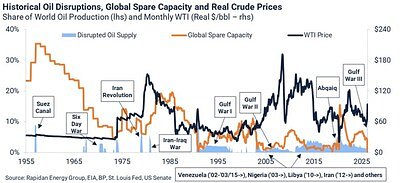
Global Oil Supply Collapses as Gulf War III Zeros Out Spare Capacity
WASHINGTON, DC – March 09, 2026 – The global economy is confronting its most severe energy crisis in history, as a new analysis confirms the ongoing 'Gulf War III' has not only disrupted a staggering 20% of the world's oil supply but has also completely eliminated the spare production capacity that has cushioned every major oil shock for the last 70 years.
A sobering report released today by Rapidan Energy Group, a respected Washington-based consultancy, details a market catastrophe unfolding in real-time. For nine consecutive days, the conflict—which escalated in late February involving US-Israeli strikes on Iran and retaliatory actions across the Gulf—has effectively sealed the Strait of Hormuz, a chokepoint for one-fifth of global petroleum. The result is a supply disruption more than double the size of any previous event, including the infamous Suez Crisis of 1956.
“This is not a demand shock. It is a simultaneous supply and buffer shock,” Rapidan Energy Group stated in its findings. The firm, headed by former White House energy advisor Bob McNally, warns that the conflict has disrupted both production flows and the spare capacity that markets rely upon to offset such events. This dual shock has pushed the global energy system into uncharted and perilous territory.
A Market Without a Shock Absorber
What makes this crisis uniquely dangerous is the complete evaporation of the global oil market's safety net. In every major past disruption—from the 1973 Arab Oil Embargo to the first Gulf War in 1990—the world could rely on 'spare capacity,' primarily held by Saudi Arabia and other Gulf producers, to ramp up production and stabilize prices. That mechanism is now broken.
The conflict zone directly encompasses the very nations that held this buffer. With the Strait of Hormuz impassable due to the threat of missile and drone attacks, producers like Saudi Arabia, the UAE, Kuwait, and Iraq have been forced to slash production as their domestic storage facilities reach maximum capacity. They cannot export their crude, effectively taking millions of barrels of both primary and spare production offline.
Rapidan's historical data paints a stark picture of this new reality:
- Suez Crisis (1956-57): Disrupted ~10% of world supply, but spare capacity stood at a massive ~35%.
- Arab Oil Embargo (1973): Disrupted ~7% of world supply, with ~8% spare capacity available.
- Gulf War III (2026): Has disrupted ~20% of world supply, with available spare capacity now at an effective 0%.
“The primary holders of spare capacity – Saudi Arabia and the UAE – have been cut off from global oil markets, effectively eliminating the industry's traditional shock absorber,” the report concludes. This means there is no swing producer positioned to step in and alleviate the shortfall. The standard playbook for analyzing and responding to oil crises no longer applies.
The Specter of Demand Destruction
The immediate market reaction has been violent. Brent crude, the international benchmark, rocketed from around $70 per barrel before the conflict to briefly touch $119.50 on March 9. While prices have shown extreme volatility, the underlying pressure remains immense. Global stock markets have tumbled, with Asian and European indices posting significant losses as investors brace for the economic fallout.
With no supply-side relief in sight, analysts agree that the global oil market will be forced to balance through the painful mechanism of 'demand destruction.' This economic term describes a brutal process where prices rise so high that they force consumers and industries to slash their consumption. It means businesses cutting back operations, supply chains seizing up, and households facing excruciating choices as the cost of fuel, heating, and goods skyrockates.
Historical precedents from the 1970s and 2008 show that such severe oil price shocks are often precursors to global recessions, hitting lower-income households the hardest and fueling widespread inflation. The surge in energy prices is already rippling through the aviation and shipping industries, with thousands of flights grounded and logistics networks in chaos.
A Desperate Search for Solutions
World leaders are scrambling to formulate a response. The International Energy Agency (IEA), after initial hesitation, joined G7 nations in calling for a massive, coordinated release of strategic petroleum reserves (SPR). Reports suggest a release of up to 400 million barrels is being considered to temper the price surge. However, experts caution that while such a release can provide a temporary bridge, it is a finite resource and ultimately insufficient to replace the 20 million barrels per day of crude now missing from the market.
Meanwhile, the United States is reportedly weighing more direct action, including waiving sanctions and potentially using the U.S. Navy to escort tankers through the Strait of Hormuz—a move fraught with risk of further escalating the military conflict. Other nations, like India, have been forced to seek alternative supplies, including increased purchases of Russian oil.
For now, the world's energy security rests on a razor's edge. Without a swift diplomatic resolution that reopens the Strait of Hormuz, the global economy is staring down the barrel of a protracted energy crisis defined by cripplingly high prices and the severe economic pain required to destroy demand on a scale never seen before.