
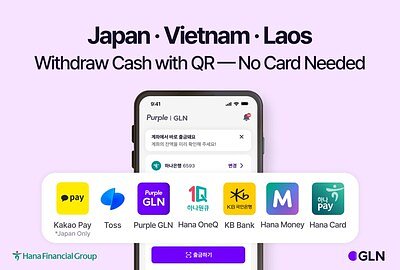
- 7 connected Korean apps now enable QR cash withdrawals in Japan, including Kakao Pay, Toss, and Hana Money.
- QR-based withdrawal fees in Thailand were ~66% lower than conventional ATM withdrawals.
- 36 million Kakao Pay users in South Korea can now access the service in Japan.
Experts view GLN's expansion as a strategic move to create a seamless, borderless payment ecosystem in Asia, enhancing traveler convenience while fostering economic integration through digital finance.
GLN Expands QR Cash Service, Unlocking Cardless Travel in Asia
SEOUL, South Korea – April 28, 2026 – International travel throughout Asia is undergoing a significant digital transformation as GLN International, a fintech subsidiary of South Korea's Hana Financial Group, announced a major expansion of its overseas QR cash withdrawal services. The move now allows travelers in Japan, Vietnam, and Laos to withdraw local currency directly from ATMs using popular mobile payment apps, effectively eliminating the need for physical debit cards and traditional currency exchange.
The expansion is set to dramatically simplify financial transactions for a new generation of tech-savvy tourists, particularly the millions of South Koreans who travel to these popular destinations annually. This development signals a major step in the creation of a seamless, borderless payment ecosystem across the continent.
The Traveler's Wallet Goes Digital
For many travelers, the hassle of securing foreign currency or the fear of exorbitant ATM fees has long been a source of anxiety. GLN's service aims to replace these pain points with a simple, secure, and cost-effective digital solution. Travelers visiting Japan can now walk into one of thousands of 7-Eleven convenience stores or airports, scan a QR code on a Seven Bank ATM screen with their smartphone, and withdraw Japanese Yen using one of seven connected Korean apps, including the powerhouse Kakao Pay, Toss, and Hana Money.
This cardless functionality is a game-changer. It not only enhances convenience but also security, as travelers no longer need to carry multiple physical cards that can be lost or stolen. The process leverages the user's familiar home-country app, with authentication often secured by biometrics or a one-time password, adding a robust layer of protection.
Beyond convenience, the economic benefits for the user are substantial. Traditional overseas card withdrawals often come with a cocktail of hidden costs, including high transaction fees from both the local ATM operator and the user's home bank, coupled with unfavorable exchange rates applied through Dynamic Currency Conversion (DCC). GLN's model aims to disrupt this by offering more transparent, real-time exchange rates and significantly lower fees. For instance, in Thailand, where GLN previously launched a similar service, QR-based withdrawal fees were found to be roughly two-thirds lower than those of conventional ATM withdrawals—a level of savings now anticipated in Japan, Vietnam, and Laos.
A Strategic Play for a Borderless Asia
This expansion is more than just a new feature; it is a calculated move in GLN International's broader strategy to build what could be called a 'Digital Silk Road' for payments across Asia. As a leading cross-border payment infrastructure provider, the company is methodically connecting financial ecosystems, aiming to make digital payments as fluid across borders as they are within them.
Travelers to Vietnam and Laos can now access local currency at BIDV and BCEL ATMs, respectively, using six of GLN's partner apps. This strategic selection of ATM networks ensures wide coverage in key urban and tourist areas. The inclusion of Kakao Pay, with its more than 36 million users in South Korea, for the Japan service is particularly significant, tapping into the massive flow of Korean tourists to their number one preferred travel destination.
Suk Lee, CEO of GLN, articulated this vision in the company's announcement. "With the expansion of QR cash withdrawal services across Japan, Vietnam, and Laos, more travelers can now conveniently withdraw cash overseas using familiar domestic apps," he stated. "We will continue to lead in delivering simple withdrawal experiences that eliminate the need for currency exchange or physical cards."
GLN's ambition is not confined to Asia. The company has already forged partnerships with financial platforms in other regions, including Moreta Pay in North America and the DeCard App in Singapore, signaling its intent to build a truly global network.
Navigating a Dynamic Fintech Landscape
The successful rollout of this service is a testament to GLN's ability to navigate complex regulatory environments and form crucial local partnerships. In Vietnam, the expansion goes beyond ATM withdrawals. GLN has partnered with the National Payment Corporation of Vietnam (NAPAS) to integrate directly into VietQR Global, the country's national QR payment infrastructure. This deep integration, which received approval from the State Bank of Vietnam, allows travelers using GLN-connected apps to make QR payments at a vast network of merchants across the country, from Da Nang to Ho Chi Minh City.
This collaborative approach—working with, rather than against, national payment systems—gives GLN a powerful competitive advantage. It ensures broad acceptance and regulatory compliance, positioning the service for long-term success. In Japan, the partnership with Seven Bank provides unparalleled physical access, while Kakao Pay's separate integration with the PayPay merchant network further solidifies the digital payment footprint for Korean visitors.
While regional giants like Alipay and WeChat Pay have long dominated the cross-border QR payment space, GLN's strategy of focusing on a coalition of national payment apps and deep banking partnerships presents a formidable alternative, particularly for the intra-Asian travel market.
The Economic Ripple Effect of QR Payments
The implications of this expansion extend far beyond traveler convenience. By making it easier and cheaper for tourists to access and spend money, GLN's network is poised to stimulate local economies. Increased tourist spending directly benefits a wide range of businesses, from small retailers and restaurants to larger chains, fostering economic growth in the host countries.
Furthermore, the proliferation of such services accelerates the digital transformation of local commerce. As more tourists arrive with digital wallets ready to spend, merchants are increasingly incentivized to adopt QR payment systems, which can lead to greater efficiency and financial inclusion for the businesses themselves. This creates a virtuous cycle, strengthening the digital payment infrastructure for both locals and visitors alike.
By weaving together the financial networks of South Korea, Japan, Vietnam, and Laos, GLN is not only facilitating tourism but also fostering deeper economic integration. This interconnected web of payments helps reduce friction in cross-border commerce, laying the groundwork for a more unified and prosperous regional economy powered by digital finance.