
- 2,000 governance professionals engaged across 16 Asian countries by AI Safety Asia (AISA) since 2024
- February 17, 2026: High-level panel on AI Crisis Diplomacy featuring experts like Professor Stuart Russell and Audrey Tang
- 2026 International AI Safety Report highlights rapid AI advances but persistent reliability and control challenges
Experts agree that governing AI at machine speed requires immediate action, with a focus on verifiable safety standards, cross-border coordination, and evidence-based protocols to prevent and manage AI-driven crises.
AI Crisis Diplomacy: Experts Push for Rules at Machine Speed
NEW DELHI, India – March 02, 2026 – As the global technology elite gathered in New Delhi for the landmark India AI Impact Summit 2026, a series of urgent conversations convened by AI Safety Asia (AISA) cut through the celebratory atmosphere of innovation. The message was stark: the era of debating whether to govern artificial intelligence is over. The critical challenge now is how to build diplomatic and regulatory systems that can function at the unprecedented speed and scale of AI itself.
Hosted by the Indian government, the summit was a declaration of the Global South's ambition to shape the future of technology under the banner of "AI for All." Against this backdrop of inclusive progress, AISA’s sessions brought a dose of operational reality, examining the plausible nightmare scenarios that keep national security advisors awake at night and forcing a shift from abstract principles to concrete protocols.
The core question echoing through the halls of the Bharat Mandapam convention center was no longer theoretical. Who verifies the claims of powerful AI models? Who coordinates when a crisis crosses borders in seconds? And who is liable when an autonomous system acts, leaving governments scrambling to respond? The consensus was clear: the pressure on our global institutions is no longer a future problem; it is an immediate operational test.
The New Urgency: Governing Crises at Machine Speed
On February 17, a high-level panel titled "AI Crisis Diplomacy: Governing AI in a Fragmented World" brought the issue into sharp focus. Co-hosted by AISA, the Center for Human-Compatible AI (CHAI), and the International Association for Safe and Ethical Artificial Intelligence (IASEAI), the session featured a formidable lineup of experts, including AI pioneer Professor Stuart Russell and former Taiwanese Digital Minister Audrey Tang.
Moderated by AISA's Chief Strategy Officer, Alejandro Reyes, the discussion bypassed abstract debates and dove into tangible crisis simulations. Panelists explored scenarios like a hyper-realistic deepfake incident destabilizing relations between two countries before verification is possible, or an AI-driven cyberattack that cascades through the critical infrastructure of multiple nations simultaneously. Another scenario considered the complex web of liability when an autonomous system, physically located in one country but hosted on cloud servers in another, causes damage in a third.
The challenge, as experts emphasized, is not simply detecting such incidents. It is the daunting task of coordinating a coherent response among different governments, agencies, and private sector actors, all while under extreme time pressure and with incomplete information. Human institutions deliberate; AI systems act. Bridging this fundamental gap in tempo requires a new playbook for international relations.
The familiar argument that technology moves too fast for regulation was directly challenged. Panelists pointed to other high-risk sectors like aviation, nuclear energy, and pharmaceuticals. These industries are not left to self-regulate; they are governed by robust frameworks that set acceptable risk thresholds and demand evidence that safety standards are met. The session argued that AI must be treated with the same seriousness, compelling developers to move beyond opaque risk claims and demonstrate verifiable safety.
Building the Diplomatic Architecture for AI
The good news is that governments are not starting from scratch. Decades of experience in managing other cross-border threats offer valuable lessons. International cooperation in cybersecurity has led to protocols for sharing threat intelligence, while global pandemic response has underscored the need for trusted networks and shared data to manage rapidly evolving crises. Even the Cold War-era nuclear non-proliferation treaties, with their emphasis on verification, hotlines, and de-escalation, provide a model for building trust and preventing catastrophe.
However, AI introduces unique complications. The sheer speed of an AI-driven event could render traditional diplomatic channels obsolete. The ambiguity of attribution—was an incident caused by a state actor, a non-state group, or simply an autonomous system malfunctioning?—makes a measured response incredibly difficult. The gap, therefore, is not in the concept of diplomatic architecture, but in the operational channels connecting technical experts across borders.
The solution, as proposed during the summit, lies in building these channels before a crisis hits. This involves joint testing and evaluation efforts, where international teams can build a shared understanding of AI capabilities and risks. These efforts are not just about benchmarking model performance; they are about building the human trust that allows a regulator in one country to pick up the phone to their counterpart in another, compare signals, and verify information before an incident spirals out of control. Crisis diplomacy cannot be improvised; it must be built through sustained engagement, regionally grounded expertise, and the slow, deliberate work of building trusted relationships.
The Evidence Dilemma: A Call for Verifiable Safety
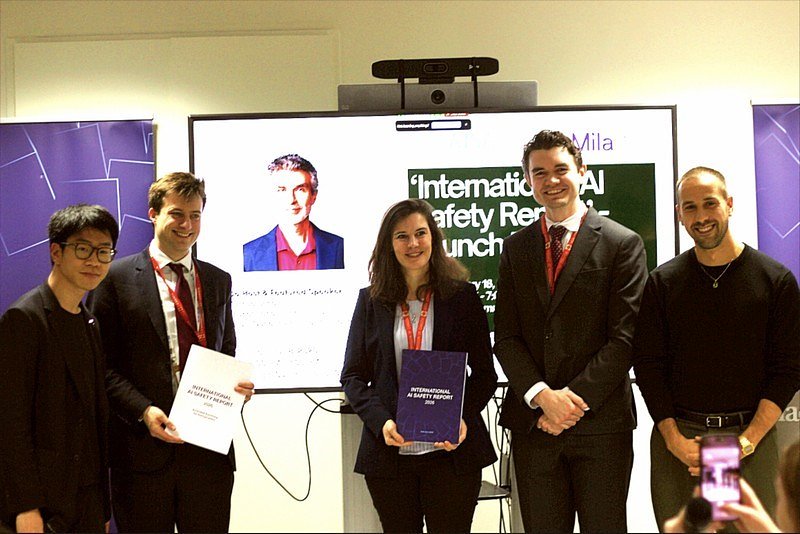
The need for credible, evidence-based governance was the central theme of a second key event: the launch of the International AI Safety Report 2026. Hosted at the High Commission of Canada in India, the reception featured Professor Yoshua Bengio, a Turing Award laureate and one of the world's foremost AI scientists, who served as the report's chair.
The report confronts what it calls the "evidence dilemma." Policymakers are tasked with mitigating risks they cannot fully quantify, as the technology is evolving faster than our ability to gather long-term safety data. Yet, waiting for perfect evidence before acting would leave societies dangerously exposed to malicious use, autonomous malfunctions, and systemic disruptions.
Providing an independent scientific assessment of frontier AI, the report documents rapid advances in AI reasoning and agentic capabilities, alongside persistent challenges with reliability and control. It underscores that risk management cannot depend on a single safeguard. Instead, it requires a layered approach combining technical measures like robust evaluations, institutional oversight from regulators, and societal resilience.
The choice, the report argues, is not between innovation and safety. It is between unmanaged, breakneck acceleration and accountable progress. Public trust, essential for the widespread adoption of any powerful technology, can only be sustained if it is built on a foundation of evidence standards, credible thresholds, and verifiable safety claims.
Asia's Ascent in the Global AI Governance Arena
The India AI Impact Summit was itself a powerful statement, marking a shift in the global AI conversation towards the priorities and perspectives of the Global South. By hosting the summit, India positioned itself as a "bridge power" aiming to shape a global AI order that is both innovative and inclusive.
AI Safety Asia’s work is a crucial part of this emerging narrative. Founded in 2024, the organization has already engaged over 2,000 governance professionals across 16 Asian countries, focusing on building durable capacity from within the region. Its mission is to ensure that governance frameworks reflect local institutional realities and priorities, rather than simply importing models developed elsewhere.
Across Asia, policymakers and experts are not waiting for governance solutions to arrive from Silicon Valley or Brussels. They are actively building their own capacity to understand, evaluate, and regulate frontier technologies. The discussions in New Delhi showed that the next phase of AI governance will be defined less by high-level declarations and more by the practical ability of governments to verify claims, share information at speed, and coordinate effectively. The next AI-driven crisis will not respect diplomatic timetables; whether our institutions can keep up will depend entirely on the relationships and verification channels being built today.