
- 80% of Argentina's imports and exports transit through the Paraná–Paraguay Waterway (Hidrovía).
- USD 4 billion in potential earnings for U.S. contractors tied to the project.
- 25-year, multi-billion-dollar concession for dredging and maintaining the waterway.
Experts view the Hidrovía tender as a critical test of Argentina's strategic alignment, with the choice between Western-backed DEME Group and Jan De Nul—linked to Chinese interests—carrying significant geopolitical and economic implications.
Geopolitical Showdown Looms Over Argentina's Vital Hidrovía Tender
BUENOS AIRES, Argentina – March 26, 2026 – A high-stakes battle for control of South America’s most critical commercial waterway has escalated into a geopolitical flashpoint, pitting a consortium backed by major American investors against a long-term incumbent whose local partner is allegedly intertwined with Chinese state-owned enterprises. The decision on who will win the 25-year, multi-billion-dollar concession to dredge and maintain the Paraná–Paraguay Waterway is now seen as a defining test of President Javier Milei's strategic alignment and the future of U.S.-Argentine relations.
The waterway, known locally as the Via Navegable Troncal (VNT) or Hidrovía, is the economic backbone of Argentina, carrying over 80% of the nation's imports and exports. Its importance is comparable to the Mississippi River in the United States, making control over its maintenance and operation a matter of national and regional security. After a previous tender was voided, the Argentine government relaunched the process in December 2025, attracting global attention. Following the recent disqualification of a Brazilian firm on technical grounds, the competition has narrowed to two Belgian giants: DEME Group and Jan De Nul.
A Defining Choice for Milei's Argentina
The decision facing the Milei administration is fraught with economic and political implications. It comes just months after the United States provided a crucial USD 20 billion in emergency financing in October 2025, a move widely seen as bolstering Milei's government ahead of his re-election. This was followed by the signing of a landmark Reciprocal Trade and Investment Agreement between the U.S. and Argentina on February 5, 2026, with a primary focus on agricultural products and critical minerals—nearly all of which transit through the VNT.
This tender represents the largest critical infrastructure project under the Milei government. With an estimated USD 4 billion in potential earnings for U.S. contractors tied to the project's execution, Washington's interest is more than just strategic. The outcome is being closely watched as the first major test of the new trade pact and Argentina's commitment to its renewed partnership with the West. The tender, Licitación Pública Nacional e Internacional N° 1/2025, stipulates a private concession at the risk of the winning bidder, with no state guarantees, a structure designed to attract highly capitalized global operators with stringent compliance standards.
A Tale of Two Bidders
The two remaining contenders present a stark choice between Western-aligned investment and a deeply entrenched operator now facing scrutiny over its associations.
The consortium led by DEME Group, a world-leading dredging company, is openly backed by American interests. Its partners include Great Lakes Dredge and Dock, the largest and oldest dredging company in the U.S., and the financial firm Clear Street, which counts institutional heavyweights like Calpers, Blackrock, and Goldman Sachs among its investors. Signaling strong Western institutional support, this consortium has reportedly received letters of interest from the U.S. International Development Finance Corporation (DFC) and the World Bank.
On the other side is Jan De Nul, the company that has held the VNT concession since 1995. Its deep roots in Argentina have allowed it to survive numerous regime changes, making it a formidable part of the country's logistical establishment. However, this history is also shadowed by controversy. The company's owners previously received a suspended sentence for bribery, and the firm was embroiled in a major corruption probe in Ukraine in 2016. More pointedly, various stakeholders have raised concerns that the current tender includes unusual provisions that only Jan De Nul can meet, effectively tailoring the bid in its favor.
The Shadow of the Dragon: Unpacking Chinese Linkages
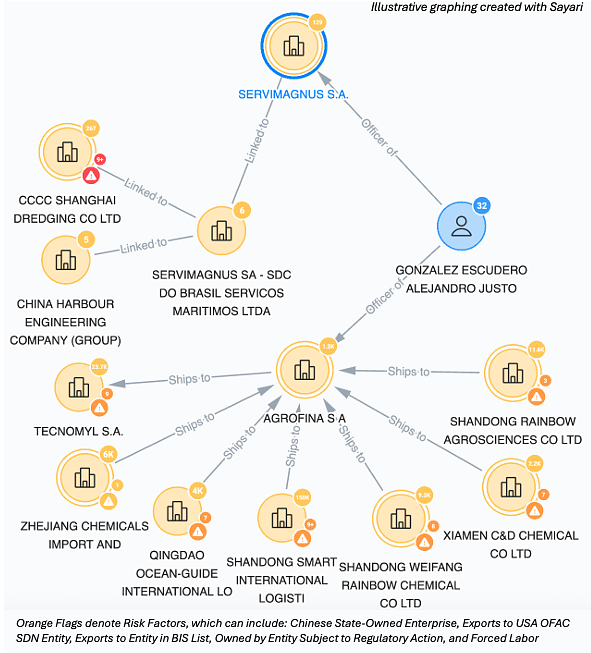
While state-owned companies were disqualified from direct participation, the most serious concerns center on Jan De Nul's alleged use of a local partner, Servimagnus S.A., as a backdoor for Chinese state influence. Public records show that Servimagnus has a long and documented history of partnership with Shanghai Dredging, a key subsidiary of the China Communications Construction Company (CCCC), a massive Chinese state-owned enterprise.
Recent findings have uncovered a wider, more troubling network of commercial linkages. Corporate mapping reveals connections between Servimagnus and another Argentine company, agrochemical manufacturer Agrofina S.A., which in turn has dealings with a cluster of Chinese and Hong Kong-based firms. Several of these entities, such as Shanghai Sunwise Chemical Co. Ltd. and Shandong Rainbow Agrosciences Co. Ltd., have been flagged or sanctioned for reasons including forced labor. Furthermore, Servimagnus's parent group, controlled by the influential Román family, includes a logistics operator that handles cargo for major Chinese state-linked companies like COSCO and CRRC.
This pattern of overlapping commercial ties and personnel creates what experts describe as a significant counterintelligence and strategic risk. The concern is not merely about conventional business dealings but about the potential for Chinese state-aligned actors to embed themselves within critical infrastructure. Such a foothold could be leveraged to shape procurement, gain sensitive commercial and logistical data, and normalize a Chinese presence in a strategic waterway with consequences far beyond Argentina's borders.
A Litmus Test for Regional Influence
For the United States and its allies, this pattern aligns with a familiar playbook used by the People's Republic of China globally: gain influence around ports, logistics, and dual-use infrastructure through commercial channels, then expand that presence into a durable strategic advantage that is difficult to reverse. The Hidrovía corridor is not just an Argentine asset; it is a vital artery for Bolivia, Brazil, Paraguay, and Uruguay, making its security a matter of regional concern.
While the discovered evidence does not prove direct control by the Chinese state, the sheer volume of China-facing relationships is sufficient to trigger heightened scrutiny. The presence of an intermediary like Servimagnus, positioned across a critical waterway tender and a web of China-linked commercial networks, presents a clear vector for influence operations.
As the Argentine National Port Authority, ANPYN, evaluates the final bids, the Milei government faces a monumental decision. Awarding the contract to the DEME-led consortium would signal a firm commitment to its economic and security partnership with the United States. Choosing Jan De Nul, despite the serious questions surrounding its partner's extensive links to Chinese state interests, would raise profound doubts about Argentina's strategic direction. The future of South America's river of commerce now hangs in the balance, with the outcome set to send ripples across the global geopolitical landscape.