
- 26 GW of new generating capacity brought online in 2025, equivalent to Louisiana's total installed capacity.
- 47% of new capacity deployed in developing and emerging economies.
- $9 billion R&D investment planned through 2028 for breakthrough technologies.
Experts would likely conclude that GE Vernova is strategically balancing immediate power demand with long-term decarbonization through high-risk, high-reward technological bets and global market positioning.
GE Vernova's High-Wire Act: Juggling Global Power Demand and Hard Tech Bets
CAMBRIDGE, Mass. – June 17, 2026
GE Vernova dropped its 2025 Sustainability Report today, and for strategists watching the global energy transition, it’s a dense ledger of progress, ambition, and the stark realities of rewiring the planet. While the report is framed around sustainability, it reads more like a strategic blueprint for an industrial giant navigating the treacherous crosscurrents of soaring energy demand and the urgent mandate to decarbonize. The story behind the numbers isn't just about megawatts and emissions; it's about high-stakes technological bets and a fundamental reshaping of the global power map.
In a world suddenly grappling with the voracious energy appetite of AI data centers—a demand driver barely on the radar a few years ago—GE Vernova’s mission to “electrify the world” has taken on a new, urgent dimension. The report’s release confirms the company is positioning itself not merely as a participant in the energy transition, but as a foundational builder of it. As CEO Scott Strazik noted, “Energy is about people, and we’re working to electrify the planet in a way that enables individuals, communities, and economies to thrive, every day.” The question is, how do you build that future when the demands of today are already straining the system?
The Electrification Mandate: Powering Growth and Equity
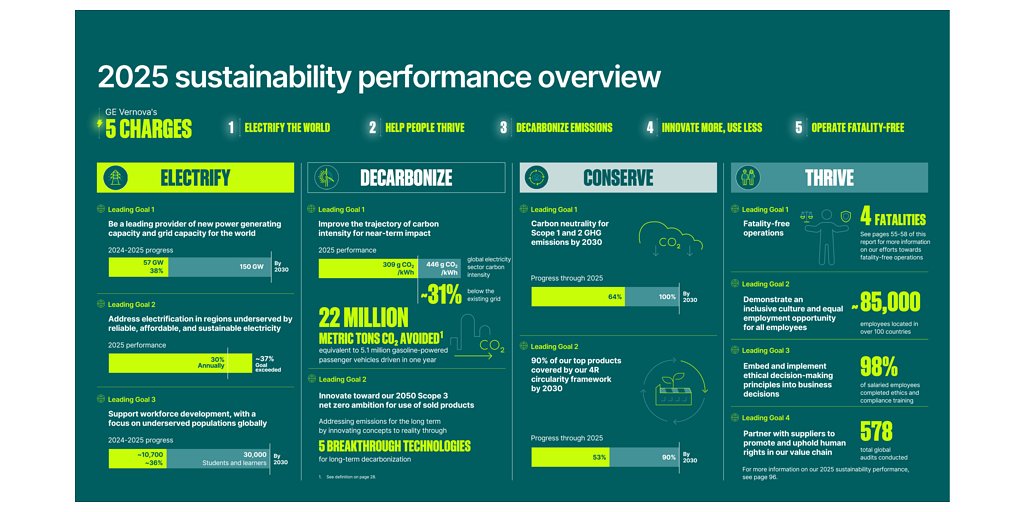
The report's headline figures paint a picture of massive scale. In 2025, GE Vernova brought 26 GW of new generating capacity online—roughly equivalent to the entire installed capacity of Louisiana. Alongside this, it energized 68 GW of new power transformers, critical hardware for grid stability and expansion. While the 26 GW figure is a slight dip from the 31 GW reported in 2024, it underscores the relentless pace of deployment required to keep the lights on globally.
More strategically significant is where that power is going. Nearly half (47%) of the new capacity was deployed in developing and emerging economies. This isn’t just corporate altruism; it's a shrewd long-term market play. These are the regions where energy demand growth will be most explosive in the coming decades. By embedding its technology now, GE Vernova is establishing a decades-long foothold.
This focus on global equity is being formalized through initiatives like the Mendoza Collective Action Summit, which yielded a set of “Mendoza Principles” aimed at accelerating energy access. While principles are one thing, execution is another. The company is backing this with tangible workforce development, reaching over 10,700 learners since early 2024. To add a layer of transparency to these global efforts, the company also launched a new digital Electrification Impact Tracker, visualizing its project footprint and impact on communities—a clear nod to stakeholders demanding more than just promises.
From Concept to Concrete: The Bet on Breakthrough Tech
While deploying existing technology is the company's bread and butter, the most compelling part of the report is the tangible progress on breakthrough technologies. This is where GE Vernova is making its biggest, riskiest, and potentially most transformative bets. These are the “hard tech” solutions designed to solve the intermittency of renewables and decarbonize industries where electrons alone won't suffice.
In Ontario, Canada, construction on the GE Vernova Hitachi BWRX-300 Small Modular Reactor (SMR) has officially begun. This isn't a PowerPoint slide; it's a licensed construction site for what is slated to become the first commercial SMR in the Western world, with a target operational date of 2028. For a sector that has been long on promises and short on tangible projects, this is a landmark moment.
Across the Atlantic, another major project is taking shape. Construction started on the Net Zero Teesside power station in the UK, which is expected to be the world's first commercial-scale gas plant equipped with Carbon Capture & Storage (CCS). The facility will capture its carbon emissions for storage beneath the North Sea, aiming to provide over 740 MW of lower-carbon, dispatchable power. Together, the SMR and CCS projects represent a bet that the future grid needs a firm, flexible backbone that wind and solar alone cannot provide.
“The story of GE Vernova is one of an unrelenting focus on delivering the technologies the world needs not just today, but importantly for the decades ahead,” said Roger Martella, Chief Corporate Officer and Chief Sustainability Officer. This focus is backed by a planned $9 billion R&D investment through 2028, funding further work in everything from Direct Air Capture (DAC) to hydrogen-as-a-fuel, signaling a portfolio approach to a deeply uncertain technological future.
Reading the Carbon Ledger
For any energy company, the ultimate test is in the emissions data. Here, the story is one of substantial progress mixed with nuanced realities. The company reports that its new power generation equipment deployed in 2025 operates at a carbon intensity ~31% below the global grid average. This is a critical metric, demonstrating that adding their capacity helps pull the global average down.
On its own operations, the progress is undeniable. A 64% reduction in Scope 1 and 2 emissions since 2019, including a 27% year-over-year drop, shows a serious commitment to cleaning its own house on the path to a 2030 carbon neutrality goal. However, the 22 million metric tons of CO₂ avoided by deploying lower-carbon technologies is down from 27 million tons the previous year. This fluctuation highlights the complex dynamics of project timelines and technology mix in any given year and serves as a reminder that decarbonization is rarely a straight, linear path.
Rewiring the Corporate DNA
Underpinning the technological and financial strategy is a concurrent effort to rewire the company's internal operating system. The report’s emphasis on AI is telling. GE Vernova is not just a supplier to the AI boom; it's a user, deploying AI to optimize its own operations and customer outcomes. This dual role—powering the AI revolution while using its tools for efficiency—places the company at the very nexus of this new industrial age.
Further evidence of this internal shift comes from its focus on circularity. The company's “Rethink, Reduce, Reuse, Recycle” framework now covers 53% of its top products, up from 38% in 2024, with an ambitious goal of 90% by 2030. This is a critical, and often overlooked, component of industrial transformation, moving away from a linear “take-make-waste” model.
The adoption of a new, values-based Code of Conduct and a detailed Human Rights Statement are not just compliance footnotes. They are essential elements for building a resilient, modern corporation capable of managing complex global supply chains and attracting top-tier talent. In a world of increasing supply chain scrutiny and stakeholder activism, this ethical infrastructure is as vital as any physical asset.
As the world confronts the dual challenge of surging power demand and an accelerating climate crisis, GE Vernova’s report serves as a detailed field guide from the front lines. The strategy is clear: deploy mature technologies at scale today while making massive, targeted bets on the breakthrough systems that will form the backbone of tomorrow's grid. The success of this high-wire act will be measured not just in gigawatts and stock performance, but in the stability and sustainability of the global energy system itself.