
- First shipments of natural graphite from GBM's Ontario mine to U.S. customers for qualification
- 97% carbon content achieved in lab-scale purification, a critical step toward commercial-scale manufacturing
- 2025 deadline for U.S. vehicles to avoid battery components from 'foreign entities of concern' (FEOC), including China
Experts view GBM's graphite shipments and processing lab as a pivotal step toward reducing North America's dependency on China for critical battery materials, aligning with strategic industrial and policy goals.
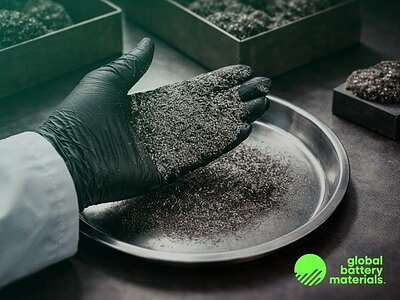
GBM Ignites North American Battery Race with Key Graphite Shipments
TORONTO, ON – March 25, 2026 – In a move that signals a significant acceleration in the race for a self-reliant North American battery industry, Global Battery Materials Corp. (GBM) has commenced its first shipments of natural graphite from its Ontario mine to U.S. customers for qualification. The announcement, coupled with the simultaneous opening of a new, state-of-the-art graphite processing laboratory in Quebec, marks a critical milestone in the continent's effort to build an end-to-end supply chain for electric vehicle (EV) batteries, independent of foreign dominance.
These developments position GBM as a pivotal player in a strategic industrial shift, directly addressing the urgent need for a secure, domestic source of graphite—a mineral essential for the anodes in virtually all lithium-ion batteries. By proving its ability to mine and begin purifying this critical material within Canada, the company is laying the groundwork for a supply chain that can meet the stringent demands of the burgeoning North American EV market.
Fueling a New Era of Supply Chain Security
The timing of GBM's announcement is no coincidence. It comes as Western governments and automotive manufacturers scramble to de-risk their supply chains, which are currently overwhelmingly dependent on China for the processing of critical minerals. China’s control over the global graphite market, particularly the refining and manufacturing stages, has been identified as a major economic and national security vulnerability. This dependency has been thrown into sharp relief by geopolitical tensions and recent export controls, creating intense pressure to develop alternative, localized sources.
This push is powerfully supported by government policy, most notably the U.S. Inflation Reduction Act (IRA). The IRA's Clean Vehicle Credit, which offers up to $7,500 to consumers, includes strict sourcing requirements. To qualify for the full credit, an increasing percentage of a vehicle's battery minerals must be extracted or processed in North America or by a free-trade partner. Crucially, starting in 2025, vehicles are ineligible for the credit if they contain battery components from a "foreign entity of concern" (FEOC), a category that includes China. This provision makes Canadian-sourced and processed graphite, like that from GBM, exceptionally valuable to automakers aiming to offer eligible EVs to the American market.
"North America has very limited capacity to process critical minerals like graphite, and this announcement marks an important step in urgently closing this gap," said Eric Miller, Chief Executive Officer at GBM. "We're excited to expand our Canadian footprint beyond the Kearney Mine... as we work to build a secure supply chain that eliminates the need to export resources overseas for evaluation and refinement."
A Vertically Integrated Vision Takes Shape
GBM's strategy is not limited to a single mine or lab; it is a comprehensive, vertically integrated approach designed to control the process from raw material to advanced battery component. The company's platform connects three key assets: the recently restarted Kearney Mine in Ontario, one of North America's only previously producing natural graphite assets; the new GBM Graphite Lab in Quebec for purification and analysis; and a mature R&D and pilot production facility in South Korea that is already producing premium anode material using patented technology.
This integrated model offers a significant competitive advantage. By controlling the supply chain, GBM can ensure quality, traceability, and compliance with the strict sourcing rules mandated by policies like the IRA. The new Quebec lab is the critical link in this chain, providing the domestic capability to upgrade raw ore into a high-value product. The facility is equipped to run complete simulations of industrial plant processes, demonstrating purification levels of up to 97 percent carbon content at a lab scale. While battery-grade anode material ultimately requires even higher purity—often exceeding 99.9 percent—achieving 97 percent in a production-representative process is a vital intermediate step that de-risks the path to commercial-scale manufacturing.
Operations at the lab are being conducted under ISO 9001 certification guidelines, a globally recognized standard for quality management that provides customers with confidence in the consistency and reliability of the product.
Quebec at the Heart of Battery Innovation
The strategic choice of Quebec for the new laboratory leverages the province's emergence as a North American hub for the battery industry. Quebec offers a unique combination of clean, low-cost hydroelectric power, a highly specialized workforce in advanced materials science, and strong provincial government support for developing a complete battery ecosystem, from mining to recycling. By establishing a presence there, GBM plants itself firmly at the center of this growing cluster of innovation.
Lending further credibility to the operation is its leadership. The GBM Graphite Lab is managed by Benoit Briere, a senior director with nearly three decades of experience in the natural graphite industry. His career includes key technical and operational roles at Imerys, which for years operated North America's only graphite mine, and more recently as operations director at Nouveau Monde Graphite, another key player in Quebec's graphite sector. Briere's deep expertise in graphite processing and battery material requirements is a crucial asset as GBM moves to scale its technology and meet market demands.
The Long Road of Customer Qualification
While the first shipments of graphite samples represent a major achievement, they also mark the beginning of another long and arduous process: customer qualification. In the automotive industry, validating a new material for use in an EV battery is a rigorous, multi-year endeavor. Potential customers, including major automakers and battery manufacturers, will now subject GBM's graphite to a battery of tests to assess its chemical properties, electrochemical performance, consistency, and long-term durability.
This qualification gauntlet can often take between two and five years. It involves not only laboratory testing but also building prototype battery cells and, eventually, full-scale pack validation. Throughout this period, customers will also audit GBM's production processes and quality control systems to ensure they can reliably supply the required volume and quality for mass production. Successfully navigating this process is the final gate before securing the large, long-term offtake agreements needed to finance and build a commercial-scale production plant. These initial shipments, therefore, represent the first tangible steps in a complex journey to power the continent's automotive future with locally sourced materials.