
- 62% of financial institutions cite technology outpacing workforce capabilities as the primary barrier to progress (AICB 2025 Workforce Survey).
- 71% of banking institutions in Malaysia implemented at least one AI application in 2024 (Bank Negara Malaysia).
- 159 critical job roles and 157 in-demand skills identified in Malaysia's Future Skills Framework (FSF).
Experts agree that Malaysia's proactive approach to upskilling its banking workforce through initiatives like the Future Skills Framework is essential to bridge the AI skill gap and ensure the financial sector remains competitive and resilient in an evolving technological landscape.
Future-Proofing Finance: Malaysia Tackles Banking's AI Skill Gap
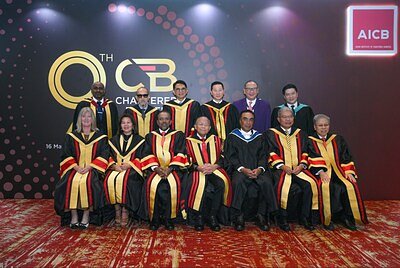
KUALA LUMPUR, Malaysia – May 22, 2026 – The Asian Institute of Chartered Bankers (AICB) recognized more than 700 banking professionals at its 9th Chartered Banker Conferment Ceremony, a landmark event highlighting a concerted national effort to prepare the financial sector for a future dominated by artificial intelligence, complex risks, and new sustainability demands. The ceremony, held at the Kuala Lumpur Convention Centre, not only celebrated individual achievement but also underscored the urgency of bridging a critical and widening skills gap in the industry.
Among the honorees were professionals from across the region, including Cambodia, the Maldives, and the Philippines, signaling AICB's growing influence in setting regional standards. The event celebrated 114 new Chartered Bankers, 611 Associate Chartered Bankers, and conferred the prestigious Fellow Chartered Banker status upon seven distinguished industry leaders, marking a significant milestone in strengthening the talent pipeline for a rapidly evolving financial landscape.
A National Response to a Widening Gap
The ceremony took place against a backdrop of stark industry data. According to AICB's 2025 Workforce Survey, a significant 62% of financial institutions cite technology outpacing their workforce's capabilities as the primary barrier to progress. This challenge is compounded by the fact that 57% of these institutions remain in the nascent stages of AI adoption. However, separate data from Bank Negara Malaysia (BNM) reveals an accelerating trend, with 71% of banking institutions having implemented at least one AI application in 2024, a sharp rise from 56% the previous year. This discrepancy highlights a critical challenge: banks are adopting technology faster than they can upskill their people, creating an urgent need for targeted talent development.
This urgency was a central theme of the day. In his welcome remarks, AICB Chairman Tan Sri Azman Hashim stressed the need for a paradigm shift in investment priorities. "Malaysia's banking sector must continue investing in people with the same urgency that it invests in technology," he stated. "As artificial intelligence, digital assets and sustainability expectations reshape financial services, the industry needs bankers who can apply these tools responsibly, manage new risks and uphold public confidence."
Echoing this sentiment, Deputy Governor Encik Adnan Zaylani, in his special address, called for a redefinition of the banker's role. "Looking ahead, the role of bankers must also evolve beyond traditional financing to become enablers of growth," he said. He emphasized that as the operating landscape shifts, banks are not just financial intermediaries but "strategic enablers of economic transformation," requiring professionals with superior judgement, contextual understanding, and forward-looking risk assessment skills.
Building the Blueprint for a Future-Ready Workforce
To address this challenge head-on, Malaysia's financial ecosystem, led by BNM and industry bodies like AICB, has moved beyond rhetoric to implement a concrete national strategy. The cornerstone of this effort is the Future Skills Framework (FSF), an ambitious initiative developed by AICB in partnership with the Islamic Banking and Finance Institute Malaysia (IBFIM) and The Malaysian Insurance Institute (MII). As a key component of BNM's Financial Sector Blueprint 2022-2026, the FSF identifies 159 critical job roles and 157 in-demand skills essential for the industry's future.
To operationalize this framework, AICB launched FSF Xcel in late 2025, Malaysia's first industry-wide digital skills assessment platform. This tool allows financial institutions to systematically evaluate their workforce against the FSF's benchmarks, identify specific skill gaps at both individual and organizational levels, and map out targeted learning and career pathways. The platform is being progressively rolled out in collaboration with BNM and technology partners, creating a structured, data-driven approach to talent management.
This strategic framework is bolstered by a robust support system, including BNM's Financial Sector Talent Enrichment Programme (FSTEP) and collaborations with national agencies like the Human Resource Development Corporation (HRD Corp) and Talent Corporation Malaysia (TalentCorp), ensuring a coordinated, multi-agency push to future-proof the nation's financial talent.
From Local Excellence to Regional Leadership
The conferment ceremony also highlighted Malaysia's growing role as a hub for professional banking standards in the ASEAN region. The international partnership with the Chartered Banker Institute (CBI), UK, lends global prestige to the Chartered Banker qualification. Paul Denton, President of CBI, noted the significance of this collaboration, stating, "Through our long‑standing partnership with AICB, we are proud to support banking professionals in Malaysia and across the region as they build the skills, judgement and values needed to lead through change."
This year's event marked a historic first, demonstrating the high caliber of talent being nurtured through this ecosystem. Vorn Samedy from Wing Bank (Cambodia) PLC and Thong Min Fong from Hong Leong Bank Berhad were recognized as Overall Subject Prize Global Winners by the Chartered Banker Institute for achieving the highest marks worldwide in Commercial Banking and Bank Risk Management, respectively. Their achievement as the first AICB members to receive this global honor is a powerful testament to the quality of the program and the potential within the region.
The seven senior leaders conferred with the Fellow Chartered Banker status further exemplified the depth of expertise within the industry. They included top executives from AmBank Group, Cagamas Berhad, and Malaysian Rating Corporation Berhad, representing critical functions from sustainability and compliance to risk management.
Corporate Champions Paving the Way
The success of this national upskilling initiative ultimately depends on the commitment of financial institutions themselves. The ceremony recognized two of Malaysia's largest banking groups for their exemplary leadership in talent development. Public Bank Group was awarded the Platinum Winner of the Leading Bank for Professional Development Award for certifying the highest number of employees among AICB's corporate members in 2025.
Meanwhile, Maybank Group received the Leading Bank for Chartered Banker Award for producing the highest number of new Chartered Bankers in 2025. These awards highlight how Malaysia's leading banks are actively investing in human capital, viewing continuous learning and professional standards not as a compliance exercise, but as a core strategic advantage. This institutional buy-in is critical for embedding a culture of lifelong learning and ensuring the financial sector is supported by professionals who are not only capable and accountable but are also trusted to lead through an era of unprecedented change.