
- 1,500+ projects submitted by students from 70+ countries
- 5 categories of innovation: Aerospace & Aviation, Cyber-Technology & Security, Energy & Environment, Health & Nutrition, and The Water Challenge
- Winning teams receive scholarships, patent support, and potential space applications for their inventions
Experts agree that the Conrad Challenge is a vital platform for cultivating 21st-century skills, fostering global collaboration, and driving innovation through hands-on, project-based learning.
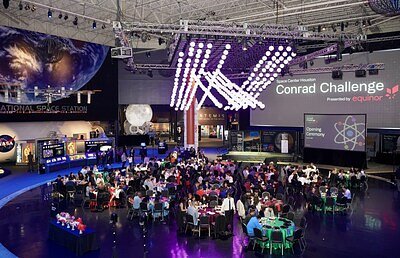
Future Forged: Teen Innovators Awarded at 2026 Conrad Challenge
HOUSTON, TX – April 30, 2026 – The future of innovation was on full display at Space Center Houston as teams of high school students from around the globe were honored as Pete Conrad Scholars. At the conclusion of the 2026 Conrad Challenge, an intense, year-long competition, these young entrepreneurs presented solutions to some of the world's most pressing challenges, carrying on a legacy of exploration and ingenuity.
This season saw a remarkable convergence of young talent, with more than 1,500 projects submitted by students from over 70 countries. The innovations spanned five critical categories: Aerospace & Aviation, Cyber-Technology & Security, Energy & Environment, Health & Nutrition, and The Water Challenge. The final awards ceremony, held on April 25, was the culmination of a journey that tested not just their scientific knowledge, but their collaborative spirit and business acumen.
"We are excited about this year's impressive pioneers," said Daniel Newmyer, Chief Learning Officer at Space Center Houston. "Seeing these passionate students collaborate on such amazing inventions underscores what's possible through STEM principles."
A Global Proving Ground for 21st-Century Skills
The Conrad Challenge, founded in 2007 by Nancy Conrad in honor of her late husband, NASA astronaut and Apollo 12 commander Charles "Pete" Conrad Jr., has evolved into far more than a typical science fair. It operates as a global incubator, pushing students aged 13-18 to move beyond theory and build commercially viable solutions.
Experts in education and industry note that programs like this fill a critical gap. "Competitions like the Conrad Challenge provide a hands-on, project-based learning environment that cultivates essential 21st-century skills, moving beyond rote memorization to genuine innovation," explained one educational policy researcher. Students are required to develop business plans, marketing strategies, and graphical representations of their concepts, forcing them to think like entrepreneurs from day one.
This year's competition was a testament to that model. Teams collaborated across oceans and time zones, forming virtual companies to tackle everything from orbital debris to food scarcity. This international framework is a key component of the challenge's success. As one futurist specializing in global trends noted, "Learning to collaborate with peers from different cultures on shared challenges is invaluable. It teaches empathy, diverse perspectives, and how to leverage collective intelligence for complex problems."
From Beehives to the Cosmos: This Year's Ideas
The winning projects showcased a stunning breadth of creativity and technical insight. In the Aerospace & Aviation category, team Aphelion from Santa Monica, California, was named a Pete Conrad Scholar, likely for an innovation aimed at deep-space travel or orbital mechanics, as their name suggests. In Cyber-Technology & Security, team VOCL from Naperville, Illinois, earned the top honor for their work in a field critical to modern society.
Perhaps most indicative of the students' focus on pressing global issues was The Bee Initiative, a joint team from San Jose, California, and Groton, Massachusetts. As Pete Conrad Scholars in the Energy & Environment category, their project highlights a growing awareness among youth of the importance of ecological health and biodiversity. Other winners included The Cartographers from Redmond, Washington, in Health & Nutrition, and Soaring Seeds from China in The Water Challenge, each recognized for their novel approaches in their respective fields.
"My husband, Pete Conrad, would be incredibly proud of what these students have accomplished so early in their lives," said Nancy Conrad, founder and chair of the Conrad Foundation. "Their work is already making a meaningful impact and paving the way for the next generation of innovators."
Fueling the Future: Legacy and Corporate Partnerships
The Conrad Challenge thrives on an ecosystem of support that combines the inspirational legacy of a space pioneer with the strategic backing of industry leaders. This year, the Energy & Environment category was sponsored by Equinor, a global energy company deeply invested in the transition to sustainable power.
Equinor's involvement extends beyond a simple logo on a banner. The company's U.S. country manager, Chris Golden, presented the special Equinor Searching for Better Award to team OctoScope from China, a Power Pitch Award Winner. This award recognizes a team whose idea embodies progress, ingenuity, and the determination to find better outcomes for people and the planet. For a company like Equinor, sponsoring the challenge is a strategic investment. It allows them to connect with the next generation of engineers and scientists who will lead the energy transition, fostering innovation that aligns with their corporate mission of providing energy in a more sustainable way.
This synergy between a non-profit foundation and a corporate powerhouse demonstrates a modern approach to fostering innovation, where the drive for social good and the need for industry solutions meet.
Launching Careers: From Patent Support to Orbit
For the winning teams, the prize is more than a trophy. Each member receives scholarships, an all-expenses-paid trip to Boston, and additional resources from Equinor to continue their work. Perhaps most significantly, the challenge offers a tangible launchpad for their inventions. Select teams receive professional patent support, a critical first step in protecting their intellectual property and attracting future investment.
This support often involves legal guidance to file a provisional patent application, a process that secures an invention's filing date and gives the young entrepreneurs a year to refine their product and business plan. It's a crucial lesson in the real-world mechanics of innovation.
The most ambitious prize, however, is the potential for an invention to be "used in space." While this may seem like a distant dream, it is grounded in reality. A past Conrad Challenge winner, team Lasar from the Czech Republic, developed a laser system to reboot malfunctioning satellites, and their technology was subsequently launched into orbit. This precedent transforms the claim from marketing hyperbole into a credible, awe-inspiring goal for every student who enters the Aerospace & Aviation category.
As the Conrad Challenge prepares to celebrate its 20th anniversary next year, its impact is clear. It is not merely a competition, but a powerful engine for change, empowering the brightest young minds on the planet to stop waiting for the future and start building it themselves.