
- Versal ACAP Integration: Combines dual Arm® Cortex®-A72 processors, dual Cortex-R5 real-time cores, AI/DSP engines, and programmable logic in a single chip.
- SWaP Optimization: Reduces size, weight, and power consumption by consolidating multiple processing functions.
- Standardized SpaceVPX Architecture: Designed to the 3U SpaceVPX (VITA 78) standard for interoperability and reliability.
Experts agree that Frontgrade's MAMBA platform represents a significant advancement in satellite autonomy, enabling real-time data processing and reducing reliance on ground stations, which is critical for modern space missions.
Frontgrade's New AI Brains to Revolutionize Satellite Autonomy
COLORADO SPRINGS, CO – March 25, 2026
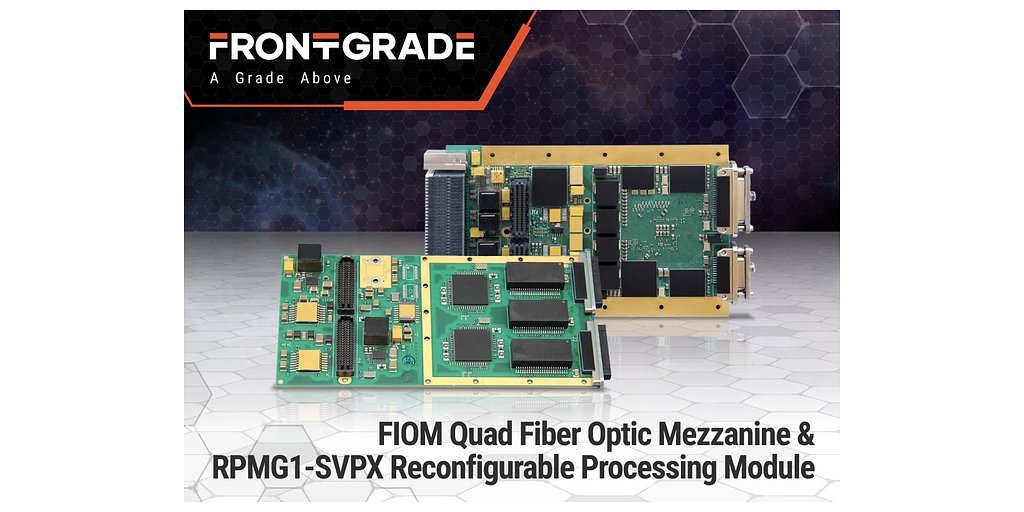
Frontgrade Technologies, a veteran in high-reliability electronics for space and defense, has unveiled a new integrated solution poised to significantly advance the computational power and connectivity of next-generation satellites. The company announced the launch of its RPMG1-SVPX Reconfigurable Processing Module and the complementary FIOM-RPMG1 Fiber Optic Mezzanine Card. Together, they form the MAMBA (Modular Approach for Mission Processing in a Bifurcated Architecture) platform, a system designed to inject powerful artificial intelligence and high-speed data handling capabilities directly into spacecraft operating from low-Earth orbit to cislunar space.
This launch marks a critical step in the industry-wide shift towards more intelligent, autonomous, and data-efficient satellites. By combining a cutting-edge adaptive processor with high-throughput fiber optics in a standardized, space-resilient package, Frontgrade is addressing the core challenges of modern mission design: managing massive data volumes, enabling real-time decision-making, and reducing the physical footprint of onboard systems.
A Leap in Onboard Intelligence
At the heart of the new system is the RPMG1-SVPX, a processing module built around the powerful AMD Versal VC1902 adaptive compute acceleration platform (ACAP). Unlike traditional processors, the Versal ACAP integrates a heterogeneous mix of computing engines: dual Arm® Cortex®-A72 processors for general-purpose tasks, dual Cortex-R5 real-time cores for deterministic control, powerful AI and Digital Signal Processing (DSP) engines, and a fabric of programmable logic. This allows mission designers to accelerate a wide range of workloads, from hardware-accelerated signal processing to complex AI inference, all on a single chip.
The implications for satellite functionality are profound. By embedding this level of intelligence directly onboard, satellites can perform tasks that were previously impossible or required extensive communication with ground stations. For Earth observation missions using synthetic aperture radar (SAR) or advanced optical sensors, the system can sift through terabytes of raw data, identify relevant features like ship movements or environmental changes, and transmit only the crucial, processed information. This drastically reduces data downlink requirements and accelerates the delivery of actionable intelligence.
“The combination of Versal adaptive compute and high-speed fiber connectivity in a SpaceVPX architecture gives our customers a new level of onboard performance and integration flexibility,” stated Lorne Grave, SVP & Chief Technology Officer at Frontgrade. “With RPMG1-SVPX and FIOM-RPMG1, we’re enabling mission designers to consolidate processing, accelerate data movement, and deploy more intelligent, autonomous systems while meeting the reliability demands of space and defense environments.”
Building on a Standardized Space Backbone
The MAMBA solution is not just about raw processing power; it is also a testament to the growing importance of standardization in space hardware. The RPMG1-SVPX is designed to the 3U SpaceVPX (VITA 78) standard, an open architecture specifically enhanced for the rigors of spaceflight. Born from a government-industry collaboration, SpaceVPX provides a modular, scalable, and highly reliable framework for building complex electronic systems.
By adopting this standard, Frontgrade ensures its platform is interoperable, fault-tolerant, and adaptable. The standard mandates features like redundant power distribution and robust thermal management, which are critical for surviving the harsh radiation and temperature swings of space. This modularity allows system integrators to easily scale performance, add new capabilities, and iterate on designs, significantly reducing development risk and lifecycle costs. It also fosters a competitive ecosystem where modules from different vendors can coexist, giving designers more choice and flexibility. This approach is vital for missions ranging from large commercial LEO constellations, where cost-effective scalability is key, to one-of-a-kind Class A scientific missions that demand the highest levels of reliability.
The SWaP Advantage: More Power, Less Footprint
For any spacecraft, the guiding mantra is SWaP: Size, Weight, and Power. Every cubic centimeter, every gram, and every watt is a precious commodity that directly impacts launch costs and mission capability. Frontgrade's MAMBA solution is engineered to deliver a significant SWaP advantage through intelligent design and technology consolidation.
The Versal ACAP's ability to consolidate multiple processing functions—such as signal processing, AI inference, and mission management—onto a single device eliminates the need for numerous individual circuit boards. This compute consolidation directly reduces the size, weight, and power consumption of the entire avionics suite.
This efficiency is further enhanced by the FIOM-RPMG1 Fiber Optic Mezzanine card. This module provides essential high-speed I/O, including Ethernet and serial interfaces, but its most critical feature is the conversion of signals to ruggedized fiber optic connectors. Fiber optic cables are significantly lighter than their traditional copper counterparts and are immune to the electromagnetic interference (EMI) that can plague the densely packed electronics of a modern satellite. The mezzanine's Firehawk™ 10GBASE-SR optical transceiver provides four duplex fiber ports, enabling massive data throughput for inter-module communication or for high-speed data downlink via laser communications systems.
This SWaP-optimized approach not only lowers the barrier to entry by reducing launch costs but also frees up mass and power budgets for additional scientific instruments or other payload components, ultimately increasing the value and return of a mission.
Redefining the Future of Satellite Architectures
The introduction of the MAMBA platform is a clear indicator of the broader trends shaping the space industry. It represents a definitive move towards edge computing in space, where data is processed at the source rather than being sent to the ground for analysis. This paradigm shift is essential for enabling the truly autonomous systems required for deep space exploration, persistent surveillance, and dynamic constellation management.
Furthermore, the reconfigurable nature of the Versal chip's programmable logic aligns with the concept of the “software-defined satellite.” Missions can be launched with a baseline set of capabilities, and new algorithms or processing functions can be uploaded on-orbit to adapt to changing mission requirements or new threats. This offers unprecedented flexibility and extends the operational life and relevance of space assets.
For national security, such capabilities are transformative. Resilient, intelligent, and autonomous satellites that can process intelligence in real-time and operate with minimal ground intervention are critical for maintaining an advantage in an increasingly contested space domain. Frontgrade's new offering provides a foundational building block for the next generation of defense and intelligence architectures, capable of supporting everything from tactical electronic warfare to strategic global monitoring. By integrating these advanced technologies into a standardized, scalable, and space-proven package, Frontgrade is providing the tools to build the more capable and autonomous space infrastructure of tomorrow.