
- 1,683 BTC: DDC's total Bitcoin holdings after its latest purchase.
- 42.3% YTD Yield: The reported year-to-date return on its Bitcoin investment.
- $150 Million: Current value of DDC's Bitcoin holdings at the time of the article.
Experts would likely conclude that DDC's Bitcoin treasury strategy represents a high-risk, high-reward approach that could either bolster long-term value or expose underlying financial vulnerabilities, depending on market volatility and regulatory developments.
From Woks to Wallets: DDC Deepens Its Bitcoin Treasury Strategy
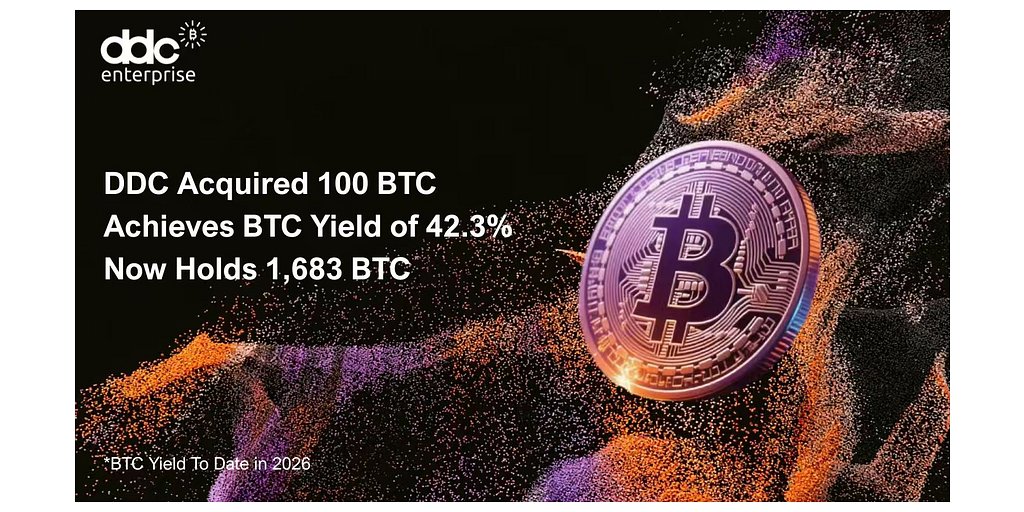
NEW YORK, NY – January 28, 2026 – DDC Enterprise Limited (NYSEAMERICAN: DDC), a company navigating the unique intersection of Asian cuisine and cryptocurrency, announced today its third Bitcoin purchase of the year, adding 100 BTC to its corporate coffers. The acquisition boosts its total digital asset holdings to 1,683 BTC, reinforcing a bold and unconventional corporate strategy that continues to draw both interest and scrutiny from Wall Street.
The move is the latest step in what DDC calls its “structured Bitcoin accumulation program,” a strategy that positions the volatile digital asset as a core component of its long-term balance sheet. While the company maintains its foundation as a global platform for Asian food brands like DayDayCook and Nona Lim, its aggressive pivot into digital asset management marks it as a key player in a growing, and often controversial, corporate trend.
A Hybrid Model Under Scrutiny
DDC's approach is deliberate. The company has framed its Bitcoin acquisitions not as speculative trades, but as a disciplined treasury management strategy aimed at long-term value creation and resilience. This latest purchase, made at an average cost of $88,130 per coin across its total holdings, is part of a consistent accumulation plan.
“Our approach to Bitcoin accumulation remains measured and intentional,” said Norma Chu, Founder, Chairwoman and Chief Executive Officer of DDC, in the company's official announcement. “This latest purchase reflects our conviction-driven strategy and our commitment to deploying capital responsibly. We continue to prioritize strong governance, disciplined execution, and long-term value creation for our shareholders.”
This conviction comes at a time when DDC's traditional business operations have also seen strategic shifts. In 2025, the company refocused its food business on its strongest Asian markets and exited its U.S. operations. The move appeared to pay dividends, with DDC reporting its first-ever profitability in the first half of 2025, driven by a record high gross margin of 33.4%. This success in its core food business provides a stark contrast to the high-tech, high-risk world of its digital treasury, creating a hybrid corporate identity that is still a rarity in the public markets.
The Bitcoin Gamble: Risk vs. Reward
The financial picture surrounding DDC is complex and presents a duality that mirrors its business model. On one hand, the company's Bitcoin strategy appears to be performing well. With a reported year-to-date yield of 42.3% and an average cost basis slightly below the current market price of roughly $89,300 per Bitcoin, the investment has generated significant paper gains. At current prices, its 1,683 BTC are worth approximately $150 million.
This digital asset success, however, is set against a backdrop of more challenging financial metrics. Analysis of the company's fundamentals reveals potential warning signs, including a multi-year trend of declining revenue and a negative Altman Z-Score of -4.66, a metric that suggests a heightened risk of bankruptcy. The company's stock has also been valued at a low price-to-sales ratio, and at times in early 2026, its entire market capitalization was less than the value of its Bitcoin holdings—a situation that excites crypto enthusiasts but unnerves traditional financial analysts.
This disparity highlights the central question for investors: Is DDC's Bitcoin treasury a savvy hedge against inflation and a gateway to future growth, or is it a high-stakes gamble that masks underlying weakness in its core business? The volatility of cryptocurrency means that the 42.3% yield could shift dramatically, turning a balance sheet asset into a significant liability in a short period. For shareholders, the strategy represents a ride on the cutting edge of corporate finance, with the potential for both spectacular gains and precipitous losses.
Leading a Corporate Trend
While DDC's dual focus is unique, its embrace of Bitcoin is not. The company is part of a growing cohort of publicly traded firms integrating digital assets into their financial architecture. This movement is led by giants like Strategy (formerly MicroStrategy), which holds over 700,000 BTC, and includes other major players like MARA Holdings and Riot Platforms. In 2025 alone, public companies reportedly added nearly 500,000 BTC to their balance sheets.
What sets DDC apart is its identity as a non-tech, consumer-facing company. Its aggressive adoption serves as a powerful case study for other mainstream businesses contemplating a similar move. The trend has evolved beyond simple purchases, with a market for sophisticated, capital-markets-funded accumulation strategies emerging. This “quiet adoption,” as some analysts call it, signals a maturation of corporate attitudes towards crypto, viewing it less as a speculative fad and more as a strategic reserve asset.
By establishing a dedicated governance framework, complete with advisory support and risk monitoring, DDC is attempting to professionalize its approach and mitigate the inherent risks. This structured methodology is becoming a hallmark of the new wave of corporate adopters who aim to blend the disruptive potential of digital assets with the disciplined oversight required of a public company.
Navigating an Evolving Landscape
DDC and its peers are operating in a regulatory environment that is rapidly playing catch-up. Recent years have brought increasing, albeit still incomplete, clarity from bodies like the U.S. Securities and Exchange Commission (SEC) and the Financial Accounting Standards Board (FASB). Landmark legislation in 2025, such as the GENIUS Act for stablecoins, has provided clearer pathways for corporations to hold digital cash equivalents, adding a layer of confidence for corporate treasurers.
This evolving legal and accounting landscape makes DDC’s emphasis on governance and internal controls particularly critical. For a public company, navigating the complexities of digital asset valuation, custody, and disclosure is paramount. As DDC continues to chart this dual course, investors and market analysts alike will be watching closely to see if the fusion of a traditional food enterprise with a pioneering digital treasury will ultimately serve up long-term value or result in a cautionary tale of corporate ambition.
Topics & Related
Acquisition
Gross Margin
Revenue
Cryptocurrency & Digital Assets
CPG & FMCG
Bitcoin
Stablecoins
Blockchain & Web3
Related Company Pulse