
- 75,000-liter industrial fermentation campaign: Successful validation of technology transforming crude glycerin into Sustainable Aviation Fuel (SAF).
- 90% lipid content: Engineered microbes achieve a four-fold improvement over natural microbes, enhancing economic viability.
- 98% oil recovery: Proprietary system maximizes efficiency in converting glycerin to high-grade renewable oil.
Experts would likely conclude that Cemvita's breakthrough represents a significant advancement in sustainable aviation fuel production, demonstrating scalable, circular-economy solutions that convert industrial waste into high-value, renewable resources.
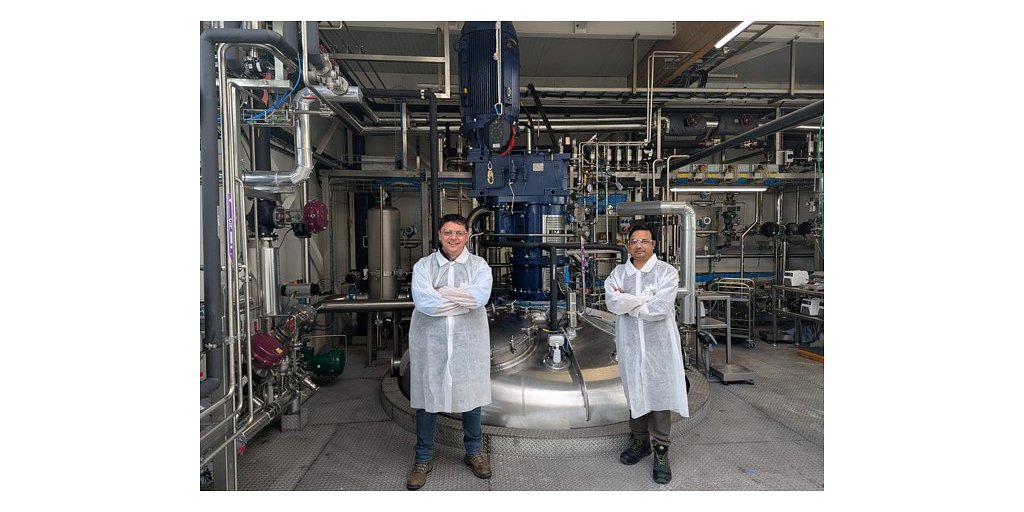
From Waste to Wing: Cemvita's Tech Transforms Glycerin into Jet Fuel
HOUSTON, TX – June 03, 2026 – In the global race to decarbonize aviation, a Houston-based synthetic biology firm has just crossed a critical milestone, demonstrating a powerful new pathway from industrial waste to sustainable flight. Cemvita recently announced the successful completion of a 75,000-liter industrial fermentation campaign, validating its technology that transforms crude glycerin—a plentiful byproduct of biodiesel production—into a high-grade renewable oil suitable for producing Sustainable Aviation Fuel (SAF).
This achievement, conducted at the renowned Bio Base Europe Pilot Plant in Belgium, is more than just a successful experiment; it's a powerful proof point for a new industrial paradigm. “Successfully reaching 75,000 liters while achieving our set target metrics demonstrates that carbon-rich effluent streams like crude glycerin can become a scalable foundation for the next generation of sustainable fuels and bio-based materials,” said Moji Karimi, CEO of Cemvita. “Biology is becoming infrastructure.”
This breakthrough signals a pivotal shift, where the principles of the circular economy are not just theoretical but are being implemented at an industrial scale. By creating a high-value product from an underutilized, low-value waste stream, Cemvita is charting a course for a more resilient and resource-efficient bioeconomy.
The Science of Upcycling
At the heart of Cemvita's innovation is a sophisticated application of synthetic biology. The company has engineered specialized microorganisms to perform a task that nature alone cannot do efficiently: consume impure crude glycerin and convert it into valuable lipids, or oils. While wild microbes might naturally accumulate 15-20% of their mass as lipids, Cemvita's proprietary strains have been optimized to achieve an astounding 90% lipid content—a four-fold improvement that dramatically enhances the process's economic viability.
The FermOil™ process begins by feeding these engineered microbes crude glycerin, which is often laden with impurities that make it difficult to use in other applications without costly purification. Cemvita's technology bypasses this hurdle, directly valorizing the raw byproduct. Once the microbes are rich with oil, a proprietary system breaks down their cell walls and separates the contents, achieving up to 98% oil recovery. In a testament to its circular design, the remaining microbial biomass doesn't go to waste; it is repurposed as a nutrient-rich biofertilizer, FermNPK™, creating a secondary value stream for regenerative agriculture.
This approach is a game-changer for the biodiesel industry, which produces approximately one pound of crude glycerin for every ten pounds of biodiesel. This has led to a global glut of the substance, depressing its price and creating a disposal challenge. Cemvita’s technology provides a robust solution, turning a liability into a key asset for the burgeoning SAF market.
From Lab Bench to Industrial Reality
A brilliant idea in a petri dish holds little value without a clear path to commercial scale. Cemvita’s journey to 75,000 liters has been a masterclass in methodical de-risking and process validation. The company progressed systematically through multiple stages, advancing from bench-scale systems to 2-liter, 30-liter, 1,500-liter, and 15,000-liter fermentations before this landmark industrial-scale demonstration.
This step-by-step progression is crucial for building confidence among investors and future partners. “Across multiple vessel runs, the fermentation control strategy remained stable, and the results were consistent all the way from 30 liters to 75,000 liters,” explained Luciano Zamberlan, VP of Engineering at Cemvita. “That level of reproducibility is exactly what gives us confidence as we move toward commercial deployment.”
The choice of partner for this critical phase was no accident. The Bio Base Europe Pilot Plant is an open-access facility renowned for helping innovative companies bridge the infamous 'valley of death' between laboratory research and industrial production. “We are proud to support innovative companies like Cemvita in scaling breakthrough industrial biotechnology solutions,” stated Hendrik Waegeman of Bio Base Europe Pilot Plant. “Successfully operating at the 75,000-liter scale using a feedstock such as crude glycerin highlights both the maturity of the technology and the quality of the scale-up execution achieved by the Cemvita team.”
Fueling the Future of Aviation
The timing of Cemvita's success could not be more opportune. The global aviation industry is under immense pressure to reduce its carbon footprint, with bodies like the International Air Transport Association (IATA) setting ambitious targets for SAF adoption. However, a major bottleneck has been the limited availability of sustainable, non-food-competing feedstocks. Cemvita's FermOil™ directly addresses this challenge.
The resulting renewable natural oil is designed for seamless integration into existing refinery infrastructure. It is fully compatible with the Hydroprocessed Esters and Fatty Acids (HEFA) pathway, the most mature technology for producing SAF today. This eliminates the need for costly new infrastructure and accelerates the path to market.
Further bolstering its commercial prospects, especially in Europe, is a key regulatory advantage. Crude glycerin is recognized under Annex IX Part A of the EU's Renewable Energy Directive (RED III). This classification designates it as an advanced feedstock, making fuels derived from it eligible for preferential treatment and helping producers meet escalating blending mandates. This regulatory alignment provides significant market tailwinds as Cemvita engages in commercial discussions across the EU, UK, and Brazil.
Charting a Global Commercial Course
With technology validated and market demand soaring, Cemvita is moving aggressively toward commercialization. The company is targeting a Final Investment Decision (FID) for its first full-scale industrial plant, dubbed FermWorks™, by 2026, with the first commercial molecules anticipated by late 2027 or early 2028. A Memorandum of Understanding is already in place with Invest RS to build this flagship facility in Rio Grande do Sul, Brazil—a region chosen for its abundant glycerin supply and supportive government.
Strategic partnerships are the cornerstone of this global rollout. Cemvita has secured a major offtake MOU with United Airlines for up to 1 billion gallons of SAF and is collaborating with Brazilian biorefiner Be8 to integrate its technology into their operations. These agreements, along with backing from investors like Occidental Petroleum's low-carbon venture arm, provide powerful market validation and a clear route to revenue.
The vision extends far beyond a single plant. Cemvita plans for its FermWorks™ facilities to be modular and replicable, enabling rapid deployment worldwide. By the end of the decade, the company aims to have new modules launching in key markets like India, the UAE, and Germany, with a long-term goal of operating over 50 facilities across the globe by 2040, cementing its role as a global leader in industrial circularity.