
- 4.5 million kilometers driven autonomously by ASI's Mobius® software
- 300 million tons of material moved autonomously
- 105% productivity increase over human benchmarks
Experts would likely conclude that ASI's playbook provides a strategic, data-driven framework for scaling industrial autonomy, though the competitive landscape remains challenging with established players like Caterpillar and Komatsu.
From Theory to Tractor: ASI’s Playbook for Scaling Industrial Autonomy
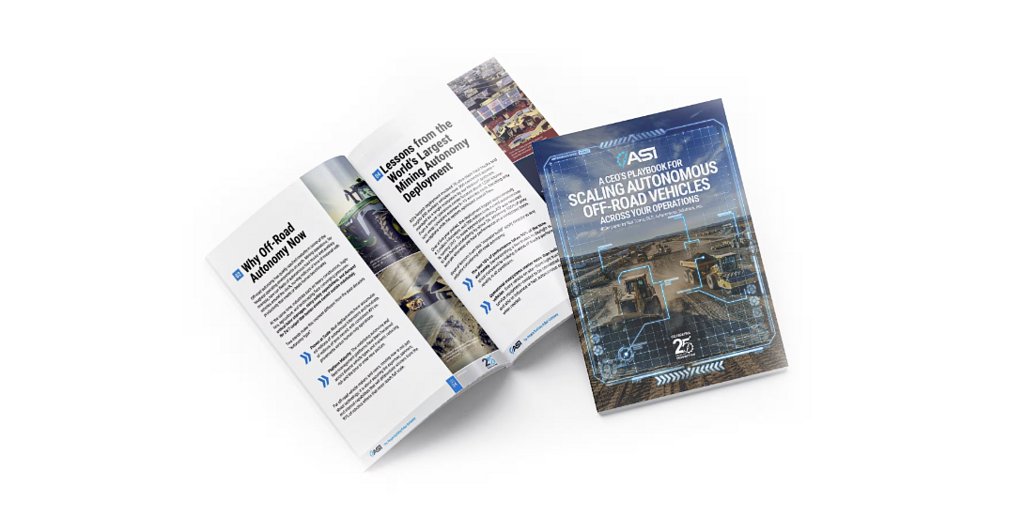
MENDON, UT – June 12, 2026 – For years, the promise of fully autonomous industrial operations has hovered on the horizon, a powerful but often distant goal for sectors like mining, agriculture, and construction. While pilot programs have demonstrated potential, the leap to full-scale, profitable deployment has remained a formidable challenge. Now, Autonomous Solutions, Inc. (ASI) is aiming to close that gap with a new white paper, “A CEO’s Playbook for Scaling Autonomous Off-Road Vehicles Across Your Operations,” designed to move the conversation from if to how.
Authored by CEO Mel Torrie, the playbook distills over two decades of the company's experience into a strategic guide for executive leaders. It argues that the era of speculative investment in autonomy is over, replaced by a new reality where scaled automation is a proven, decisive competitive advantage.
“Autonomy has moved past theory. It’s already delivering measurable results in the harshest environments on the planet,” said Torrie in the company's announcement. “The real question for leadership teams is no longer if to adopt autonomy, but how to do it safely, profitably, and at scale.”
The Executive Blueprint for Automation
The playbook directly targets the C-suite, acknowledging that successful automation is as much a business strategy decision as it is a technological one. While many companies recognize autonomy as a strategic priority, few have managed to break out of the pilot phase. Industry analysts note that common hurdles include high initial implementation costs, the complexity of integrating new systems with existing infrastructure and mixed fleets, and navigating workforce transitions.
ASI's guide aims to provide a field-proven blueprint to overcome these obstacles. The core of its teachings is drawn from what it describes as one of the largest autonomy ecosystems ever deployed: a network of over 300 autonomous assets managed by its Mobius® software. This ecosystem has logged staggering performance metrics, including 4.5 million kilometers driven autonomously and 300 million tons of material moved, all while operating 24/7 and reportedly exceeding human productivity benchmarks by 105%.
By codifying the lessons from these deployments, the playbook provides a framework for leaders to assess their operations, identify scalable use cases, and build a business case that withstands boardroom scrutiny. It shifts the focus from a single-machine trial to a holistic, fleet-wide strategy.
Navigating the Chasm from Pilot to Profit
The industrial autonomy market is booming, projected to grow from USD 23.3 billion in 2023 to over USD 69 billion by 2032. This growth is fueled by intense pressure on heavy industries to deliver more output with fewer resources, all while meeting higher safety standards and navigating persistent labor shortages. Automation offers a compelling solution, with studies indicating potential productivity gains of 15-20% and significant cost reductions in fuel and maintenance.
However, the path to realizing these benefits is complex. According to one consultant specializing in heavy industry technology adoption, the “messy reality” of dynamic, harsh worksites often derails ambitious automation projects. Integrating autonomous vehicles from one manufacturer with manned equipment from another, for example, presents a significant software and operational challenge.
This is where ASI has carved out a distinct market position. While industry giants like Caterpillar and Komatsu are dominant forces with their integrated autonomous haulage systems—together accounting for a vast majority of the world's autonomous mining trucks—ASI focuses on an OEM-agnostic approach. Its Mobius® platform is designed to retrofit and automate existing fleets, regardless of the manufacturer. This flexibility is a critical enabler for companies looking to scale automation without completely overhauling their capital-intensive equipment inventory.
This approach has been validated in diverse, real-world applications. In South Florida, U.S. Sugar is deploying a fleet of John Deere tractors fitted with ASI’s technology, creating the largest commercial use of autonomous tractors in the American sugar industry. At the other end of the spectrum, the Los Angeles Police Department uses ASI’s automation for its “BatCat” robotic vehicle, allowing operators to remotely handle bomb threats and other high-risk situations.
Data-Backed Leadership in a Competitive Field
While ASI claims leadership, the competitive landscape is formidable. Caterpillar recently surpassed 5 billion tonnes hauled autonomously with its MineStar system, boasting zero lost-time injuries over nine years. Komatsu, a pioneer with its FrontRunner system, has moved over 11.5 billion tonnes of material with its autonomous trucks. These figures underscore the maturity of high-end autonomy in the mining sector, which has long been the primary proving ground.
Against this backdrop, ASI’s playbook serves as both a strategic guide and a testament to its own credentials. The company points to its 150-acre proving ground in Northern Utah and partnerships with global Fortune 500 companies as evidence of its deep expertise. Its work with Ford Motor Company, automating punishing 24/7 durability testing on vehicle proving grounds, demonstrates the technology's reliability and its ability to remove human drivers from dangerous and physically demanding tasks.
As Torrie concludes, “Organizations that act now will define the future of their industries. Those that wait may struggle to catch up.” By releasing this playbook, ASI is making a calculated bet that the next wave of industrial transformation will be driven not just by the biggest players, but by any organization with the strategic foresight to implement a scalable plan for automation.