
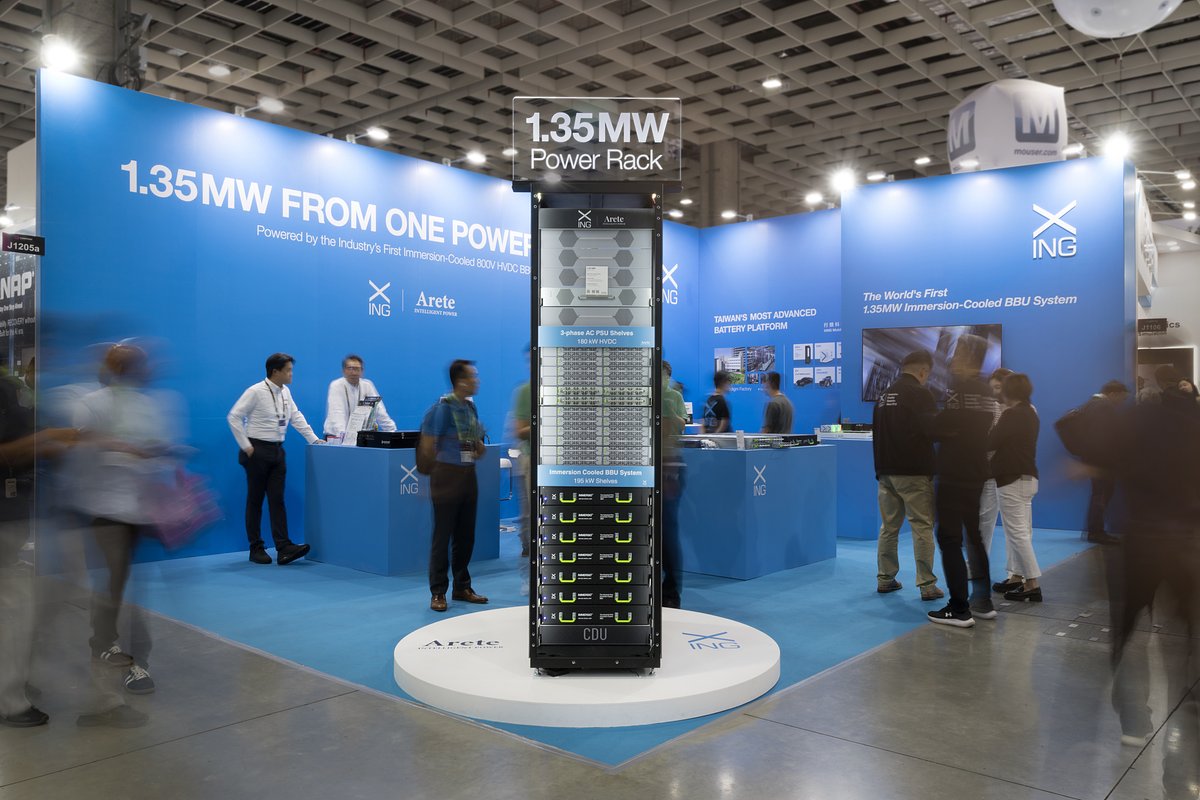
- 1.35 MW Power Rack: World's first High-Voltage DC (HVDC) power rack with immersion-cooled Backup Battery Unit (BBU).
- 2.5x Power Density: Delivers up to 2.5 times the power density of comparable air-cooled systems.
- 98% Efficiency: Claims end-to-end efficiency of over 98%, a leap from typical 85-92% in data centers.
Experts would likely conclude that this cross-industry innovation represents a significant breakthrough in addressing AI's thermal and power efficiency challenges, with potential to redefine data center operations and sustainability.
From Supercars to Supercomputers: Cooling the AI Power Crisis
TAIPEI, Taiwan – June 03, 2026 – The engine of the artificial intelligence revolution runs on two things: data and electricity. While the data is endless, the electricity—and the ability to manage the immense heat it generates—is not. This physical constraint is the single greatest bottleneck threatening to throttle the explosive growth of AI. But here at Computex 2026, a novel solution has emerged from an unlikely source, promising to shatter that ceiling by borrowing engineering principles from the world of electric supercars.
Taiwanese battery innovator XING Mobility and U.S.-based Arete Intelligent Power have unveiled what they claim is the world's first 1.35-megawatt High-Voltage DC (HVDC) power rack featuring an immersion-cooled Backup Battery Unit (BBU). This isn't just an incremental upgrade; it represents a fundamental rethinking of how to power and cool the high-density computing racks that form the backbone of modern AI, directly addressing the industry’s most critical pain points: power efficiency and thermal management.
The Thermal Bottleneck: AI’s Billion-Dollar Problem
For years, data center operators have been locked in an escalating arms race with heat. A decade ago, a standard server rack consumed 10-15 kilowatts (kW) of power. Today, a single AI training rack packed with GPUs can demand anywhere from 80 kW to over 120 kW. Industry roadmaps project that figure will climb toward 600 kW and beyond. At these densities, traditional air cooling is no longer just inefficient; it's physically impossible.
This creates a phenomenon known as thermal derating. When components overheat, their performance is automatically reduced to prevent damage. For a data center running multi-million-dollar AI workloads, this means throttling its most valuable assets precisely when peak performance is needed. The result is a direct hit to both computational output and return on investment. According to industry analysts, as much as 40% of a data center's energy consumption can be dedicated to cooling alone, a staggering operational cost that only grows as power densities rise.
This challenge is forcing a paradigm shift. The market is rapidly moving away from legacy AC power architectures—which can lose up to 25% of energy in conversions from grid to chip—toward more efficient 800V HVDC systems. This trend has been supercharged by industry giants like NVIDIA, which is aligning its next-generation AI platforms with the 800V standard. It’s within this critical context that the XING-Arete partnership makes its debut.
A Supercar Solution for a Supercomputing Challenge
The core innovation of the new power rack lies in XING Mobility’s IMMERSIO™ Backup Battery Unit. Instead of using fans to blow air over hot components, the entire battery and power conversion assembly is submerged in a non-conductive, dielectric coolant. This technique, known as immersion cooling, allows for heat to be captured directly at its source, a method thousands of times more effective than air.
This technology wasn't conceived in a traditional data center lab. XING Mobility forged its expertise under the extreme demands of high-performance electric vehicles, beginning with Taiwan's first electric supercar, MISS R, and more recently partnering with legendary British automaker Caterham on its first electric model. As XING's Founder and Chairman Royce Hong stated, "Peak output, millisecond-level dynamic response, absolute reliability under extreme conditions, these are the standards we refined building supercar-grade battery systems. Partnering with Arete to bring this immersion-cooled BBU into AI infrastructure is a natural next step for that technology."
The performance claims are striking. The system delivers up to 2.5 times the power density of comparable air-cooled battery backups and requires only one-sixth of the cooling energy. By eliminating thermal derating, it ensures the 1.35 MW of backup power is fully available on demand, capable of supporting up to two 660 kW AI racks simultaneously. The synergy with Arete Intelligent Power, which designed the high-efficiency 800V AC-to-DC power supply, results in a claimed end-to-end efficiency of over 98%. This figure is a monumental leap from the 85-92% efficiency typical of many existing data center power chains.
Redefining the Grid-to-Chip Power Chain
The impact of this level of efficiency extends far beyond a single rack. It fundamentally alters the economic equation for data center operators and has profound implications for the energy grid. The explosive growth of AI is placing unprecedented strain on utility infrastructure, with some analysts predicting that power availability, not processing power, will be the primary constraint on AI development by 2027.
By drastically reducing the energy lost to power conversion and cooling, solutions like the XING-Arete power rack can significantly lower a data center's overall demand. This efficiency is measured by a key industry metric: Power Usage Effectiveness (PUE), a ratio of total facility energy to IT equipment energy. While a typical data center might have a PUE of 1.5, advanced immersion cooling deployments can achieve a PUE below 1.05, meaning almost all energy is used for computation rather than overhead.
This efficiency translates directly into lower long-term operating costs and a reduced physical footprint, as bulky and noisy air-handling systems are no longer needed. For an industry where every percentage point of efficiency can mean millions of dollars in savings and a significant competitive advantage, the move to highly integrated, liquid-cooled HVDC systems appears not just logical, but inevitable.
The Green Imperative in an AI World
Beyond the raw economics, this technological shift addresses the growing pressure on the tech industry to ensure the AI revolution is sustainable. The massive energy footprint of AI has drawn scrutiny from regulators, investors, and the public. Building a 'green' AI infrastructure is no longer a marketing slogan but a core business imperative.
Innovations that dramatically improve PUE are central to this effort. By slashing the energy wasted on cooling by over 80% compared to conventional systems, the immersion-cooled architecture offers a clear path toward more sustainable data center operations. This aligns with the goals of ESG-focused investors and corporations seeking to minimize their environmental impact while scaling their AI capabilities.
The solution unveiled at Computex is more than just a new piece of hardware; it is a powerful example of cross-industry innovation. By adapting battle-tested technology from the demanding world of electric supercars, XING Mobility and Arete Intelligent Power are providing a compelling answer to AI's existential power question, demonstrating that the future of computing may depend on how well we can keep it cool.