
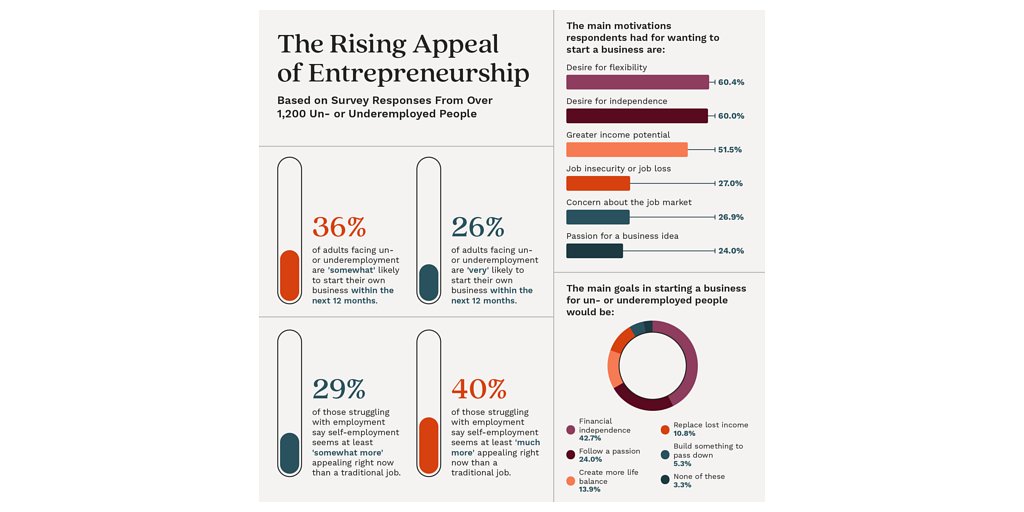
- 62% of underemployed adults are likely to launch their own business within the next year.
- 69% now view self-employment as more appealing than a traditional job.
- 430,000 new business applications filed monthly in 2024, a 50% increase from pre-pandemic levels.
Experts agree that economic uncertainty and AI-driven job displacement are fueling a surge in entrepreneurship, as individuals seek greater control and flexibility in an unstable job market.
From Layoff to Launch: Why Job Insecurity Fuels a New Startup Boom
MOUNTAIN VIEW, CA – January 15, 2026 – A seismic shift is reshaping the American career landscape as economic uncertainty and the rapid rise of artificial intelligence are pushing a growing number of adults off the traditional corporate ladder and onto the path of entrepreneurship. A new survey from online legal services platform LegalZoom reveals that for those facing unemployment or reduced work hours, the allure of starting a business is stronger than ever.
The survey of over 1,200 underemployed adults found that a staggering 62% are somewhat or very likely to launch their own business within the next year. Furthermore, 69% now view self-employment as more appealing than a traditional job, with 40% describing it as much more appealing. This pivot reflects a deep-seated desire to reclaim control in an unstable job market.
“During periods of economic transition or uncertainty, we often see a surge in entrepreneurship as people seek to take control of their future,” said Jeff Stibel, CEO of LegalZoom, in the company's announcement. “What’s striking in this data is not just the high level of interest, but the clear pattern of individuals actively pursuing a path to business ownership as a response to both personal disruption and market opportunity.”
The AI Double-Edged Sword
Fueling this professional reevaluation is the dual impact of artificial intelligence. On one hand, AI is a source of significant job market anxiety. Research from Goldman Sachs, cited in the report, suggests that AI adoption could displace the equivalent of 6-7% of the U.S. workforce, with white-collar professions like administrative assistants, programmers, and even legal roles being particularly exposed. The World Economic Forum’s projections paint a similar picture, forecasting that AI will transform 86% of businesses by 2030, rendering many current skills obsolete.
Yet, this same disruptive technology is simultaneously acting as a powerful entrepreneurial catalyst. AI is dramatically lowering the barriers to entry for starting a business, automating complex tasks from marketing and content creation to financial analysis and customer service. For a solo founder, AI-powered tools can function as a virtual team, making it possible to launch and scale a venture with fewer resources and less initial capital than ever before. This has created a new paradigm where job displacement by AI can, for some, directly lead to the creation of an AI-powered business.
This trend is visible in the real world, as individuals laid off from tech and administrative roles are now building their own ventures. One former data scientist, after a layoff, built a successful online coaching business in under a year by leveraging AI for content generation and personal branding. This reflects a broader movement of workers not just adapting to a new economy, but actively building it.
A National Quest for Control and Flexibility
The LegalZoom survey highlights that the primary drivers for this entrepreneurial pivot are deeply personal. The desire for flexibility and independence was the top motivator, cited by 60% of respondents. This was followed closely by the potential for greater income (52%), a factor especially important for underemployed individuals (61%) looking to supplement their earnings.
This isn't an isolated sentiment. The findings mirror a nationwide trend of robust entrepreneurial activity. According to the Global Entrepreneurship Monitor (GEM), Total Entrepreneurial Activity in the United States rebounded to 19% in 2024, the highest level in the report's history. Tellingly, the GEM report also found that over two-thirds of entrepreneurs cited job scarcity as a key motivation, a sentiment that has grown since 2022.
The numbers are backed by federal data. The U.S. Census Bureau’s Business Formation Statistics show a sustained boom, with the nation averaging around 430,000 new business applications per month in 2024—a 50% increase from pre-pandemic levels in 2019. This surge indicates that the desire for self-determination is translating into concrete action on a massive scale, as millions of Americans file the initial paperwork to become their own boss.
Bridging the Chasm Between Ambition and Reality
Despite the high level of interest, the path to business ownership is fraught with challenges. The survey identified significant hurdles that prevent ambition from becoming reality. A lack of start-up capital was the most cited barrier (66%), followed by fears of financial risk (56%). Nearly half of respondents admitted they were unsure where to even start (48%) or lacked the confidence to proceed (47%).
Perhaps most critically, the administrative and legal complexities of launching a business loom large. A majority of aspiring founders (59%) stated they feel unprepared for the legal paperwork and compliance requirements. This knowledge gap is a formidable obstacle, turning the dream of entrepreneurship into a source of anxiety.
This is where a growing ecosystem of support services is stepping in. Online platforms like LegalZoom, and its competitors such as ZenBusiness and Rocket Lawyer, aim to demystify the process by offering streamlined services for business formation, registered agent services, and compliance management. These tools are designed to handle the bureaucratic heavy lifting, allowing founders to focus on their core business idea.
Beyond commercial platforms, a network of government-backed and non-profit organizations provides crucial, often free, support. The U.S. Small Business Administration (SBA), along with its partners like SCORE, offers invaluable mentorship from experienced business executives. These volunteer mentors help new entrepreneurs navigate everything from writing a business plan to securing funding, directly addressing the confidence and knowledge gaps identified in the survey. Local Small Business Development Centers (SBDCs) offer similar free consulting and low-cost training, ensuring that guidance is accessible to all, not just those who can afford it.
This combination of accessible technology and human-led mentorship is creating a vital support structure. For the millions of Americans re-evaluating their careers, these resources are turning the daunting prospect of starting a business into an attainable next step, empowering a new generation of resilient founders to build their own futures in an uncertain world.
Topics & Related
Artificial Intelligence
Generative AI
AI & Machine Learning
Fintech
ChatGPT
Revenue
Related Company Pulse