
- Alliance Formation: Open Quantum Design (OQD) partners with Western Digital and QuScript to tackle quantum error correction (QEC).
- Goal: Develop advanced error correction techniques on OQD's open-source trapped-ion quantum computer.
- Challenge: Quantum error correction requires a massive 'overhead' of physical qubits for each logical one, demanding ultra-fast classical electronics for real-time corrections.
Experts view this collaboration as a strategic move to accelerate the transition from noisy, experimental quantum systems to reliable, fault-tolerant quantum computers, leveraging classical error correction expertise from Western Digital.
From Hard Drives to Qubits: A New Alliance Tackles Quantum Errors
WATERLOO, ON – March 26, 2026 – A new and unconventional alliance has formed to tackle the single greatest obstacle to practical quantum computing. Open Quantum Design (OQD), a proponent of open-source quantum hardware, today announced a working group with data storage titan Western Digital and the entrepreneurial software firm QuScript. Their shared mission: to crack the code of quantum error correction (QEC), the critical technology needed to build reliable, fault-tolerant quantum machines.
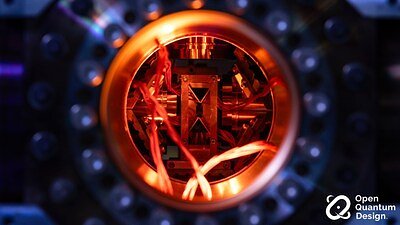
The collaboration aims to develop and demonstrate advanced error correction techniques on OQD's open-source, full-stack trapped-ion quantum computer, potentially accelerating the entire industry's transition from noisy, experimental systems to powerful, problem-solving computers.
The Fault-Tolerant Frontier
For all their promise, today's quantum computers are fundamentally fragile. The basic units of quantum information, qubits, are exquisitely sensitive to their environment. The slightest vibration or temperature fluctuation can introduce errors, a phenomenon known as decoherence, destroying the delicate quantum states needed for computation. This inherent instability means that complex calculations on current quantum systems are quickly overwhelmed by an avalanche of errors, rendering the results useless.
This is where quantum error correction becomes indispensable. Unlike classical computers, where bits are robust, QEC provides a lifeline for fragile qubits. The core idea is to encode the information of a single, ideal "logical qubit" across many less-reliable physical qubits. By constantly monitoring this collective for tell-tale signs of errors—without directly observing and collapsing the precious quantum state—the system can detect and reverse the damage.
Achieving this is a monumental engineering challenge. It requires a massive "overhead" of physical qubits for each logical one, along with ultra-fast classical electronics to decode error signals and apply corrections in real-time. Leading approaches, such as the widely studied surface code, are promising but demand a level of hardware scale and control that remains just beyond the industry's grasp. Success in QEC is not just an improvement; it is the defining threshold between today's Noisy Intermediate-Scale Quantum (NISQ) era and the long-awaited age of Fault-Tolerant Quantum Computing (FTQC).
From Hard Drives to Qubits
Perhaps the most intriguing aspect of this new working group is the participation of Western Digital. A household name in hard disk drives (HDDs) and flash storage, the company seems an unlikely player in the esoteric world of quantum mechanics. Yet, the connection is surprisingly deep.
For decades, Western Digital has perfected the art of error correction in a different domain: storing trillions of bits reliably on spinning magnetic platters. An HDD's read/write head must detect incredibly faint magnetic signals amidst a sea of electrical and thermal noise, a challenge that shares deep conceptual parallels with protecting qubits.
"Quantum error correction shares deep parallels with challenges we've mastered in hard disk drive storage systems -- managing noise, signal integrity, and reliability at massive scale," said Zvonimir Bandic, Distinguished Engineer at WD, in the official announcement. "This collaboration allows us to extend decades of error correction and precision engineering expertise directly into quantum systems."
This expertise isn't just theoretical. It involves the practical implementation of sophisticated error-correcting codes, advanced signal processing to distinguish signal from noise, and a holistic approach to system reliability honed over billions of manufactured devices. Western Digital's contribution is a bet that these battle-tested principles from classical data integrity can be adapted to manage the unique probabilistic errors of the quantum world, providing a crucial bridge from classical engineering to quantum reality.
Cracking the Code with Collaboration
The foundation of this effort is OQD's unique open-source philosophy. In a field often characterized by intense secrecy and proprietary technology, OQD is making its full-stack quantum computer—from the hardware designs of its trapped-ion system to its control software—openly accessible to its partners.
This strategy is a calculated gambit to accelerate progress by lowering barriers to participation. By creating a shared environment, the initiative invites experts from different sectors to contribute directly, test ideas, and build upon each other's work. It aims to replicate the success of open-source software projects like Linux, Qiskit, and Cirq in the far more complex and capital-intensive domain of quantum hardware.
"Open-source collaboration lowers barriers and accelerates progress," stated Greg Dick, Co-founder and CEO of OQD. "Working with industry experts from WD (Western Digital) and creative entrepreneurs from QuScript amplify what is possible."
The goal extends beyond a single technical demonstration. The working group intends to develop open protocols for error correction that could become shared standards across the industry. Such standards would foster interoperability, prevent fragmentation, and allow the entire ecosystem to build upon a common, reliable foundation.
A New Front in the Quantum Race
The announcement sends a clear signal to a competitive industry where giants like IBM, Google Quantum AI, Quantinuum, and IonQ are all racing to build the first truly fault-tolerant quantum computer. These major players have invested billions in their own, largely proprietary, QEC strategies, with Google and others recently demonstrating promising results in reducing logical qubit errors.
The OQD-led initiative presents an alternative path forward, one based on collective problem-solving rather than walled-garden development. Its success could pressure other companies to adopt more open practices, at least for certain layers of the technology stack, to keep pace with community-driven innovation.
By focusing on OQD's trapped-ion architecture—a modality known for high qubit fidelity and connectivity, which are advantageous for QEC—the collaboration is well-positioned to make meaningful contributions. The immediate goal will be to demonstrate a measurable reduction in errors on a small number of logical qubits. The long-term vision, however, is far more ambitious: to create a robust, open, and standardized framework for reliability that helps lift the entire quantum industry into its next, more practical, era. This effort represents a significant new front in the global quest for quantum advantage, where the key to unlocking the future may lie not in a single company's breakthrough, but in the power of open collaboration.