
- Top speed of WaveFly 5X: 85 km/h
- Range of WaveFly 5X: Up to 80 km
- Projected low-altitude economy value by 2030: Over $2 trillion (Morgan Stanley)
Experts would likely conclude that NAVEE's foray into low-altitude water-based flight represents a high-risk, high-reward bet with significant technological and regulatory hurdles to overcome before achieving mainstream consumer adoption.
From E-Scooters to Flying Boats: NAVEE's Gamble on the Low-Altitude Economy
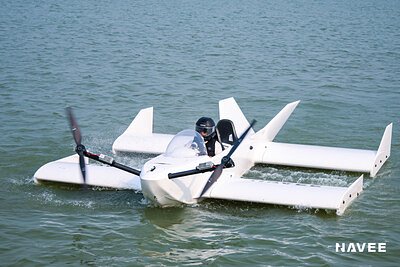
SUZHOU, China – June 05, 2026 – Over the placid surface of Dong Taihu, a vehicle unlike any other skipped across the water, its wings generating a cushion of air that lifted it into a low-altitude flight. This was the global debut of the WaveFly 5X, and for its creator, NAVEE, it represented a monumental leap. Best known for its popular line of electric scooters navigating city streets, the company has now plunged into the nascent world of personal water-based flight.
The WaveFly 5X is what’s known as a Wing-in-Ground (WIG) craft, a hybrid vehicle that blurs the line between boat and airplane. Built from aerospace-grade carbon fiber and sporting a dual tandem-wing structure, it’s designed to operate just meters above the water. The successful maiden flight, witnessed by a global audience of media and partners, was more than a product launch; it was a bold declaration of intent. NAVEE, a brand synonymous with last-mile land transport, is betting its future on a connected mobility ecosystem spanning ground, water, and air.
"Mobility innovation should not be limited by terrain or conventional transportation categories," said Lu Jian, President of NAVEE, in a statement accompanying the launch. "WaveFly 5X marks an important step in bringing water-based, low-altitude mobility for personal use." It's a grand vision, but one that propels the company from a well-understood market into a far more complex and uncertain one.
A New Frontier for Personal Mobility
At its core, the WaveFly 5X leverages a fascinating aerodynamic principle known as “ground effect.” As the craft gains speed, air becomes trapped between its wings and the water's surface, creating a high-pressure cushion that dramatically increases lift and reduces drag. This allows for highly efficient flight at low altitudes, a concept that has been explored for decades, primarily for military and commercial cargo applications.
NAVEE's innovation is its attempt to package this technology into a "consumer-grade" product. The specifications are certainly compelling for the recreational market: a top speed of 85 km/h, a range of up to 80 km, and a payload of 140 kg—enough for a single rider and some gear. In a world populated by high-performance personal watercraft (PWCs) and the recent emergence of electric hydrofoils (e-foils), the WaveFly 5X aims to create an entirely new category of water-based thrill.
However, the term "consumer-grade" carries significant weight. It implies a level of accessibility, safety, and affordability that has so far eluded WIG technology. While pricing remains undisclosed, the use of a full carbon fiber body suggests a premium product. Its true competitors may not be just Sea-Doos and WaveRunners, but also light sport aircraft and other high-end recreational vehicles. Success will depend on whether NAVEE can convince consumers that the novel experience of skimming above the waves is worth the premium and the learning curve.
The Multi-Trillion Dollar Bet
The launch is strategically timed to capitalize on the burgeoning “low-altitude economy,” a sector Morgan Stanley projects could exceed $2 trillion by 2030. While much of that forecast is built on urban air mobility and drone logistics, NAVEE is carving out a niche on the water's surface. The company’s move is a calculated diversification, a pivot from the crowded e-scooter market toward a blue-ocean opportunity where it can be a first-mover.
The announcement that multiple international distributors have already signed letters of intent (LOI) adds commercial credibility to the debut. However, it's crucial to understand that an LOI is a non-binding expression of interest, not a firm purchase order. It’s a starting point for negotiation, contingent on pricing, certification, and a clear path to market. This strategy suggests an ambitious plan for a simultaneous global rollout, but it also multiplies the logistical and regulatory complexities the company will face.
This venture is a textbook example of a company attempting to expand its total addressable market by redefining its core identity. NAVEE is no longer just a scooter company; it’s positioning itself as an integrated mobility platform. The WaveFly 5X is the flagship of this new identity, a high-risk, high-reward gambit that will test the company's ability to execute on a vision that extends far beyond the pavement.
Navigating Uncharted Regulatory Waters
For all its technological promise, the greatest obstacle facing the WaveFly 5X is not engineering but bureaucracy. WIG crafts occupy a regulatory no-man's-land, hovering uncomfortably between maritime and aviation law. Is it a boat that flies, or a plane that never truly leaves the ground?
International and national bodies have struggled with this question for years. The International Maritime Organization (IMO) generally classifies WIGs as ships, provided they operate exclusively in ground effect. In the United States, jurisdiction is split between the Federal Aviation Administration (FAA) and the U.S. Coast Guard, with no clear, dedicated framework for a consumer-grade WIG. A similar ambiguity exists in Europe. China, with its top-down push for a low-altitude economy, may be the first to create a specific, streamlined regulatory pathway, potentially giving NAVEE a home-field advantage.
For the consumer, this ambiguity translates into critical unanswered questions. Will operators need a pilot's license, a maritime captain's license, or a new, bespoke certification? How will insurance be underwritten for a vehicle class with no historical data? And what safety standards will the craft be required to meet? "The technology might be ready, but the rulebook hasn't been written yet," noted one industry analyst. "That's the biggest risk for any consumer-facing pioneer in this space."
From Pavement to Waves: A Question of Expertise
NAVEE has earned a solid reputation in the micro-mobility sector, with its N-series and S-series scooters being recognized for robust construction and performance. The company has proven its ability to manage a consumer electronics supply chain and deliver reliable products for urban commuting. But designing and manufacturing a WIG craft is a challenge of a different magnitude.
The project required a five-year development cycle, signaling a serious and long-term investment in R&D that goes far beyond tweaking battery packs and motor controllers. It demands deep expertise in aerodynamics, hydrodynamics, advanced materials, and the complex flight control systems needed to keep a WIG craft stable and safe, especially in variable wind and wave conditions. While NAVEE touts its “intelligent” product DNA, the stakes for a control system failure are exponentially higher on a WIG craft than on an e-scooter.
The WaveFly 5X is a testament to the company's ambition, and its successful maiden flight is a significant technical achievement. NAVEE has charted its course into a new dimension of mobility, one filled with both incredible potential and formidable challenges. The true test will not be on the water, but in the conference rooms of regulators and the unforgiving calculus of the consumer market.