
- 100 million 5G-A users globally already online, with commercial deployments accelerating.
- 20 Mbps uplink required for real-time multimodal AI interactions like AI glasses.
- 80% of the world’s population in regions where U6 GHz spectrum is designated for mobile communications.
Experts would likely conclude that Huawei's 'token economy' model represents a strategic pivot for telecom carriers, shifting from commoditized data transport to monetizing AI-driven intelligence—a move that could redefine the industry's value chain if widely adopted.
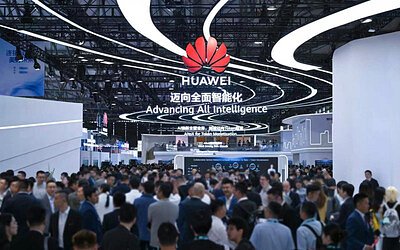
From Bytes to Tokens: Huawei's Blueprint for the AI-Powered Telecom Future
SHANGHAI, CN – June 24, 2026 – For decades, the business model for the world’s telecommunication carriers has been deceptively simple: build bigger pipes and charge for the data, or bytes, that flow through them. But at this year’s MWC Shanghai, Huawei unveiled a strategy that signals a fundamental break from that past. The company is championing a future built not on bytes, but on 'tokens'—a move designed to transform carriers from commoditized data plumbers into central players in the burgeoning AI economy.
This vision hinges on what the tech giant calls 'Service-Network-Compute Integration,' a plan to re-architect global networks to monetize the intelligence generated by AI models. Speaking at the event, David Wang, Huawei's Deputy Chairman, framed the shift as an existential necessity. "As mobile communications enters the age of intelligence, there are six key imperatives that will pave the way for the next decade of industry growth," he stated, outlining a future where AI and mobile communications are inextricably linked.
This isn't just another incremental upgrade. It's a proposed rewriting of the economic rules that govern our digital infrastructure. By shifting the unit of value from data volume to AI processing, Huawei is betting that the future of carrier profitability lies in enabling and delivering intelligence itself.
Deconstructing the 'Token Economy'
The term 'token' can be misleading, evoking images of cryptocurrencies and blockchain. However, in Huawei’s lexicon, a token is a unit of AI consumption. Think of it as a metered charge for an action performed by an AI model—translating a sentence, generating an image, or processing a query from a personal AI agent. It represents a shift from monetizing the transport of raw data to monetizing the creation and application of valuable information.
This concept is born from the changing nature of network traffic. The explosion of AI agents and sophisticated applications like real-time multimodal interaction on AI glasses—which can require a sustained 20 Mbps uplink—creates a demand profile that the old 'byte monetization' model fails to capture. The value is no longer in the volume of data downloaded, but in the real-time, interactive intelligence being delivered. Carriers that simply provide the data pipe risk being left behind, their infrastructure supporting a high-value economy from which they can't profit.
Huawei is already putting this theory into practice. Its cloud division has introduced a 'Token Service' in the Asia Pacific region, offering a pay-per-use billing model for access to its AI Model-as-a-Service (MaaS) platform. This provides a concrete example of how carriers could package and sell AI capabilities, generating revenue from the entire lifecycle of token generation, transmission, and application.
The Engine Room: 5G-A and U6 GHz
This ambitious token-based future cannot run on today's networks. It requires a profound infrastructure upgrade, an engine room powered by two key technologies: 5G-Advanced (5G-A) and the Upper-6 GHz (U6 GHz) spectrum.
5G-A, sometimes called 5.5G, is the next evolution of 5G, and its standout feature for the AI era is its high-uplink capability. While previous network generations focused on download speeds for content consumption, interactive AI demands a more symmetric relationship. Users are constantly sending queries, voice commands, and real-world data to AI agents, making robust uplink crucial. With over 100 million 5G-A users already online globally and commercial deployments accelerating, the foundation is being laid. Huawei is working with carriers to monetize this enhanced experience, aiming to increase average revenue per user (ARPU) by offering premium, AI-ready connectivity.
Supporting this is the strategic allocation of new spectrum. Huawei identifies the U6 GHz band as the 'next-generation golden frequency band' for AI services. This swath of spectrum is essential for building the ultra-broadband, high-capacity, and low-latency networks that token services will demand. The global regulatory landscape is moving in concert; over 20 countries and regions, representing nearly 80% of the world’s population, have designated U6 GHz for mobile communications. The first commercial deployments are imminent, with networks expected to go live in the Middle East, Hong Kong, and Macao in 2026, marking a critical step toward making this vision a reality.
Rewriting the Carrier Business Model
At its core, Huawei's strategy is a blueprint for carriers to escape the 'dumb pipe' trap. The proposed 'AI-centric target network' is designed to do more than just transport data; it's engineered to perform network-wide compute scheduling. In this model, connecting to the network becomes synonymous with accessing compute power.
This shift has a dual impact on a carrier's business. First, it unlocks new revenue streams. By collaborating with partners like China’s three major carriers, Huawei is already exploring how to reengineer consumer, home, and business services with AI. This could manifest as carrier-branded smart home assistants, AI-powered personal communication agents, or integrated compute-and-network packages for enterprises. The goal is to drive token consumption and capture value directly from the AI services customers use.
Second, it promises a revolution in operational efficiency. By embedding AI into the network itself, carriers can move toward Level-4 autonomous networks. Huawei's work in this area is already delivering domain-specific intelligence for maintenance, optimization, and energy management. This automation not only reduces operating expenditures but also allows carriers to deliver higher-quality, differentiated services for demanding scenarios like high-speed rail or crowded event venues, creating a virtuous cycle of better service and increased network momentum.
Navigating an AI-Native Future
Ultimately, Huawei is advocating for an 'AI-native' architecture—a ground-up redesign of networks and services built around the assumption that intelligence is the primary payload. This involves building multi-agent collaboration platforms at the service layer and embedding intelligence at every level of the network, a vision that extends far beyond the telecom sector.
This aggressive push for technological leadership is also taking place within a complex geopolitical landscape. While facing restrictions in some Western markets, the company is forging ahead, leveraging its deep integration with carriers in Asia, the Middle East, and other regions to create de facto standards for the next generation of network infrastructure. Its stated emphasis on supporting open-source and open ecosystems for its AI computing infrastructure can be seen as a strategic effort to foster broader collaboration and mitigate political friction.
By championing the shift from bytes to tokens, Huawei is not merely introducing a new billing model. It is proposing a structural re-architecture of the digital economy, placing the network carrier at the center of a new value chain powered by artificial intelligence. How the industry responds to this blueprint will define the competitive landscape for decades to come.