
- India's AI sector valued at over $9 billion in 2024, projected to reach $130 billion by early 2030s
- 30%+ compound annual growth rate for India's AI market
- 400 million 5G subscribers in India, contributing significantly to GitHub AI projects
Experts view this Franco-Indian AI alliance as a strategic move to promote ethical, sovereign AI development and counterbalance U.S. and Chinese dominance in global technology.
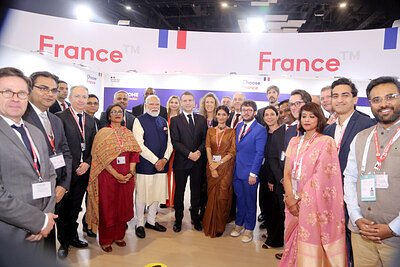
France and India Forge AI Alliance to Shape a New Tech Order
NEW DELHI, India – February 25, 2026 – A landmark week of high-stakes diplomacy and technological showcases has culminated in a formidable Franco-Indian alliance, poised to influence the global trajectory of artificial intelligence. The inauguration of the "India-France Year of Innovation 2026" by Prime Minister Narendra Modi and President Emmanuel Macron, set against the backdrop of France's commanding presence at the India AI Impact Summit & Expo, signals a strategic deepening of ties that extends far beyond trade, aiming to forge a new axis in the world's technological power structure.
A "Special Global Strategic Partnership"
The flurry of activity in New Delhi and Mumbai was far more than a trade mission; it represented the public launch of a newly elevated "Special Global Strategic Partnership." This framework, designed to guide bilateral cooperation for decades, positions the two nations as key partners in building a multipolar world order. Both Paris and New Delhi have articulated a vision for a "third way" in global technology and geopolitics, one that champions strategic autonomy and seeks to counterbalance the dominance of the United States and China.
This shared vision is firmly rooted in the Indo-Pacific, where both countries have significant interests. Guided by their "Horizon 2047 Roadmap," France, an Indo-Pacific resident power, and India, a pivotal regional actor, are leveraging technology to reinforce a rules-based order. The collaboration on AI, cybersecurity, and deep tech is seen as a critical component of this strategy, aiming to build resilient, trusted digital ecosystems free from the coercive influence of any single power bloc. The "Year of Innovation" serves as the operational vehicle for this ambition, with planned collaborations across aerospace, health, sustainable development, and creative industries.
The Blueprint for Sovereign and Ethical AI
At the heart of the partnership lies a shared philosophical commitment to developing ethical, responsible, and sovereign AI. This contrasts sharply with the often-unregulated, growth-at-all-costs approach seen elsewhere. The collaboration aims to set a global standard for AI development that prioritizes trust, human rights, and societal well-being. This was a recurring theme throughout the India AI Impact Summit, which concluded with the adoption of the multilateral "New Delhi Declaration on AI Impact," a commitment endorsed by nearly 90 nations to pursue safe, secure, and trustworthy AI.
France's approach is heavily influenced by its national AI strategy and the European Union's landmark AI Act, which mandates risk-based regulation. French officials, including Minister Delegate for AI Anne Le Hénanff, emphasized France's commitment to responsible governance. This aligns with India's own "AI for All" vision, which seeks to harness AI for public good while ensuring digital sovereignty. The presence of influential figures like AI pioneer Yann LeCun and French Special Envoy for AI Anne Bouverot lent significant weight to this ethical discourse. LeCun, who recently launched his own AI research lab in Paris, has been a vocal advocate for open research, a principle that resonates with India's focus on building its domestic talent pool.
From Policy to Practice: Deals and Demonstrations
The high-level strategic alignment was substantiated by a wave of concrete deals and practical demonstrations. The French Pavilion at the India AI Impact Summit, organized by Business France, was the largest international presence at the expo, a 436-square-meter showcase of French industrial and technological prowess. It brought together 29 leading companies, including strategic partners like CMA CGM, TotalEnergies, Capgemini, and Schneider Electric.
The summit catalyzed several significant agreements. A joint venture between India's Bharat Electronics Limited (BEL) and French aerospace firm Safran to produce Hammer missiles domestically underscores the deepening defense co-production. Similarly, the inauguration of an H125 helicopter assembly line, a joint venture between Tata Advanced Systems and Airbus, moves the relationship beyond a simple buyer-seller dynamic.
Further collaborations were announced in critical sectors, including a proposed Centre on Advanced Materials and an Indo-French Centre for AI in Health at AIIMS, New Delhi, involving a partnership between Sorbonne University and the Paris Brain Institute. On the expo floor, companies offered a glimpse into the future, with CMA CGM providing a live demonstration of Digital Twin-enabled maritime operations, showcasing how AI can optimize complex global supply chains.
Tapping India's AI Gold Rush
Underpinning this strategic convergence is a powerful economic reality: India's AI market is exploding. While the official press release cited a conservative figure, recent market analysis values India's AI sector at over $9 billion in 2024 and projects a compound annual growth rate exceeding 30%, making it one of the world's most dynamic technology markets. The market is projected to surge towards $130 billion by the early 2030s.
This rapid growth is fueled by a perfect storm of factors: a massive and growing pool of digital data, a government-led push for digital transformation through initiatives like the $1.24 billion IndiaAI Mission, a burgeoning startup ecosystem, and a vast, increasingly skilled talent pool. With over 400 million 5G subscribers and the world's second-largest contribution to GitHub AI projects in 2024, India possesses both the infrastructure and the human capital to become a global AI powerhouse.
The French delegation, comprising over 110 companies, was a clear signal of France's intent to be a primary partner in this journey. French innovators showcased solutions in agritech, decarbonization, and industrial automation tailored to India's specific needs. By embedding French technology and expertise within India's rapidly scaling digital economy, the partnership aims not only to generate significant economic returns but also to co-develop solutions that can be scaled globally, cementing the Franco-Indian alliance as a defining force in the next era of technological innovation.