
- Four large-scale, high-grade targets identified, including Wolverine (2,400 x 650m) with up to 0.14% DTR nickel
- First-ever drill program planned for summer 2026 at Advocate Nickel Property
- JOGMEC funding 60% of project expenditures, validating technical and geopolitical confidence
Experts would likely conclude that FPX Nickel's Advocate project represents a high-potential, low-carbon nickel play with strong geological prospects, strategic partnerships, and favorable jurisdictional advantages.
FPX Nickel's Newfoundland Bet: A Strategic Play on Greener Metal
VANCOUVER, BC – June 23, 2026 – In the world of mineral exploration, a press release announcing positive sampling results is common. But when FPX Nickel Corp. detailed its latest findings from the Advocate Nickel Property in Newfoundland, it signaled more than just a promising find. The identification of four large-scale, high-grade targets and a commitment to an inaugural drill program this summer represents a calculated move in a much larger game—one that intersects technological innovation, geopolitical strategy, and the global scramble for clean energy metals.
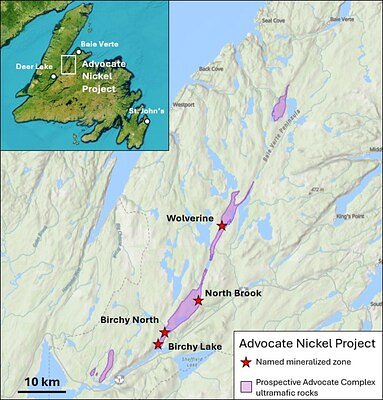
The Vancouver-based company has confirmed that its exploration efforts have delineated significant zones of awaruite, a unique nickel-iron alloy, at Advocate. The results are compelling enough to fast-track the project to its first-ever drilling phase. Among the identified zones, the Wolverine target stands out, sprawling across 2,400 by 650 meters with samples yielding up to 0.14% Davis Tube Recoverable (DTR) nickel. Close behind is the now drill-ready Birchy North target, an 800 by 350-meter area showing consistently high grades.
"I congratulate our field teams on the significant progress made to date at Advocate," commented Keith Patterson, FPX's Vice President, Exploration. "Each sampling campaign has resulted in new discoveries, with Birchy North now confirmed as our first drill-ready target. I'm looking forward to continued work with our joint venture partners JOGMEC in the 2026 field season, including the execution of our first drill program at the Property this summer."
Beneath the surface of these technical achievements lies a multi-layered corporate strategy. FPX is not merely expanding its footprint; it is validating a specific, and potentially revolutionary, approach to nickel production at a time when the world is demanding more of the metal, but with a smaller environmental footprint.
The Awaruite Advantage
To understand the significance of the Advocate project, one must first understand awaruite. Unlike the vast majority of global nickel resources, which are locked in sulfide or laterite ores, awaruite is a naturally occurring nickel-iron alloy. This distinction is not merely geological; it is profoundly economic and environmental.
Traditional nickel production is an energy-intensive and often polluting business. Sulfide ores require smelting, a process that can release significant quantities of sulfur dioxide. Laterite ores, common in tropical regions, typically demand either pyrometallurgical methods or High-Pressure Acid Leaching (HPAL), both of which are capital-intensive and carry substantial environmental liabilities. Awaruite, however, has a unique superpower: it is highly magnetic.
This property allows for a dramatically simpler and cleaner processing path. Instead of complex chemical flotation or high-temperature smelting, awaruite can be concentrated using magnetic separation—a well-established, low-cost technology borrowed from the iron ore industry. The metric used to measure this potential, Davis Tube Recoverable (DTR) nickel, is therefore the most critical number in FPX's announcements. High DTR values, like those reported at Advocate, indicate that a significant portion of the nickel is in a form that can be easily and cheaply separated from the host rock.
The end product is a high-grade nickel concentrate with very low impurities, ideal for the stainless steel industry. Furthermore, this concentrate can be refined into battery-grade nickel sulfate for the electric vehicle market, but without the massive carbon footprint associated with conventional methods. This positions awaruite projects as a potential source of low-carbon, ethically sourced nickel for Western supply chains.
Newfoundland's Nickel Frontier
The choice of Newfoundland for this strategic expansion is no accident. The Advocate property, located on the Baie Verte Peninsula, is situated in a jurisdiction with a rich mining history and, crucially, a government eager to support the development of critical minerals. As Canada's second-largest nickel-producing province, Newfoundland and Labrador offers a stable and predictable regulatory environment.
More practically, the project is surrounded by essential infrastructure. It lies just 5 to 10 kilometers from the Trans-Canada Highway and is accessible via a network of logging roads. Critically, the property vendor operates a deep-sea port at Pine Cove, about 50 kilometers away, offering a direct route to global markets. This pre-existing infrastructure dramatically lowers the logistical hurdles and capital costs that often plague remote exploration projects, providing a significant de-risking factor from day one.
De-Risking Discovery: The JOGMEC Partnership
Perhaps the most telling aspect of FPX's strategy is the partner standing beside it: JOGMEC, the Japan Organization for Metals and Energy Security. Advocate is the first "Designated Project" to emerge from a global generative alliance formed between the two entities in 2023. Under the agreement, JOGMEC is funding 60% of the project's expenditures.
This is not simply a financial transaction; it is a powerful geopolitical endorsement. Japan, a manufacturing powerhouse with a near-total reliance on imported raw materials, has a national security mandate to secure stable, long-term supplies of critical minerals from politically reliable partners. JOGMEC's investment in Advocate is a direct reflection of its confidence in both the technical merits of awaruite and the stability of Canada as a resource jurisdiction.
For FPX shareholders, the partnership is a masterstroke of risk mitigation. It provides a significant source of non-dilutive funding for early-stage exploration, validates the company's geological model, and secures a powerful ally with a vested interest in seeing the project succeed through to production.
A Two-Pronged Strategy
Advocate does not exist in a vacuum. It serves as a strategic complement to FPX's flagship Baptiste Nickel Project in British Columbia. Baptiste is a world-class deposit, one of the largest undeveloped nickel resources globally, and is already at the advanced Preliminary Feasibility Study (PFS) stage. The geological model and processing flowsheet perfected at Baptiste are now being directly applied to Advocate.
The DTR nickel grades being reported at Advocate's targets (up to 0.14%) are directly comparable to the average grade of Baptiste's massive mineral reserve (0.13%). This suggests that FPX may be on the verge of proving up a second, cornerstone asset. By diversifying its portfolio into a second top-tier Canadian mining jurisdiction, FPX is building a multi-asset platform. This strategy reduces single-project risk and positions the company to become a leading independent supplier of low-carbon nickel, leveraging its unique expertise in awaruite to meet the surging demands of a world in transition.