
- 50-meter night vision range: The FOSSiBOT F113 offers the world's first 50-meter ultra-long-distance infrared night vision system, a significant leap from the typical 5-20 meter range of competitors. - 20,000mAh battery: The device features an exceptionally large battery designed for multi-day endurance, three to four times larger than typical flagship smartphones. - $279 launch price: The F113 is priced competitively at $279, undercutting many rival rugged phones that retail for over $400 without comparable night vision capabilities.
Experts would likely conclude that the FOSSiBOT F113 represents a significant advancement in rugged smartphone technology, particularly for professionals and adventurers who require reliable night vision and extreme durability, potentially setting a new standard in the industry.
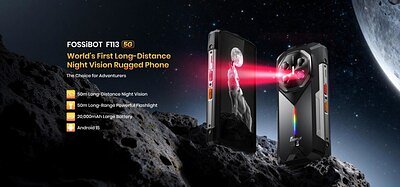
FOSSiBOT F113: A 50-Meter Leap in Smartphone Night Vision
SHENZHEN, China – November 28, 2025 – In the hyper-competitive landscape of mobile technology, innovation often arrives in incremental steps. A slightly faster processor, a marginally better camera, a slimmer design. But once in a while, a product emerges that takes a significant leap, challenging the established boundaries of what a device can do. Today, that challenge comes from the rugged smartphone sector, with FOSSiBOT's launch of the F113, a device that aims to give its users the power to see clearly in absolute darkness from an unprecedented distance.
The FOSSiBOT F113 is not just another durable handset built to withstand drops and dunks. Its headline feature is what the company claims is the world's first 50-meter ultra-long-distance infrared night vision system integrated into a smartphone. This isn't a minor improvement; it's an order-of-magnitude jump over the 5 to 20-meter range typical of competing night-vision-equipped phones. For professionals and adventurers who operate when the sun goes down, this development could shift the smartphone from a convenient backup to an essential piece of primary equipment.
A New Standard for Seeing in the Dark
At the heart of the F113's capability is a sophisticated 64-megapixel infrared night vision camera, paired with a powerful 3-watt IR light and a specially designed long-distance optical structure. This combination is engineered to cut through total darkness, illuminating subjects up to 50 meters (approximately 164 feet) away. Early reports suggest the system maintains clarity even in adverse conditions like fog and rain, where traditional visibility is compromised.
The strategic implications are profound. For search and rescue teams, this means being able to scan a dark, hazardous area for a missing person from a safer distance. For wildlife biologists, it offers a non-invasive way to observe nocturnal animals in their natural habitat without disturbance. Security professionals can conduct night patrols with enhanced situational awareness, identifying potential threats long before they are within close range. "It's a standout feature," noted one early tester, describing the capability as "remarkable in total darkness" for users who need a genuine survival or work tool.
To complement this visual prowess, FOSSiBOT has also equipped the F113 with a dedicated 1.5W long-distance flashlight, also rated to illuminate targets up to 50 meters away. This is not the typical LED flash found on consumer phones; it’s a powerful beam designed for long-range spotting, effectively turning the device into a high-performance torch. This dual-pronged approach to nighttime utility—passive IR vision and active illumination—makes the F113 a uniquely capable tool for any low-light operation.
The Rugged Phone Arms Race Heats Up
FOSSiBOT is a relatively young company operating in a niche dominated by established Chinese brands like Doogee, Ulefone, and Blackview. In this "rugged phone arms race," manufacturers constantly vie for an edge by integrating specialized hardware, from thermal imaging cameras to laser rangefinders. With the F113, FOSSiBOT is making a bold strategic play, choosing to innovate aggressively in one specific, high-impact area rather than competing on all fronts.
This focus on a breakthrough feature is a classic disruption tactic. By creating a device with a capability that is demonstrably superior to anything else on the market, the company can attract a dedicated user base for whom that feature is a mission-critical requirement. This strategy is bolstered by a very competitive pricing model. With a limited-time launch price of $279, the F113 significantly undercuts many rival rugged phones, some of which retail for well over $400 without offering a comparable night vision range.
However, the F113 is far from a one-trick pony. It is powered by the MediaTek Dimensity 7050 chipset, a modern processor that delivers stable 5G connectivity and solid mid-range performance. This is paired with a generous 12GB of physical RAM, which can be virtually expanded to an enormous 36GB, and 256GB of internal storage expandable up to 2TB. These specifications ensure that the device is not just a specialized tool but also a capable and responsive daily driver.
The Ultimate Endurance Companion
For the target user of a rugged phone, a dead battery in a remote location is not an inconvenience; it's a critical failure. FOSSiBOT has addressed this head-on by equipping the F113 with a colossal 20,000mAh battery. This capacity is three to four times larger than that of a typical flagship smartphone, designed to power the device through multiple days of active, off-grid use. It cements the phone's role as a dependable lifeline in the field.
The company's focus on endurance is a core part of its brand identity, with previous models also featuring exceptionally large batteries. The F113 continues this tradition, promising stable power output even in extreme temperatures, from frigid mountain peaks to harsh desert environments.
Furthermore, the F113 doubles as a mobile power bank. With 18W reverse charging capability, it can be used to recharge other essential gadgets like GPS devices, headlamps, or even another phone. This transforms the F113 from a personal communication device into a central power hub for an entire expedition kit, enhancing its value proposition as the ultimate endurance companion.
Built for the Extremes, Inside and Out
A specialized tool is only as good as its durability, and the F113 is built to survive. The device is encased in a ruggedized chassis that provides IP68-rated protection against water and dust, and it's engineered to withstand drops and impacts. The 6.78-inch FHD+ display is shielded by Corning Gorilla Glass, offering superior scratch and impact resistance.
FOSSiBOT has also included several quality-of-life features tailored for its audience. A "Glove Mode" allows the screen to be operated without exposing hands to the cold, a crucial feature for worksite or winter use. The powerful 1134 BOX speaker, driven by a K-class amplifier, can reach up to 110 decibels, ensuring that calls and alerts can be heard over the noise of heavy machinery or howling winds. An integrated barometer provides real-time altitude and atmospheric pressure data, useful for mountaineering and weather prediction.
Even with its utilitarian focus, the phone incorporates a touch of modern design with a customizable rear dynamic "breathing light." This allows users to personalize lighting effects for notifications, calls, and music, adding a bit of personality to a device built for pure function.
By integrating a truly disruptive night vision system with extreme battery endurance and a full suite of rugged features, the FOSSiBOT F113 is more than just an iteration. It represents a significant step forward in the evolution of the smartphone as a specialized professional tool, blurring the line between a communication device and dedicated field equipment. Its aggressive pricing and focused innovation may very well force competitors to look beyond incremental upgrades and rethink what is possible in the rugged tech space.