
- $5 million funding round (total $7.1 million raised in 12 months)
- Q500 flywheel lifespan: 30 years with no degradation
- Potential 38% cost advantage over lithium-ion in high-cycle applications
Experts view Qnetic's flywheel technology as a promising alternative to lithium-ion batteries for grid storage, offering superior durability, safety, and cost-effectiveness in long-duration applications.
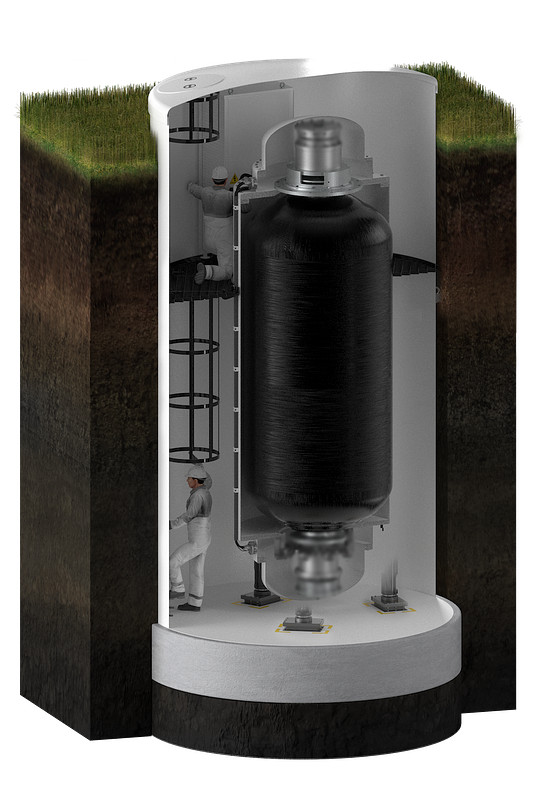
Flywheel Power: Qnetic Raises $5M to Build U.S. Energy Storage Alternative
NEW YORK, NY – March 04, 2026 – Energy storage innovator Qnetic has secured a $5 million funding round to accelerate the U.S. manufacturing and deployment of its long-duration flywheel systems, a technology poised to challenge the dominance of lithium-ion batteries in the grid storage market. The capital injection, its largest to date, brings the company's total raised in the last 12 months to $7.1 million, following a successful $2.1 million equity crowdfunding campaign.
The funds are earmarked for fitting out a California manufacturing center and launching pilot projects with utilities and national laboratories. This move signals a critical scale-up for a technology that promises a safer, longer-lasting, and more cost-effective solution for stabilizing a power grid increasingly reliant on intermittent renewable energy.
A Mechanical Answer to a Chemical Problem
At the heart of Qnetic’s strategy is the Q500, a “mechanical battery” that stores energy not through a chemical reaction, but as rotational kinetic energy. The system uses electricity to spin a large, high-tech composite rotor at high velocity within a vacuum-sealed chamber. Levitating on a frictionless magnetic cushion, the rotor maintains its momentum with minimal energy loss, ready to convert that motion back into electricity when needed.
This mechanical approach sidesteps many of the inherent limitations of today's electrochemical batteries. Qnetic projects a 30-year operational lifespan for its flywheels with no degradation in performance, a stark contrast to lithium-ion batteries which lose capacity over time. Furthermore, the system can perform unlimited daily charge-discharge cycles without wear, a crucial capability for managing the daily fluctuations of solar and wind power. Perhaps most critically, the technology carries zero risk of thermal runaway—the dangerous and difficult-to-control fires that have plagued some lithium-ion installations.
“It’s clear that the market is ready for a truly innovative energy storage solution, one that’s made in the U.S. of metals, magnets and carbon fiber, with no mineral or supply chain bottlenecks,” said Michael Pratt, Qnetic co-founder and CEO, in a statement. The company's reliance on common materials offers a strategic advantage, insulating it from the volatile supply chains and geopolitical tensions associated with cobalt and lithium mining.
Scaling Up with Strategic Capital and U.S. Manufacturing
The new funding round, which included participation from venture firms SOSV, Kingscrowd Capital, and D3 Venture Capital, provides Qnetic with the institutional backing to transition from development to production. The primary goal is to establish a low-volume production line for the Q500 system at a new facility in California.
This “Made in America” approach is not just a talking point; it’s a strategic move to enhance supply chain resilience and tap into a growing policy push for domestic clean energy manufacturing. By producing its systems in the United States, Qnetic may be positioned to benefit from incentives under the Inflation Reduction Act, further improving its cost-competitiveness. An academic report from Imperial College London has already suggested that Qnetic's flywheel could be up to 38% cheaper than lithium-ion batteries over its lifecycle in certain high-cycle applications.
While lithium-ion technology benefits from massive economies of scale driven by the electric vehicle market, its cost-reduction curve may be flattening for grid-scale applications. Qnetic and other long-duration storage players are betting that specialized, durable technologies will ultimately prove more economical for the unique demands of the power grid.
From Lab to Grid: Validation and Market Demand
Before utilities widely adopt a new technology, they demand rigorous, independent proof of its performance and reliability. Recognizing this, Qnetic has forged key partnerships to validate its flywheel systems. The company has signed agreements with the Electric Power Research Institute (EPRI) and the National Lab of the Rockies (formerly NREL), two of the country's most respected energy research institutions.
Over the next 18 to 24 months, these partners will formally assess and validate the technology across a range of grid use cases. This third-party verification is an essential de-risking step that will pave the way for commercial deployments with utility and industrial partners in the U.S. and abroad.
The timing could not be better. The market for long-duration energy storage (LDES) is expanding rapidly, driven by ambitious decarbonization goals and the urgent need to modernize an aging electrical grid. Market forecasts project the global LDES market to surge past $50 billion by the end of 2025 and approach $100 billion by 2029. This demand is fueled by the explosive growth of wind and solar power, whose intermittency requires storage solutions that can absorb excess energy and dispatch it for hours—or even days—at a time to ensure the lights stay on.
The Investor Perspective: Betting on a Post-Lithium Future
Qnetic’s financial journey, from a grassroots crowdfunding campaign to a significant venture-backed round, reflects a growing investor appetite for alternatives to the status quo. The company noted that its earlier RegCF investors have already seen an approximate 25% appreciation on their assets, highlighting the potential returns in backing next-generation hardware.
The investment in Qnetic is part of a broader trend where capital is flowing toward a diverse portfolio of LDES technologies, including advanced flywheels, thermal storage, and green hydrogen. Investors are increasingly recognizing that a resilient, decarbonized grid will not be built with a single technology. By offering a solution that excels in durability, safety, and operational intensity, Qnetic is making a powerful case that the future of energy storage will be powered by more than just chemistry; it will also be powered by physics.