
- Pasco County Population Growth: Nearly 700,000 in 2026, up 2.72% year-over-year.
- Verona Community Scale: 2,500-home master-planned project on 3,500 acres, with 2,000 acres preserved as open space.
- Home Price Trends: Median sale price in Pasco County rose 3.4% to $362,000 (Land O' Lakes near $400,000).
Experts would likely conclude that Mattamy's strategic land acquisitions reflect both the immense growth potential of Florida's Sun Belt and the complex challenges of balancing rapid development with sustainability.
Florida's Land Paradox: Mattamy's Big Bet on Pasco County's Boom
LAND O' LAKES, FL – June 29, 2026 – A press release from Mattamy Homes, North America’s largest family-owned builder, recently announced the acquisition of 145 homesites in Pasco County, Florida. On the surface, it’s a standard corporate milestone: a land deal paving the way for future sales. But look closer, and this transaction is a keyhole through which to view the foundational forces reshaping the American Sun Belt. This isn't just about building houses; it's about a strategic capital deployment into one of the nation's most powerful demographic currents, revealing the complex interplay between growth, resources, and the very definition of community.
The Anatomy of a Sun Belt Boom
The story of Mattamy's investment is fundamentally the story of Pasco County's explosive growth. This is not a gentle expansion; it is a demographic tidal wave. The county's population swelled to nearly 700,000 in 2026, growing by 2.72% in just the past year. Between 2023 and 2024, it absorbed over 23,000 new residents, making it the 28th fastest-growing county in the United States. Projections show another quarter-million people arriving by 2045. This relentless influx, driven primarily by domestic migration, creates an insatiable demand for one thing: housing.
This is the environment where major builders place their bets. The acquisition is part of the new 2,500-home Verona master-planned community, a project designed to directly meet this demand. Yet the market is more nuanced than a simple gold rush. While Pasco County's median home sale price has ticked up 3.4% year-over-year to $362,000, the market is described by analysts as "balanced." In Land O' Lakes, where Verona is located, the median price sits near $400,000, but homes are taking slightly longer to sell than last year. This complex data reveals the tightrope builders must walk: supply is desperately needed, but affordability and market saturation are ever-present risks. Mattamy is not just building homes; it is navigating a volatile economic ecosystem where thousands of individual decisions create powerful, and sometimes unpredictable, market tides.
A Builder's Blueprint for Florida Dominance
Mattamy Homes' move into Verona is no isolated foray; it is a single, calculated step in a much larger strategic march across Florida. The Canadian-based giant has been methodically increasing its footprint in the Tampa Bay area, revealing a clear strategy of diversified investment to capture growth across multiple market segments. In recent months, the company has acquired land for urban townhomes in Tampa (Sun Bay Townes), waterfront properties in St. Petersburg (Amara Bay), and suburban single-family homes in Lithia (Skyhawk) and Zephyrhills (Pasadena Ridge).
This portfolio approach demonstrates a sophisticated understanding of the regional economy. Rather than concentrating all its capital in one suburban corridor, the builder is spreading its risk and capturing buyers at different price points and lifestyle preferences. The Pasco County acquisition fits neatly into this plan. As Bob Meyn, President of Mattamy's Tampa Division, stated, "This is an exciting addition to our Tampa portfolio and a great example of where we want to be investing." The investment is targeted at what the company sees as the ideal intersection of "location, scale and lifestyle."
This is the modern resource play. The resource is not oil or ore, but land in a high-growth corridor, and the power comes from deploying capital with precision. The presence of other major builders like PulteGroup within the same Verona community underscores the point: this patch of central Pasco County has been identified by the industry's largest players as critical ground in the battle for the Florida market.
The Land O' Lakes Balancing Act: Growth vs. Green
For every action in an economy, there is a reaction. The immense pressure of population growth inevitably strains public resources, creating a deep tension between development and preservation. The Verona project is a microcosm of this conflict. The headline number is 2,500 new homes, but the fine print contains a crucial detail: approximately 2,000 acres of the 3,500-acre property are bound by a Restrictive Covenant with Pasco County, dedicated to open space, agriculture, and recreation.
This covenant represents the modern compromise—the price of admission for large-scale development. It allows developers to market a lifestyle connected to nature while allowing county officials to claim a victory for preservation. However, it does not erase the very real impacts of adding thousands of new residents. Traffic congestion on arteries like State Road 52 is a certainty. The demand on the region's water supply, a critical and finite resource in Florida, will increase. The local school system will face new pressures.
In a parallel narrative, Pasco County itself is actively working to counter the effects of its own success. The county's Environmental Lands Acquisition and Management Program (ELAMP) has been buying vast tracts of land, including the recent 1,893-acre 4G Ranch, with the explicit goal of slowing growth and protecting wildlife corridors. It is a fascinating paradox: the same county government that approves a 2,500-home community is simultaneously spending taxpayer money to buy other land to prevent similar developments. This push-and-pull is the hidden current that defines development in the 21st-century Sun Belt.
Selling the Master-Planned Dream
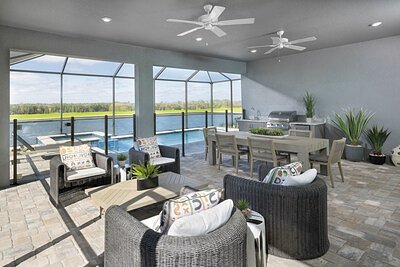
Ultimately, what Mattamy and its competitors are selling is not just a structure of wood and drywall, but a carefully packaged version of the Florida dream. The Verona community is planned to feature a clubhouse, a fitness center, a resort-style pool, pickleball courts, and a network of trails. This is the master-planned community model perfected: a self-contained world of curated leisure, offering a sense of security and belonging that can be elusive in a rapidly changing region.
The 13 different floorplans Mattamy will offer, ranging from two to six bedrooms, cater to a wide demographic, from young families to multi-generational households. This is a product engineered for mass appeal, designed to deliver a consistent and desirable experience. The success of this model has turned homebuilding into a battle of logistics, marketing, and capital management on an industrial scale, where the most successful players are those who best understand how to acquire the right resources and deliver the dream their customers are lining up to buy.